PTAC Units Explained: Sleeves, Heat, Sizing and Service
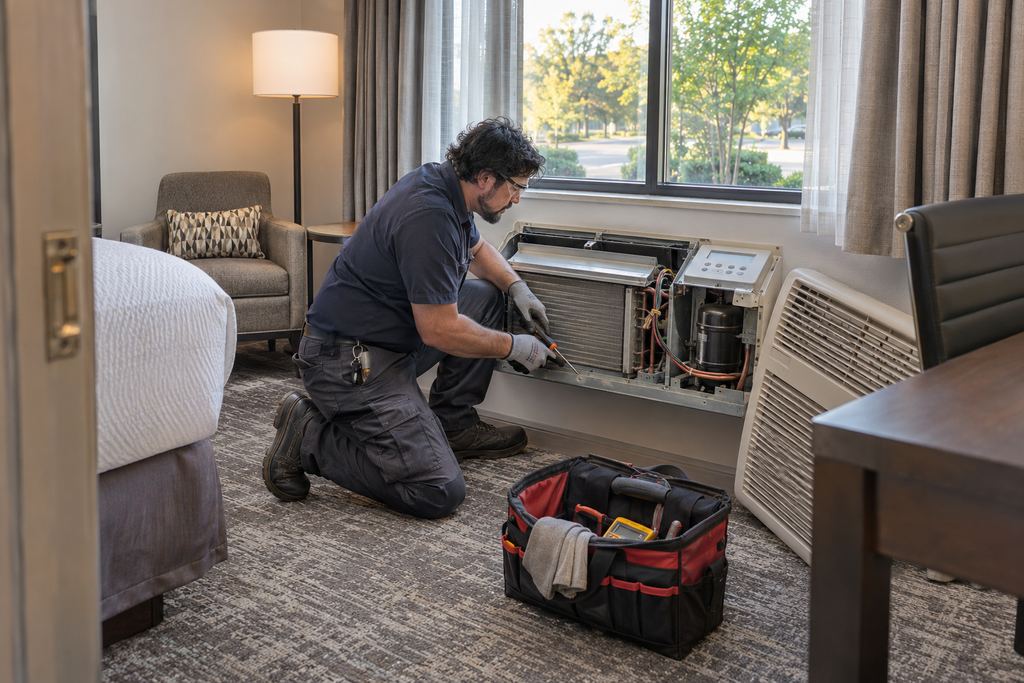
A PTAC unit (packaged terminal air conditioner) is a self-contained heating and cooling box that sits in a metal sleeve through an exterior wall. You see them under the windows of hotel rooms, apartments, dorms and senior housing, where every room gets its own controls and its own unit.
A PTAC holds the compressor, both coils, the fans and the controls in one chassis that slides into a wall sleeve. Indoor air passes over one coil and outdoor air passes over the other through a louvered grille. Most models also heat, either with electric strips or with a heat pump version called a PTHP. Sizes commonly run from about 7,000 to 15,000 Btu/h.
What is inside the chassis
Pull the front cover off a PTAC and you find two halves separated by a partition. The room side has the evaporator coil, a blower wheel, the filter and the control panel or thermostat connection. The outdoor side has the condenser coil, a fan and the compressor. The refrigerant circuit is sealed at the factory, so the unit ships charged and ready to plug in.
The chassis rests in a wall sleeve, a metal box built into the wall during construction. An exterior grille covers the outdoor end. Because the sleeve stays put, a failed unit can usually be swapped by sliding the old chassis out and a new one in, provided the new one matches the sleeve and the grille. Most current PTACs are built for a sleeve about 42 inches wide and 16 inches tall, but older buildings sometimes have odd sizes that only a few product lines fit.
Power comes through a cord with a plug whose blade pattern matches the amperage of the circuit, such as NEMA 6-15, 6-20 or 6-30. Many cords also carry a test and reset button on the plug head, which cuts power if it senses a fault in the cord. Some commercial buildings run PTACs on 265 V instead and hard-wire them through a subbase or junction box.
PTAC configurations you will run into
Model names differ by brand, but almost every PTAC falls into one of these groups.
Matching PTAC capacity to the room
ENERGY STAR publishes a room air conditioner sizing chart for an 8-foot ceiling. It is a fair starting point for a PTAC room too, before adjustments.
| Room area (sq ft) | Cooling capacity (Btu/h) |
|---|---|
| 150 to 250 | 6,000 |
| 250 to 300 | 7,000 |
| 300 to 350 | 8,000 |
| 350 to 400 | 9,000 |
| 400 to 450 | 10,000 |
| 450 to 550 | 12,000 |
| 550 to 700 | 14,000 |
Sizing a replacement is more than square footage
Most PTAC buyers are replacing a unit, not designing a room, so the old data plate is the first clue. Write down the cooling Btu/h, the heater size in kilowatts, the voltage and the plug type. A heater larger than the circuit was built for will not plug in, and that is by design.
An oversized chassis cools the room in short bursts and leaves it clammy, because it shuts off before it has pulled much moisture from the air. Undersized units run nonstop on the hottest afternoons. Corner rooms with two glass walls, rooms facing west and top-floor rooms under a hot roof usually need the next size up compared with an interior room of the same area. For a building with dozens of rooms, a contractor can work from the original mechanical drawings or run a load calculation room by room.
Why a PTAC stops cooling or heating
These are the causes technicians look at first. Some are owner fixes; most are not.
PTAC filters are small and fill quickly, especially in rentals and hotel rooms. A blocked filter can let the indoor coil freeze into a block of ice.
The outdoor grille collects lint, leaves and city grime. A matted coil cannot shed heat, so the compressor runs hot and cooling drops off.
A tripped plug head or breaker stops the unit cold. Repeated trips point to a fault that needs an electrician or HVAC technician.
Fan-only mode, a remote thermostat set incorrectly or a front desk energy setting can all look like a broken unit.
Squealing, rattling or weak airflow often traces to a worn motor or a wheel packed with dust.
If the fan runs but the air never gets cold, the sealed system or electrical parts may be failing. That is technician work.
What an owner or manager can check, and where to stop
Safe checks you can do
No tools beyond a flashlight. Turn the system off at the thermostat before opening any filter or access door.
- Confirm the mode is set to cool or heat and the setpoint is below or above room temperature.
- Wash or replace the filter as the manual describes.
- Press the reset button on the cord head once if it has tripped. If it trips again, leave it off.
- Check the breaker once and reset it if it is tripped.
- Make sure furniture and curtains are not blocking the front grille.
- If the indoor coil is iced, switch to fan only and let it thaw before running cooling again.
Leave these to a licensed technician
These involve high voltage, refrigerant or sealed components. Refrigerant work requires EPA Section 608 certification.
- Opening the chassis to reach wiring, capacitors or the control board.
- Diagnosing a compressor that will not start or runs without cooling.
- Any refrigerant leak search or recharge, which requires EPA Section 608 certification.
- Deep cleaning of both coils with the chassis pulled from the sleeve.
- Fixing a burnt plug, a scorched outlet or a cord that trips repeatedly.
- Fitting a new chassis to an old or nonstandard sleeve.
Routine PTAC care that keeps units running
Building staff can handle the filter side. A technician should do the coil work once or twice a year, depending on how dusty the location is.
- Filters: Clean or swap monthly in busy rooms. Some properties check them at every guest turnover.
- Coil cleaning: Pull the chassis and clean both coils, usually before cooling season. Coastal and urban sites may need it more often.
- Drain path: PTACs move condensate toward the outdoor coil, where a slinger ring on the fan throws it on the hot coil. Debris in the base pan can cause water to spill indoors.
- Wall seal: Check the gasket between chassis and sleeve. Gaps let in outside air, noise and insects.
- Exterior grille: Keep it clear of nests, leaves and snow. A bent grille restricts airflow on the condenser side.
- Data plate log: In a building with many units, record model, serial, heater size and install date for each room. It makes ordering a matching chassis much faster.
Efficiency, lifespan and the repair or replace question
PTACs are rated with EER (cooling) and, for heat pump models, COP (heating). Higher numbers mean less electricity for the same output. You can compare certified ratings for specific models in the AHRI directory. Heat pump PTHPs usually cost less to run in heating mode than strip heat models, at least until the weather turns cold enough that the backup strips take over.
Some owners use the informal $5,000 rule: multiply the unit's age by the repair quote, and if the result tops 5,000, lean toward replacing. It is a rule of thumb from the trade, not a standard. With PTACs the math often favors swapping the chassis, because a new unit that fits the existing sleeve may cost less than a compressor repair on an old one. It is an informal screen, not a DOE or industry standard; ask whether a warranty applies, get the diagnosis on paper and compare a net repair quote against a full replacement quote. Ask the contractor to quote both PTAC repair and PTAC replacement in writing so you can compare.
If the room needs something other than a sleeve unit, compare a ductless mini-split, which is quieter but needs a line set and outdoor unit, or a window air conditioner for a temporary fix.
Frequently asked questions
Can a PTAC heat a room as well as cool it?
Most can. Standard models heat with electric resistance strips. Heat pump models (PTHP) move heat indoors with the refrigeration cycle and use the strips only as backup in cold weather. Cooling-only models exist for buildings with separate heating.
What is the $5,000 rule, and does it apply to a PTAC?
It is a shortcut: age in years times the repair cost. Above 5,000, replacement often makes more sense. It works as a rough guide for PTACs too, but also weigh whether a new chassis fits your sleeve without modification.
Which PTAC brand lasts longest?
There is no independent ranking we can point to. Service life depends far more on filter cleaning, coil cleaning, salt air exposure and run hours than on the badge. Check parts availability and warranty terms for the brands that fit your sleeve.
What is the main drawback of a heat pump PTAC?
Heat pump output and efficiency fall as the outdoor temperature drops. In cold snaps a PTHP leans on its electric backup strips, which cost more to run. In mild climates that rarely matters.
Can I put a regular PTAC in any wall?
It needs a wall sleeve, an exterior grille, a dedicated circuit sized for the heater and a way for condensate to leave. Cutting a new opening in an exterior wall is a job for a contractor and may need a permit.
Do PTAC units need refrigerant added?
Not as routine maintenance. The circuit is sealed. A unit low on refrigerant has a leak, and only a technician with EPA Section 608 certification may work on it.
Related guides and services
Get a PTAC looked at
Tell us how many units are affected, the room type and the symptom. HVAC Service Near Me passes the request to an independent local contractor where one serves your ZIP code.
Say how many units, the room type and what the unit is doing. Availability varies by ZIP code.
Please keep this page open.
- We pair the request with an independent contractor or partner network that works in your ZIP code.
- The contractor gets in touch to go over the details and agree on a visit.
- After checking the system they quote the job, and you choose whether to proceed.
Read how requests are handled.
Online requests are not connected to a contractor network yet. Nothing you typed was sent or saved. Please phone us instead, or try again later.
Call (888) 555-0199