Whole House Dehumidifier Installation for Damp, Sticky Homes
Whole house dehumidifier installation adds a dedicated moisture-removal unit to your central air system, so drier air reaches every room the ducts serve. Tell us about the house and the problem, and the request goes to independent local HVAC contractors.
- Ducted units connect to the air handler or run on their own ducts
- The job usually includes a drain, power and a humidity control
- Sizing should start from the house, not a guess
Share your home size, where the humidity problem is and what HVAC system you have.
Please keep this page open.
- We pair the request with an independent contractor or partner network that works in your ZIP code.
- The contractor gets in touch to go over the details and agree on a visit.
- After checking the system they quote the job, and you choose whether to proceed.
Read how requests are handled.
Online requests are not connected to a contractor network yet. Nothing you typed was sent or saved. Please phone us instead, or try again later.
Call (888) 555-0199Signs a ducted unit may help
Any one of these can have other causes. Several together point to a moisture load the AC alone is not handling.
- Clammy air with the AC running: The house reaches the set temperature but still feels sticky.
- Musty basement or crawl space: Odor that comes back after cleaning. See AC musty smell for other causes.
- Condensation on windows or ducts: Sweating glass, pipes or supply ducts in summer.
- Readings above 60 percent: A cheap hygrometer shows high indoor humidity for days at a time.
Can a dehumidifier hook into my HVAC?
Yes. That is what separates a whole-home unit from a portable one. The installer mounts the dehumidifier near the air handler, in the basement, attic or crawl space, and connects it with ductwork. The common layouts are:
- Return to supply: the unit pulls air from the return side and delivers dry air into the supply plenum. The furnace or air handler blower can help move it.
- Dedicated ducts: the unit has its own intake and outlet, so it can run without the main blower.
- Standalone in a crawl space or basement: the unit treats one closed area, sometimes with a short duct run.
Which layout fits depends on the duct design, where the moisture comes from and how much room there is near the equipment. If supply ducts leak or some rooms barely get airflow, an air duct repair visit can come first.
What happens on install day
- Site check
The technician looks at the air handler, the ducts, the drain options and the power supply.
- Mounting
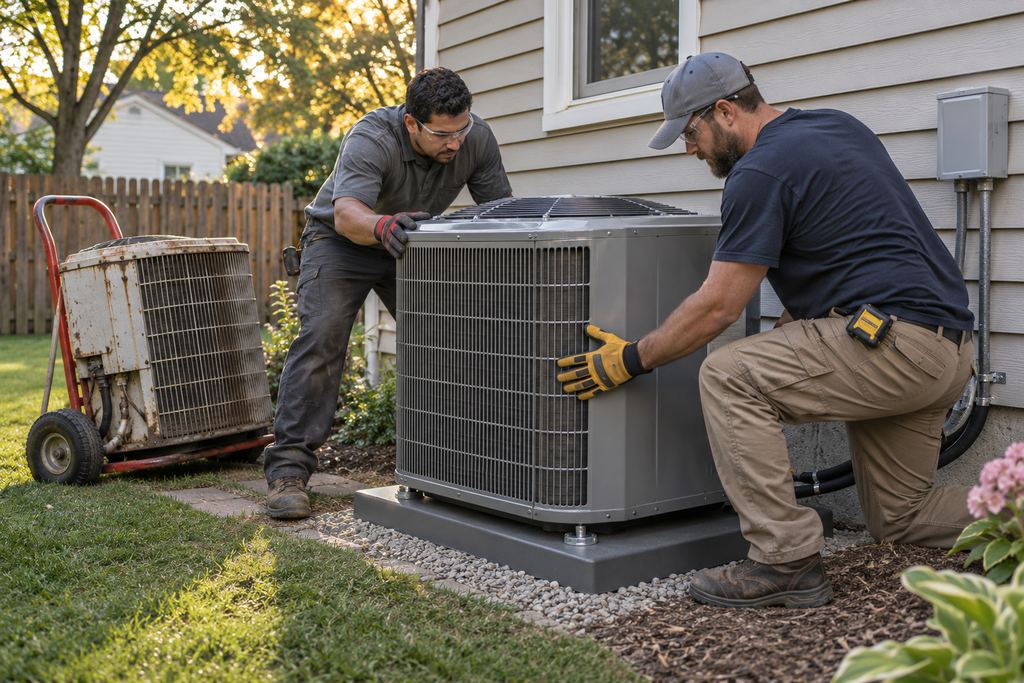
The unit is hung or set on a platform with service clearance around it.
- Duct tie-in
Collars and duct runs are cut in and sealed to the return, the supply or both.
- Drain and power
A condensate line goes to a floor drain or a pump. Power comes from an outlet or a new circuit if the unit needs one.
- Control and startup
A dehumidistat or a compatible thermostat is wired and set, then the system is run and checked.
Equipment you may see in a quote
Several manufacturers make whole-home dehumidifiers, including Aprilaire, Honeywell Home and Santa Fe. HVAC Service Near Me is independent and not affiliated with any brand. Contractors often prefer the lines their suppliers stock.
What an owner can do and what needs a technician
Safe checks you can do
No tools beyond a flashlight. Turn the system off at the thermostat before opening any filter or access door.
- Track humidity with a hygrometer for a week before you call
- Replace the unit filter on the schedule in the owner's manual
- Keep the area around the unit clear and dry
- Check that the drain hose is not kinked or pulled loose
Leave these to a licensed technician
These involve high voltage, refrigerant or sealed components. Refrigerant work requires EPA Section 608 certification.
- Choosing capacity and the duct layout
- Cutting into ducts and the air handler cabinet
- Adding a circuit or any wiring to the HVAC controls
- Diagnosing a unit that runs but removes no water
Keeping it working year after year
Maintenance is light but easy to forget because the unit sits out of sight. Change the filter as the manual says, keep the drain flowing, and ask for the dehumidifier to be checked during the regular AC maintenance visit. A coil that stays dirty or a drain that backs up will cut moisture removal long before the unit actually fails.
For the control, many owners set somewhere around 45 to 50 percent in summer. That is common practice, not a standard. EPA guidance is to keep indoor humidity below 60 percent and ideally between 30 and 50 percent.
Whole house dehumidifier installation cost
Carrier's whole-house dehumidifier cost guide (October 2026) says the total typically ranges from $1,000 to $2,800, unit and professional installation included, and that it can run higher. That is a national planning figure from a manufacturer, not an HVAC Service Near Me price; we do not set prices.
A complete quote should cover the dehumidifier, the duct connections, a condensate drain, a power circuit if the unit needs one and the control. Labor and the tie-in method swing the total more than the equipment does, so two homes with the same unit can get very different quotes. A new dedicated duct run, a new circuit or a condensate pump moves a job toward the top of the range.
Line items that move the price
Read your quote against this list. A missing line usually means either it is not needed in your home or it will show up later as an extra.
Units are rated by how many pints of water they pull out in a day. A larger, leakier or damper house needs more capacity, and bigger units cost more to buy.
A return-to-supply tie-in is the simplest ducted layout. Dedicated supply and return ducts take more labor and material, and a standalone crawl space unit needs the least duct work.
The water has to go somewhere. A nearby floor drain is simple; a long run or a condensate pump adds parts and time.
Some installs plug into an existing outlet, others need a new circuit. Circuit work may require an electrician and a permit, depending on local rules.
A wall-mounted dehumidistat or a thermostat that manages humidity can be part of the job. Pairing it with a thermostat replacement sometimes saves a second visit.
Tight attics, low crawl spaces and finished basements slow the crew down. Hard access is a common reason two quotes differ.
Estimating what it costs to run
The equipment price is only half the picture. To estimate the electric cost, multiply the unit's wattage by the hours it runs, divide by 1,000 to get kilowatt hours, then multiply by the rate on your utility bill.
For example, a unit drawing 700 watts for 2 hours uses 1.4 kWh. At a rate of 15 cents per kWh, those 2 hours cost about 21 cents. The real monthly figure depends on how humid your climate is, how tight the house is and the humidity target you set. ENERGY STAR certifies dehumidifiers that meet its efficiency criteria, so a certified model is worth asking about when you compare options.
Questions that make quotes comparable
- Which capacity did you size it to?
Ask how they chose it: square footage, a moisture reading, or both. - How will it connect to my ducts?
Return-side tie-in, dedicated ducts or standalone. Each changes cost and performance. - Where does the water drain?
Ask whether a pump is included and who services it. - Is a new circuit or a permit part of the price?
Get it in writing so it is not a surprise later. - What maintenance does the unit need?
Filter changes and drain checks are typical. Ask how often and what a service visit costs.
How a service request works
HVAC Service Near Me is a referral service. We don't send our own technicians. We connect you with independent local contractors.
- Describe the job
Type your ZIP code, pick a service and add a line or two about the problem or project.
- We pass it on
An independent HVAC contractor or partner network that works in your area and does that kind of job receives it.
- You hear back
The contractor gets in touch to check the details and set a time to come out.
- The choice is yours
After a diagnosis the contractor gives you a quote. Price, timing and warranty are agreed directly between the two of you.
Frequently asked questions
How is a dehumidifier added to an existing HVAC system?
The unit is mounted near the air handler and connected with ducts, usually from the return side into the supply, or on its own dedicated ducts. It also needs a drain, power and a control. This is contractor work because it involves cutting into ductwork and wiring.
What does it cost to add a whole-home dehumidifier?
Carrier's October 2026 guide puts a whole-house unit at $1,000 to $2,800 including professional installation, sometimes more. Capacity, the duct layout, drain and electrical needs and access decide where your home lands, so ask for an itemized written quote.
What humidity setting should I use?
EPA suggests staying below 60 percent and ideally between 30 and 50 percent. Many households pick about 45 to 50 percent in summer, then adjust for comfort and any window condensation.
How much does it cost to run a dehumidifier for 2 hours?
Multiply the watts by 2, divide by 1,000 and multiply by your kWh rate. A 700 watt unit at 15 cents per kWh costs roughly 21 cents for 2 hours. Check your unit's rated wattage and your bill for the real numbers.
Can I install a whole house dehumidifier myself?
Some owners do the plumbing side, but duct cutting, electrical work and control wiring belong with a qualified contractor. Local rules may also require a permit.
Does my AC already dehumidify?
It removes some moisture while it runs. In humid climates, or in a house with an oversized AC that runs in short bursts, that is often not enough, which is when a separate unit helps.
Related guides and services
Request a dehumidifier installer
Share the home size, where the dampness shows up and what HVAC system you have. Independent local contractors can follow up. Availability varies by ZIP code and season.
Share your home size, where the humidity problem is and what HVAC system you have.
Please keep this page open.
- We pair the request with an independent contractor or partner network that works in your ZIP code.
- The contractor gets in touch to go over the details and agree on a visit.
- After checking the system they quote the job, and you choose whether to proceed.
Read how requests are handled.
Online requests are not connected to a contractor network yet. Nothing you typed was sent or saved. Please phone us instead, or try again later.
Call (888) 555-0199