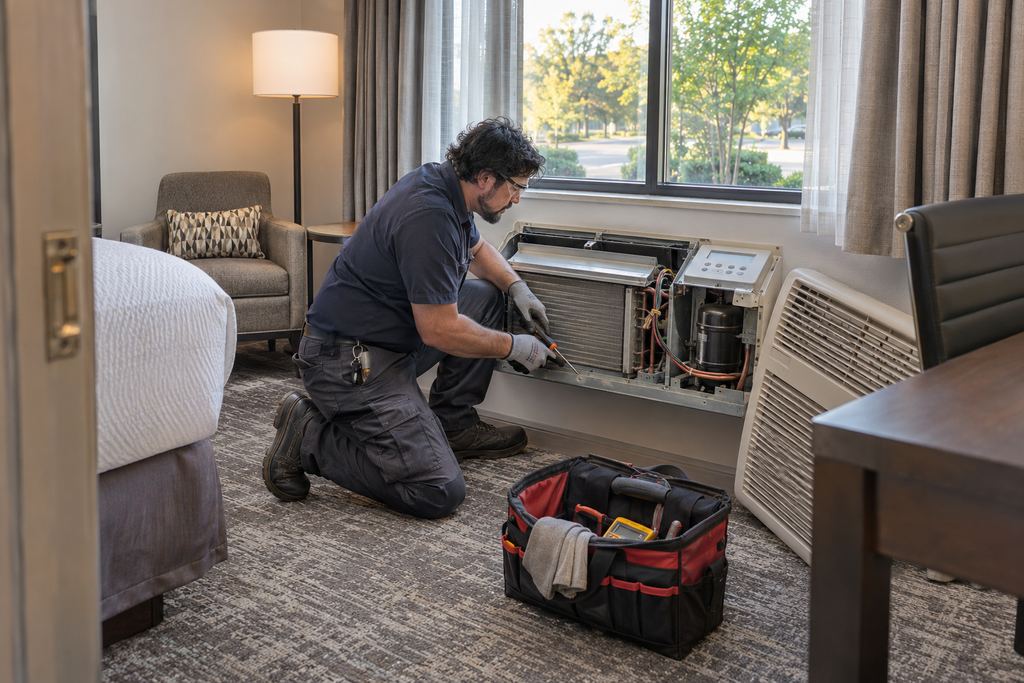
PTAC Repair for Residential and Commercial Buildings
A PTAC that blows warm air, leaks into the room or trips its plug can often be fixed in the room or on a bench, because the chassis slides out of the wall sleeve. HVAC Service Near Me forwards PTAC repair requests to independent contractors who work on packaged terminal units in homes, apartment buildings, hotels and offices.
- Chassis can be pulled for bench repair or swapped with a spare
- Typical faults: controls, fan motors, drains, heaters and refrigerant
- Multi-unit buildings can request several rooms in one visit
Give the brand, the number of units affected and the symptom. A contractor who services packaged terminal units can contact you.
Please keep this page open.
- We pair the request with an independent contractor or partner network that works in your ZIP code.
- The contractor gets in touch to go over the details and agree on a visit.
- After checking the system they quote the job, and you choose whether to proceed.
Read how requests are handled.
Online requests are not connected to a contractor network yet. Nothing you typed was sent or saved. Please phone us instead, or try again later.
Call (888) 555-0199Repairs a PTAC technician commonly handles
PTAC, PTHP and similar wall units
A standard PTAC cools with a compressor and heats with electric resistance strips. A PTHP is the heat pump version: it reverses the refrigerant flow to heat and falls back on the strips in cold weather. Repair approaches differ, since a PTHP adds a reversing valve and defrost controls that a cooling-only unit lacks. Vertical units such as VTACs sit in a closet rather than in the wall and share many parts but are serviced in place. More on the differences is in the PTAC guide.
Units run on 208/230V or 265V power. Tell the contractor which one you have, because parts are voltage specific.
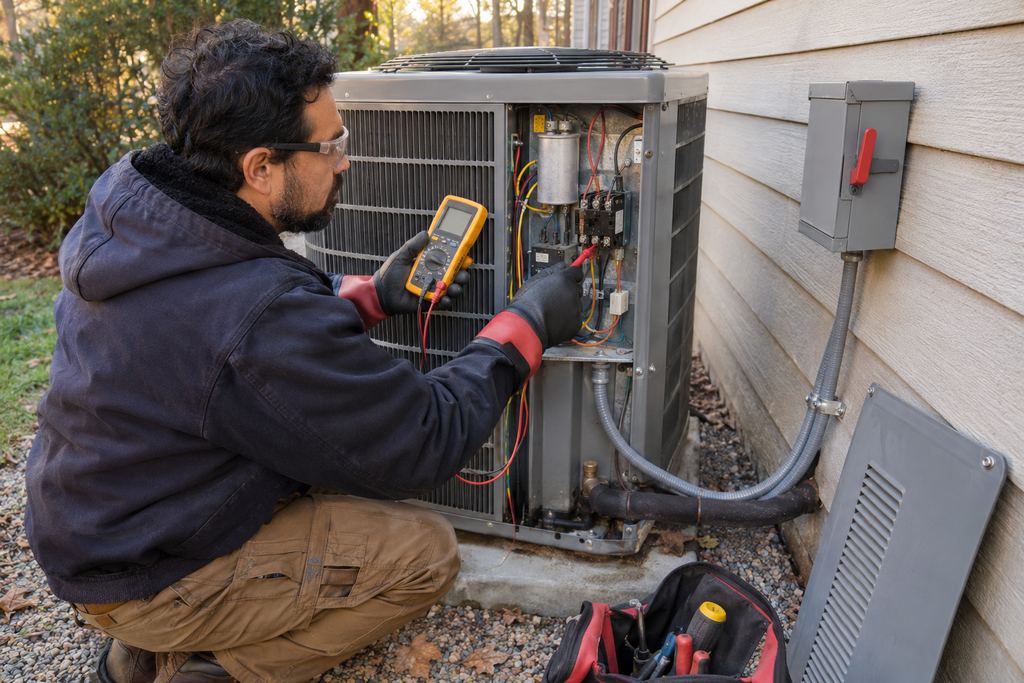
Symptoms and where they usually point
| Symptom | Likely area |
|---|---|
| Fan runs, no cold air | Dirty coils, compressor not starting, low refrigerant, failed capacitor |
| No heat in winter | Heater strip, limit switch, control board or, on PTHPs, the reversing valve |
| Water on the floor or wall | Sleeve not pitched outward, blocked drain path, missing gasket |
| Unit cycles on and off quickly | Thermostat placement, dirty filter, oversized unit or control fault |
| Loud rattle or vibration | Loose fan blade, worn motor bearing, chassis not seated in the sleeve |
| Power plug trips | Cord, heater or internal wiring fault |
What staff or residents can check
Safe checks you can do
No tools beyond a flashlight. Turn the system off at the thermostat before opening any filter or access door.
- Clean or replace the front filter as the manual describes
- Make sure the mode is set to Cool or Heat and the setpoint is sensible
- Press the test and reset buttons on the cord's safety plug if it has them
- Check the room breaker once and leave it off if it trips again
- Note any error code on the display and the unit's model and serial numbers
Leave these to a licensed technician
These involve high voltage, refrigerant or sealed components. Refrigerant work requires EPA Section 608 certification.
- Pulling the chassis from the sleeve
- Testing motors, capacitors, heaters and boards
- Refrigerant leak repair and recharge
- Fixing sleeve pitch, gaskets and drain kits
- Rewiring receptacles or hard-wired connections
A scorched smell, smoke, melted plug or a safety plug that trips again right after reset means the unit should be unplugged or switched off at the breaker and left off until a technician sees it. Never bypass the plug or use an adapter. If there is fire, evacuate and call 911. In a heat wave, residents who show signs of heat illness need help quickly; see the NWS heat safety page and call 911 for heat stroke.
Fix the unit or swap the chassis
Because PTAC chassis slide out of a standard sleeve, buildings often keep a spare. A technician can pull a failed unit, drop in the spare so the room is usable the same visit, and repair the old one on the bench. That is common in hotels and large apartment buildings where vacant time costs money.
Repair tends to make sense for boards, motors, heaters and drain problems on units that are still mid-life. Compressor failures and refrigerant leaks on older units usually tip the decision toward a new chassis, especially if the existing sleeve fits current models. The PTAC replacement page explains sleeve compatibility and what to compare, and PTAC installation covers new openings.
Keeping PTAC repairs down
- Filters: Front filters clog quickly in occupied rooms. Building staff can clean them on a set schedule.
- Annual coil wash: Dirty outdoor coils are a frequent reason units lose capacity. Chassis can be pulled and washed outside the room.
- Sleeve check: Look for rust, failed gaskets and lost pitch while the chassis is out.
- Records: Track model, serial and repair history per room so repeat failures are easy to spot.
Booking service for one unit or a building
Homeowners with a single PTAC in an addition or garage apartment can request a visit the same way a property manager can. For buildings with many units, mention the count and whether you have spare chassis on site. Commercial properties with other equipment problems can also use commercial AC repair. Availability for PTAC work varies by area, and HVAC Service Near Me cannot promise a match in every ZIP code. Browse the full PTAC section for more.
How a service request works
HVAC Service Near Me is a referral service. We don't send our own technicians. We connect you with independent local contractors.
- Describe the job
Type your ZIP code, pick a service and add a line or two about the problem or project.
- We pass it on
An independent HVAC contractor or partner network that works in your area and does that kind of job receives it.
- You hear back
The contractor gets in touch to check the details and set a time to come out.
- The choice is yours
After a diagnosis the contractor gives you a quote. Price, timing and warranty are agreed directly between the two of you.
Frequently asked questions
Why is my PTAC leaking water into the room?
The usual reason is a sleeve that has lost its slight outward pitch, so condensate runs inward. A blocked drain path or a missing gasket can do the same. A technician can re-level the sleeve and check the drain kit.
How do I reset a PTAC unit?
Many units reset by switching them off at the panel or unplugging them for a few minutes, or by pressing reset on the cord's safety plug. Check your manual. A second trip in a row means the unit needs a technician.
Is it worth repairing an old PTAC?
For boards, motors, heaters and drains, often yes. For a failed compressor or refrigerant leak on an older unit, a new chassis is usually the better value, especially when it fits the existing sleeve.
Can one technician service many units in a building?
Yes. Contractors who work in hotels and apartment buildings often service many PTACs in one visit and may recommend keeping spare chassis on hand.
Are PTACs the same as central HVAC?
No. A PTAC is a self-contained unit that serves one room through the wall. Central systems use one large system and ducts to serve many rooms.
Related guides and services
Get a PTAC looked at
Tell us the brand, how many units are affected and what they are doing. A contractor who repairs packaged terminal units can reach out.
Give the brand, the number of units affected and the symptom. A contractor who services packaged terminal units can contact you.
Please keep this page open.
- We pair the request with an independent contractor or partner network that works in your ZIP code.
- The contractor gets in touch to go over the details and agree on a visit.
- After checking the system they quote the job, and you choose whether to proceed.
Read how requests are handled.
Online requests are not connected to a contractor network yet. Nothing you typed was sent or saved. Please phone us instead, or try again later.
Call (888) 555-0199