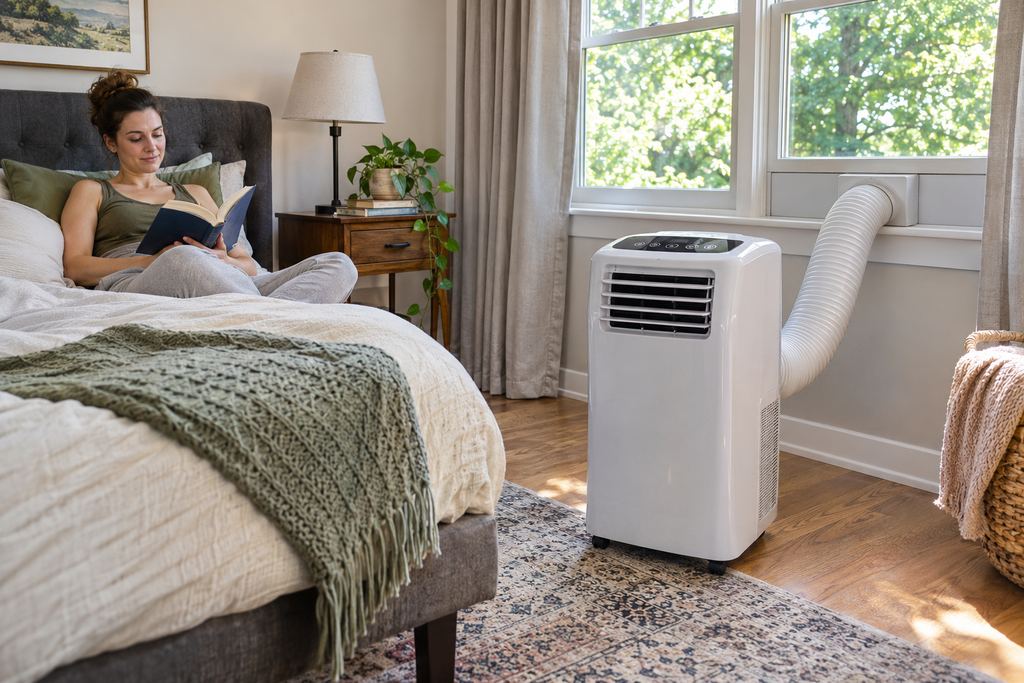
Portable AC Blowing but Not Cooling the Room
When a portable air conditioner is not cooling, the problem is usually the setup rather than the machine. Portable units push heat outside through a hose, so leaks around the window kit, a long hose or a room that is simply too big all show up as weak cooling.
Check the mode and setpoint, empty the water tank, clean the filter and make sure the exhaust hose is short, straight and sealed at the window. Then compare the unit's rated capacity with the room. If the compressor never starts or the air is not cool after these checks, the unit may need repair.
Quick checks
- Mode and temperature: COOL mode, not FAN or DRY, with the setpoint below room temperature.
- Water tank: Many units stop the compressor when the tank is full. Drain it and look for a full or bucket light.
- Filter: Rinse or vacuum the filter as the manual describes. A clogged filter cuts airflow over the coil.
- Exhaust hose: Keep it as short and straight as possible. Kinks and long runs trap heat.
- Window seal: Gaps around the window kit let hot air back in. Seal them with the included foam or panels.
- Restart wait: After power off, many models delay the compressor a few minutes before it runs.
Single hose versus dual hose
A single-hose portable takes room air to cool its condenser and blows it outdoors. That lowers indoor air pressure, so warm air leaks in from around doors and windows to replace it. In a hot room with a lot of air leaks, a single-hose unit can struggle. Dual-hose models pull outdoor air for the condenser through a second hose and generally avoid that problem. If yours is single hose, close doors to the rest of the house and seal the window kit carefully.
Is the unit big enough
Portable air conditioners are now rated with a seasonally adjusted cooling capacity, or SACC, under the DOE test procedure. That number is often lower than the older BTU figure on the box, so a unit that looked big enough may have less real capacity than expected. Rooms with large windows, high ceilings, kitchens and top-floor bedrooms need more capacity. The portable air conditioner guide explains sizing, and the window air conditioner guide covers a common alternative.
What you can check and what needs service
Safe checks you can do
No tools beyond a flashlight. Turn the system off at the thermostat before opening any filter or access door.
- Settings, filter, tank and hose routing.
- Sealing the window kit.
- Keeping the unit a few inches away from walls and curtains so air can move.
- Plugging it straight into a wall outlet.
Leave these to a licensed technician
These involve high voltage, refrigerant or sealed components. Refrigerant work requires EPA Section 608 certification.
- Testing a compressor that never starts.
- Checking the fan motor or control board.
- Diagnosing refrigerant loss, which requires EPA Section 608 certification.
Repair or replace
Many portable units are sealed appliances where refrigerant or compressor repairs cost close to a replacement. Fan and control repairs can be worth it on a newer unit. Ask a contractor whether they service portable units and for a written estimate. The portable AC repair page covers what can usually be fixed. If water is also on the floor, see portable AC leaking water.
Frequently asked questions
Why is my portable AC blowing air but not cold?
Common reasons are FAN mode, a full tank stopping the compressor, a clogged filter, a hot or leaky exhaust setup, or a unit too small for the room. If the compressor never starts after those checks, it may need repair.
What happens if you never drain a portable AC?
Many units simply stop cooling when the tank fills. If the float sticks, water can overflow onto the floor.
How long does a portable AC last?
Lifespan depends on use, maintenance and build quality. Clean filters and a well-sealed setup help it run with less strain.
Does the 3 minute rule apply to portable units?
Many portable models wait a few minutes before restarting the compressor after they switch off. Give it time before deciding it is not cooling.
Related guides and services
Request portable AC help
Share the brand, age and the symptoms. An independent local contractor can follow up if they work on portable units.
Tell us the brand, age and what the unit does. Ask whether the contractor services portable units.
Please keep this page open.
- We pair the request with an independent contractor or partner network that works in your ZIP code.
- The contractor gets in touch to go over the details and agree on a visit.
- After checking the system they quote the job, and you choose whether to proceed.
Read how requests are handled.
Online requests are not connected to a contractor network yet. Nothing you typed was sent or saved. Please phone us instead, or try again later.
Call (888) 555-0199