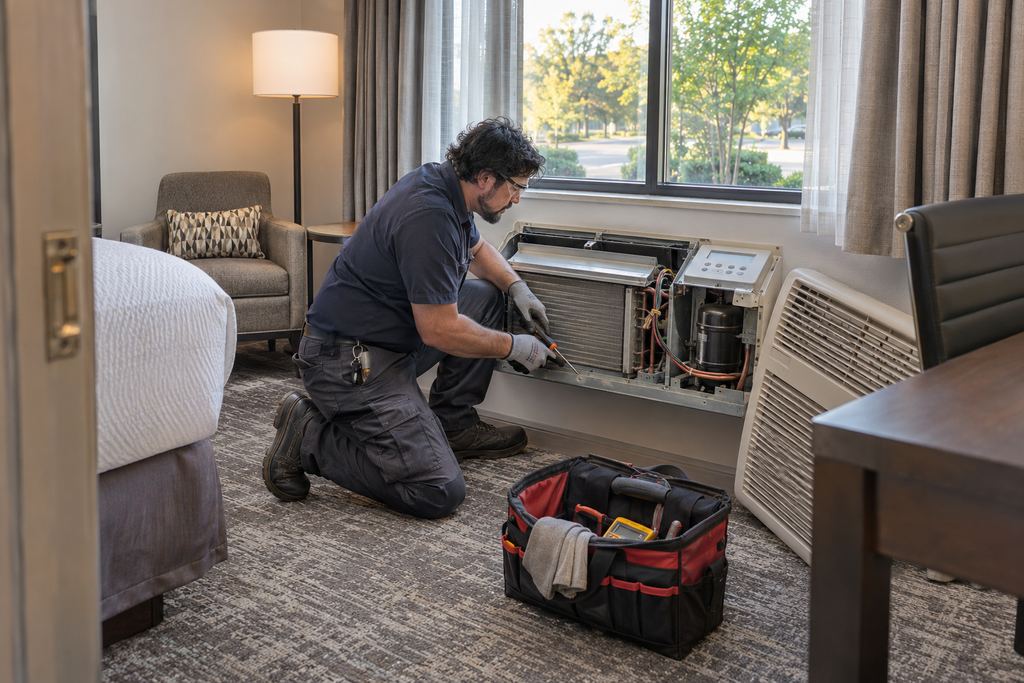
VTAC Units: Vertical Terminal Air Conditioners Explained
A VTAC unit (vertical terminal air conditioner, sometimes called a vertical packaged unit) is a self-contained cooling and heating cabinet that stands upright in a small closet against an exterior wall. It draws outdoor air through a louver in that wall and sends conditioned air to one or several rooms through short ducts.
VTACs do the same job as PTACs but hide in a closet instead of sitting under a window. That frees wall space, lowers the noise in the room and lets one unit serve a living room and a bedroom. They are common in newer hotels, apartments, condos and assisted living. Most are hard-wired on 208/230 V circuits.
VTAC and PTAC compared
| VTAC | PTAC | |
|---|---|---|
| Location | Closet, standing upright | Under a window, in the room |
| Outdoor connection | Wall louver beside the closet | Grille at the back of the sleeve |
| Rooms served | One or more, through short ducts | Usually one |
| Noise in the room | Lower; cabinet is behind a door | Higher; unit is in the room |
| Power | Usually hard-wired, 208/230 V | Usually plug-in cord |
| Heat | Electric strips, heat pump, or hot water coil | Electric strips or heat pump |
Sizing a VTAC
A VTAC replacement normally reuses the closet, louver and ducts, so sizing starts with what is already there.
Record cooling Btu/h, heater kilowatts, voltage and the minimum circuit amps. Matching these avoids electrical changes.
A unit serving a bedroom plus a living area needs more capacity than one serving a studio.
Top floors, west-facing glass and corner units usually need more cooling than interior units.
Cabinet height, width and the louver opening must match. Some product lines are designed for drop-in replacement of older models.
For new construction or a change in use, a contractor or engineer should calculate the load room by room.
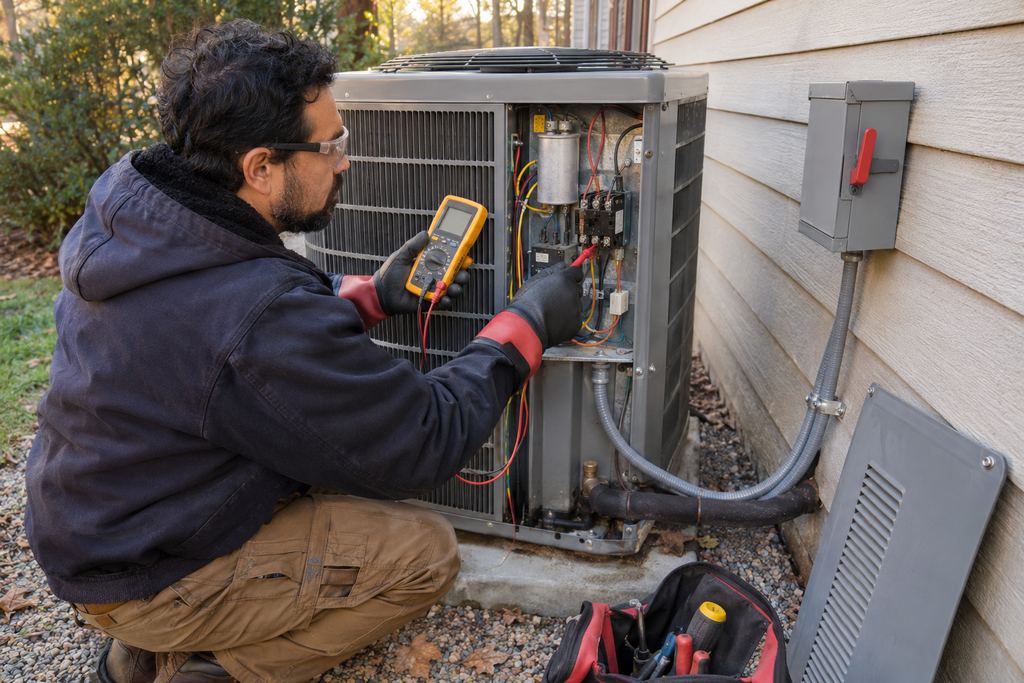
Routine VTAC care
- Filter: Clean or replace on a set schedule, often monthly in hotels.
- Closet clearance: Keep the closet free of storage so return air can reach the unit.
- Louver: Check the outside louver for debris, nests and damage.
- Drain: Watch for water at the closet floor, a sign of a blocked drain or pan.
- Coils: Have a technician clean both coils at least yearly.
What staff can do and what needs a technician
Safe checks you can do
No tools beyond a flashlight. Turn the system off at the thermostat before opening any filter or access door.
- Check the thermostat mode and setpoint.
- Replace or clean the filter per the manual.
- Check the breaker once; if it trips again, leave it off.
- Clear the closet and the outside louver.
Leave these to a licensed technician
These involve high voltage, refrigerant or sealed components. Refrigerant work requires EPA Section 608 certification.
- Opening the electrical compartment or control box.
- Diagnosing compressor, fan motor or heater faults.
- Any refrigerant work, which requires EPA Section 608 certification.
- Pulling and replacing the chassis, including electrical disconnect and duct connections.
Efficiency and replacement
VTACs are rated for efficiency like other packaged equipment, and certified ratings for many models appear in the AHRI directory. Heat pump VTACs generally cost less to heat with than strip-heat models in mild weather. If a unit is old and needs a compressor, replacing the chassis is often the practical call, especially when a drop-in model fits the existing closet. Ask for written quotes for repair and replacement, since many contractors who handle PTACs also work on VTACs. Compare the in-room alternatives in the PTAC unit guide and the through-the-wall air conditioner guide.
Frequently asked questions
What is the difference between a VTAC and a PTAC?
A PTAC sits in the room in a wall sleeve. A VTAC stands in a closet, connects to an outside louver and can duct air to more than one room.
Do VTAC units heat?
Most do, with electric strips, a heat pump or a hot water coil fed by the building's boiler.
Can I replace a VTAC myself?
It is not a good owner job. Most VTACs are hard-wired on 208/230 V circuits and are heavy. A technician should disconnect power, reconnect ducts and start up the new unit.
Why is water on the closet floor?
Usually a clogged drain or pan, or a dirty coil that froze and thawed. Turn the unit off and have it checked.
Related guides and services
Get a VTAC checked
Send the model plate details and what the unit is doing. HVAC Service Near Me passes the request to an independent local contractor where one serves your area.
Share the unit's model plate details if you can, and what it is doing.
Please keep this page open.
- We pair the request with an independent contractor or partner network that works in your ZIP code.
- The contractor gets in touch to go over the details and agree on a visit.
- After checking the system they quote the job, and you choose whether to proceed.
Read how requests are handled.
Online requests are not connected to a contractor network yet. Nothing you typed was sent or saved. Please phone us instead, or try again later.
Call (888) 555-0199