Air Conditioner Replacement Without the Guesswork
Replacing an air conditioner is usually a decision forced by a failure in July, which is the worst time to shop. If your system is aging, read this while it still runs: the signals that point to replacement, the choices you will be offered, how the swap itself goes, and how to put two bids next to each other. When you are ready, HVAC Service Near Me forwards the request to independent contractors in your area.
- Repair versus replace, with the math installers actually use
- Central AC, heat pump and ductless swaps compared
- A bid checklist so the cheapest quote is not the only yardstick
Tell us the age of the current system and what is wrong with it. A contractor serving your area follows up to look at it.
Please keep this page open.
- We pair the request with an independent contractor or partner network that works in your ZIP code.
- The contractor gets in touch to go over the details and agree on a visit.
- After checking the system they quote the job, and you choose whether to proceed.
Read how requests are handled.
Online requests are not connected to a contractor network yet. Nothing you typed was sent or saved. Please phone us instead, or try again later.
Call (888) 555-0199Clues that the end is near
One clue rarely settles it. Three or four together usually do.
- The unit runs on R-22: Production ended in 2020, so every recharge depends on dwindling reclaimed supply. A leak on an R-22 system is often the tipping point.
- Service calls every summer: Capacitor one year, fan motor the next, then a leak. Spending keeps climbing on hardware that will not get younger.
- Mid-teens or older: Lifespan varies with climate and care. Once the data plate date is fifteen years back, pricing a replacement before the next big repair is sensible.
- Compressor or coil failure: These are the most expensive repairs on a system and the ones most likely to trigger the conversation.
- Rooms that never catch up: Sometimes the cause is ducts or insulation, sometimes an undersized or worn-out system. A load calculation sorts it out.
- Bills rising with no change in use: Lost efficiency from worn parts and leaks shows up as longer run times.
Fix it or replace it: running the numbers
The informal $5,000 rule is a fast first screen. Multiply the system's age in years by the repair estimate. A 12-year-old unit with a $500 repair scores 6,000; a 6-year-old unit with the same bill scores 3,000. Think of it as an informal screen that no DOE or industry standard sets; confirm the warranty status, ask for a written diagnosis and compare the repair price after any coverage with a replacement bid before deciding. Above 5,000, get a replacement quote before approving the repair. The rule is folklore rather than a standard, and it ignores comfort problems and the efficiency jump to new equipment, so treat it as the start of the decision.
Two refinements help. First, ask whether the repair fixes a cause or a symptom: topping up refrigerant on a leaking coil is a symptom fix. Second, ask what else on the system is the same age. A new compressor bolted to a corroded 15-year-old coil is a gamble. If you are unsure, an AC inspection from a second company is a modest expense next to either option.

What you can replace it with
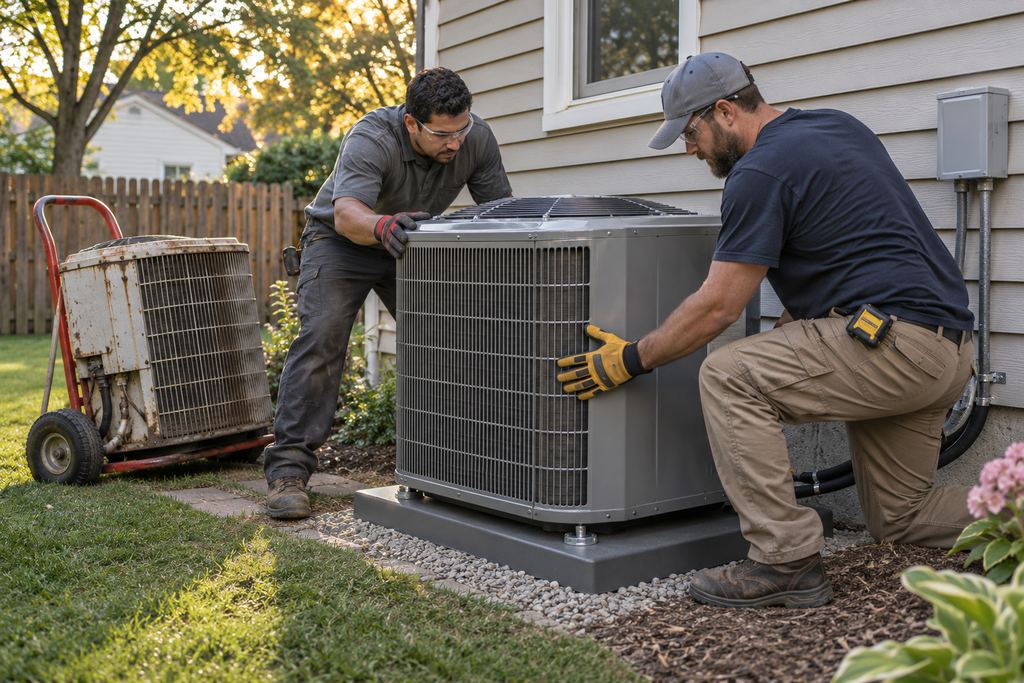
How a replacement day usually goes
- Recovery
The crew recovers refrigerant from the old system with certified recovery equipment. Venting it is illegal.
- Removal
Old condenser out, old coil out if it is being replaced, disconnect and whip checked or swapped.
- Set and connect
New pad or stand if needed, condenser set and leveled, coil installed, line set flushed or replaced, connections brazed.
- Electrical
Breaker size and wire gauge checked against the new unit's requirements.
- Vacuum and charge
The lines are pulled into a deep vacuum to remove moisture, then the refrigerant is released or weighed in.
- Startup readings
Charge, airflow, temperature split and thermostat setup. Ask for the numbers before the crew leaves.
AC replacement cost
Trane's central AC replacement cost guide gives a 2026 national average of $6,958 to $13,418 installed, with projects running from about $3,900 for a basic unit to $13,500 at the high end. Carrier's October 2026 price guide puts central AC at $3,000 to $15,000 or more including installation, without a furnace, evaporator coil or ductwork changes. Both are manufacturer figures for central split systems, not HVAC Service Near Me prices, and the written local bid is the number to plan around.
A replacement is usually priced as a package: outdoor unit, matching indoor coil, line set work, electrical, permit and removal of the old equipment. Tonnage sets the equipment tier, since one ton is 12,000 Btu per hour of cooling, but two 3-ton jobs can be far apart. One reuses a good coil, pad and wiring. The other needs a new coil, new copper for an A2L refrigerant, a larger breaker and duct repairs in a hot attic. Ask each bidder to list which of those pieces the price includes.
What moves the replacement price
HVAC Service Near Me does not set prices or sell equipment. Each contractor quotes after a visit. These factors explain most of the spread between bids.
Tonnage from a load calculation, then the SEER2 rating and compressor type you choose.
Systems built for R-454B or R-32 may need new lines or a thorough flush of the old ones.
Condenser only, condenser and coil, or the full indoor and outdoor system.
Sealing, resizing returns or replacing damaged runs.
New disconnect or breaker changes, permit and inspection fees, and recovery of the old charge before haul-away.
Attic, crawl space or rooftop work adds labor.
Efficiency, refrigerant and incentives in 2026
New central equipment has carried SEER2 ratings since January 1, 2023, and regional minimums are higher in the South and Southwest than in the North. New systems are also moving from R-410A to A2L refrigerants such as R-454B and R-32 under the EPA technology transitions rule, so confirm which refrigerant the bid includes and whether your indoor coil must change to match it. The federal 25C tax credit ended for equipment placed in service after December 31, 2025. State and utility rebates still exist in many areas; search yours with the ENERGY STAR rebate finder. If financing matters, our AC replacement financing page lists what to compare.
How to compare two replacement bids
- Same scope?
One bid may include a new coil and line set while another reuses them. That alone explains large differences. - Load calculation or nameplate?
Ask whether the size came from a Manual J calculation or was copied from the old unit. - AHRI matched?
Ask for the AHRI reference number for the outdoor and indoor pairing. - Warranty terms?
Manufacturer parts warranty usually depends on registration. Labor warranty is the installer's own, and lengths vary widely. - License and insurance?
Verify the license with your state or local board and ask for proof of insurance. - Removal and permit included?
Both should be line items.
How a service request works
HVAC Service Near Me is a referral service. We don't send our own technicians. We connect you with independent local contractors.
- Describe the job
Type your ZIP code, pick a service and add a line or two about the problem or project.
- We pass it on
An independent HVAC contractor or partner network that works in your area and does that kind of job receives it.
- You hear back
The contractor gets in touch to check the details and set a time to come out.
- The choice is yours
After a diagnosis the contractor gives you a quote. Price, timing and warranty are agreed directly between the two of you.
Frequently asked questions
What does a replacement air conditioner cost on average?
Trane's 2026 replacement guide gives a national average of $6,958 to $13,418 installed for central AC, and Carrier's October 2026 guide gives $3,000 to $15,000 or more. Tonnage, efficiency, refrigerant, scope and access decide where your home falls, so get two or three written bids built on a load calculation. HVAC Service Near Me does not publish prices of its own because it does not perform the work.
How hard is it to replace an AC unit?
For a homeowner, not something to attempt: it involves refrigerant recovery and charging that require EPA Section 608 certification, plus high-voltage wiring and often a permit. For an experienced crew, a straightforward split system swap is commonly a one-day job.
Why does a new AC sometimes wait a few minutes before starting?
After shutting off, a compressor should wait about three minutes before restarting so system pressures can equalize. Many thermostats enforce the delay. It matters after a replacement too, so do not worry if the new system pauses before starting.
Should I replace the indoor coil at the same time?
Usually yes. A new condenser paired with an old coil may not reach its rated efficiency, may not be compatible with a newer refrigerant, and can void parts of the warranty. Ask the installer to explain the match.
What time of year is cheapest to replace an AC?
Spring and fall are the calm months for most installers. Crews are less booked, you have time to collect a second bid, and nobody is sleeping in a 90 degree bedroom while the paperwork moves. Replacing in a heat wave works, but the pressure to sign the first quote is real, so planning ahead on an aging system is the cheaper habit.
Can I replace only the outdoor unit?
Sometimes, if the existing coil is compatible and in good shape. With the refrigerant transition under way, that is less common than it used to be. Get the AHRI match in writing.
How long does a new AC last?
It varies with climate, run hours, installation quality and maintenance. Yearly service and correct sizing do more for lifespan than the brand. See AC maintenance.
Will a bigger unit cool better than my old one?
Not necessarily. An oversized condenser cools the air quickly, shuts off before it pulls moisture out, and leaves the house cold and damp. If the old system struggled, the cause may be ducts, insulation or a refrigerant problem rather than size. Ask the installer what the load calculation shows before going up a ton.
Related guides and services
Ask for replacement bids
Tell us how old the current system is and what is wrong with it. HVAC Service Near Me forwards your request to an independent contractor serving your area, who follows up to look at the system and quote.
Tell us the age of the current system and what is wrong with it. A contractor serving your area follows up to look at it.
Please keep this page open.
- We pair the request with an independent contractor or partner network that works in your ZIP code.
- The contractor gets in touch to go over the details and agree on a visit.
- After checking the system they quote the job, and you choose whether to proceed.
Read how requests are handled.
Online requests are not connected to a contractor network yet. Nothing you typed was sent or saved. Please phone us instead, or try again later.
Call (888) 555-0199