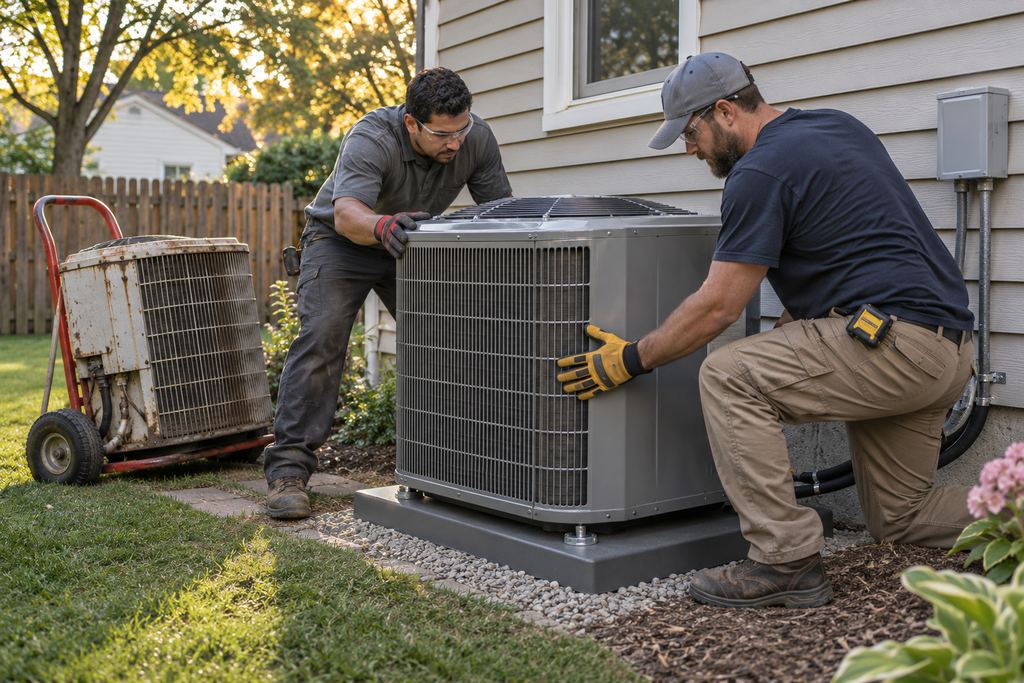
HVAC System Replacement With a Local Installer
When the AC, furnace or heat pump is worn out, HVAC Service Near Me connects you with an independent installer near you. That contractor visits, measures the home and writes up a quote for the new system. You decide whether to go ahead.
- AC, furnace, heat pump, packaged and ductless swaps
- Sizing from a room-by-room load calculation
- Scheduling depends on your area and the season
List the equipment you have now and what is wrong with it. A local installer contacts you to arrange the estimate.
Please keep this page open.
- We pair the request with an independent contractor or partner network that works in your ZIP code.
- The contractor gets in touch to go over the details and agree on a visit.
- After checking the system they quote the job, and you choose whether to proceed.
Read how requests are handled.
Online requests are not connected to a contractor network yet. Nothing you typed was sent or saved. Please phone us instead, or try again later.
Call (888) 555-0199You are probably shopping for replacement if
- The system is in its second decade: Central AC and heat pumps tend to give 10 to 15 years, gas furnaces 15 to 20, with plenty of variation.
- A big part has failed: Compressor, indoor coil or heat exchanger on equipment past its middle age.
- It still runs on R-22: That refrigerant has been out of production since 2020, which makes leaks costly to deal with.
- Repairs keep stacking up: Service calls every season with no end in sight.
- Comfort never improved: Hot upstairs, damp basement or rooms that stay off target after duct fixes.
Systems an installer can swap out

Getting the size and efficiency right
The quote should start with a load calculation, usually ACCA Manual J, not a copy of the old nameplate. Homes change. New windows, a sealed attic or a finished bonus room can shift the load by a full size. An oversized unit cools in quick bursts and leaves humidity behind; an undersized one runs and runs on hot afternoons.
Efficiency comes next. Air conditioners and heat pumps have been rated in SEER2 since January 1, 2023, and regional minimums are higher in the South than in the North. Higher tiers cost more up front, so the payoff depends on how hard your system works each year. New equipment is also moving to A2L refrigerants such as R-454B and R-32, which may affect whether the old line set can stay. The cost section below shows how these choices change a quote.
From estimate to first cool night
- Home visit
The installer measures rooms, looks at ducts, electrical service and where the equipment sits.
- Written proposal
Model numbers, scope, permit, labor warranty and price, sometimes with two or three tiers to choose from.
- Permit and scheduling
The contractor pulls the mechanical permit where one is required and books the install date.
- Removal
Refrigerant in the old system is recovered by a technician with EPA Section 608 certification before the unit is disconnected and hauled away.
- Install
New equipment set, line set and drain connected, electrical finished. A typical single-system changeout takes one to two days.
- Startup and walk-through
Charge verified, airflow checked, thermostat set up, and you get the paperwork and warranty registration.
HVAC replacement cost
Carrier's HVAC replacement cost guide (September 2026) puts replacement at $3,000 to more than $15,000, counting equipment, labor and needed modifications, with central AC at $3,000 to $15,000, a gas furnace at $3,800 to $12,000 and a heat pump at $6,000 to $25,000. Trane's 2026 AC replacement guide gives a national average of $6,958 to $13,418 installed for central AC alone. A furnace and AC replaced together are priced per piece of equipment plus shared labor, so ask for each item on the bid. These are manufacturer figures, not HVAC Service Near Me prices; independent contractors set their own rates.
Two bids that look far apart often describe different jobs. One swaps the outdoor unit only; the other replaces the indoor coil, line set, thermostat and a section of duct as well. A complete price names removal and disposal, the line set, pad, electrical, duct changes, permit and startup testing, which lets you compare line by line.
What you are replacing changes the size of the job
| Project | What gets swapped | Relative job size | Notes |
|---|---|---|---|
| Central AC only | Outdoor condenser and usually the indoor coil | Medium | Coil and condenser should be a matched pair for the rated efficiency. |
| Furnace only | Gas or electric furnace | Medium | Venting and gas line may need updates on older homes. |
| Heat pump split system | Outdoor heat pump, indoor air handler or coil | Medium to large | Can replace both an AC and an electric furnace in mild climates. |
| Full split system | AC or heat pump plus furnace or air handler | Large | Often the better value when both halves are near the end of their life. |
| Packaged unit | One cabinet on a pad or roof | Medium to large | Crane or roof access can add to the cost. |
| Ductless mini-split | Outdoor unit and one or more indoor heads | Small to large | Price rises with each added zone. See mini-split installation cost. |
Line items that move a replacement quote
One ton moves 12,000 Btu of heat per hour. A larger home or a hot, sunny exposure needs more capacity, and more capacity costs more.
Higher SEER2, HSPF2 and AFUE ratings cost more up front and less to run. Single-stage, two-stage and variable-speed equipment sit at different price points.
Leaky, undersized or crushed ducts can undo a new system. Repair, sealing or partial replacement adds labor and material.
A new disconnect, breaker or wire size may be needed, especially when a heat pump replaces a gas furnace.
Attic installs, tight closets, rooftop units and old equipment disposal all add hours.
Labor rates track the cost of living and how busy contractors are. Peak summer and winter weeks are the most crowded.
Brands matter less than the installer
People often ask which three AC brands are top of the list. Most major manufacturers make reliable equipment at several price levels, and a mid-range unit that is sized and installed carefully will usually outperform a premium one that was rushed in. Look at the product tier, the parts warranty and whether the outdoor unit and coil are a matched, rated pair. We are not affiliated with any equipment brand.
Pin these down with every bidder
- Can I see the load calculation?
The tonnage on the quote should trace back to it. - What exactly is being replaced?
Outdoor unit, coil, furnace or air handler, line set, pad, thermostat, drain. - Is the permit included?
And who is responsible for the inspection appointment? - What is your labor warranty?
Get the length and what it covers in writing. - Will you register the manufacturer warranty?
Ask for confirmation once it is done. - What is your license number?
Look it up on the contractor board website for your state or city.
Repair one more time, or replace now
The quick test many technicians use is the $5,000 rule: age times repair cost. The rule is informal and carries no DOE or industry backing; confirm the warranty status, ask for a written diagnosis and compare the repair price after any coverage with a replacement bid. Above 5,000, look hard at replacement; below it, a repair is often reasonable. A 6-year-old system with a failed capacitor is an easy repair. A 16-year-old R-22 unit with a refrigerant leak is not. For the repair route, see HVAC repair. Once new equipment is in, yearly HVAC maintenance keeps the warranty paperwork and the system itself in good order. Adding a system where none existed is covered under HVAC installation.
How a service request works
HVAC Service Near Me is a referral service. We don't send our own technicians. We connect you with independent local contractors.
- Describe the job
Type your ZIP code, pick a service and add a line or two about the problem or project.
- We pass it on
An independent HVAC contractor or partner network that works in your area and does that kind of job receives it.
- You hear back
The contractor gets in touch to check the details and set a time to come out.
- The choice is yours
After a diagnosis the contractor gives you a quote. Price, timing and warranty are agreed directly between the two of you.
Frequently asked questions
Do I need to replace my HVAC system?
Not just because of age. Replace when the repair math no longer works, a major part fails on old equipment, it uses R-22 and leaks, or comfort cannot be fixed with smaller changes. A technician's inspection gives you the facts to decide.
What does it cost to replace the HVAC system in a 2,200 square-foot house?
There is no fixed figure, because climate, insulation, ducts and the efficiency you choose all change it, and square footage alone does not size a system. A load calculation sets the tonnage and the quote follows from that and the scope. Carrier's September 2026 range of $3,000 to more than $15,000 is a first look, not a budget.
How long does an HVAC replacement take?
A straightforward swap of one system typically takes one to two days. Duct changes, electrical upgrades, rooftop access or permit timing can stretch it.
Should I replace the AC and furnace at the same time?
If both are old, replacing them together lets the contractor match the indoor coil, blower and outdoor unit for rated efficiency and often saves on labor. If the furnace is young and sound, replacing only the AC side is reasonable.
Can I replace only the outdoor unit?
Sometimes, but the outdoor unit and indoor coil are rated as a pair, and a newer refrigerant may not suit an old coil. Ask the contractor whether a partial swap keeps the rated efficiency and warranty.
Does commercial HVAC replacement follow the same steps?
Broadly, yes, with added steps for cranes, roof curbs, after-hours work and building codes. See commercial AC replacement.
What happens to the old equipment?
The refrigerant must be recovered by a Section 608 certified technician, and the contractor usually hauls the unit away for recycling. Confirm that disposal is in the quote.
What time of year is cheapest to replace HVAC?
Spring and fall are usually calmer for contractors, which can mean more scheduling choice and time to compare quotes. Waiting for an emergency in July removes that leverage.
Related guides and services
Talk to an installer about a new system
Send the details of your current equipment and your ZIP code. An independent contractor nearby reaches out to set up the in-home estimate.
List the equipment you have now and what is wrong with it. A local installer contacts you to arrange the estimate.
Please keep this page open.
- We pair the request with an independent contractor or partner network that works in your ZIP code.
- The contractor gets in touch to go over the details and agree on a visit.
- After checking the system they quote the job, and you choose whether to proceed.
Read how requests are handled.
Online requests are not connected to a contractor network yet. Nothing you typed was sent or saved. Please phone us instead, or try again later.
Call (888) 555-0199