AC Freezing Up: How to Thaw It and Stop It Returning
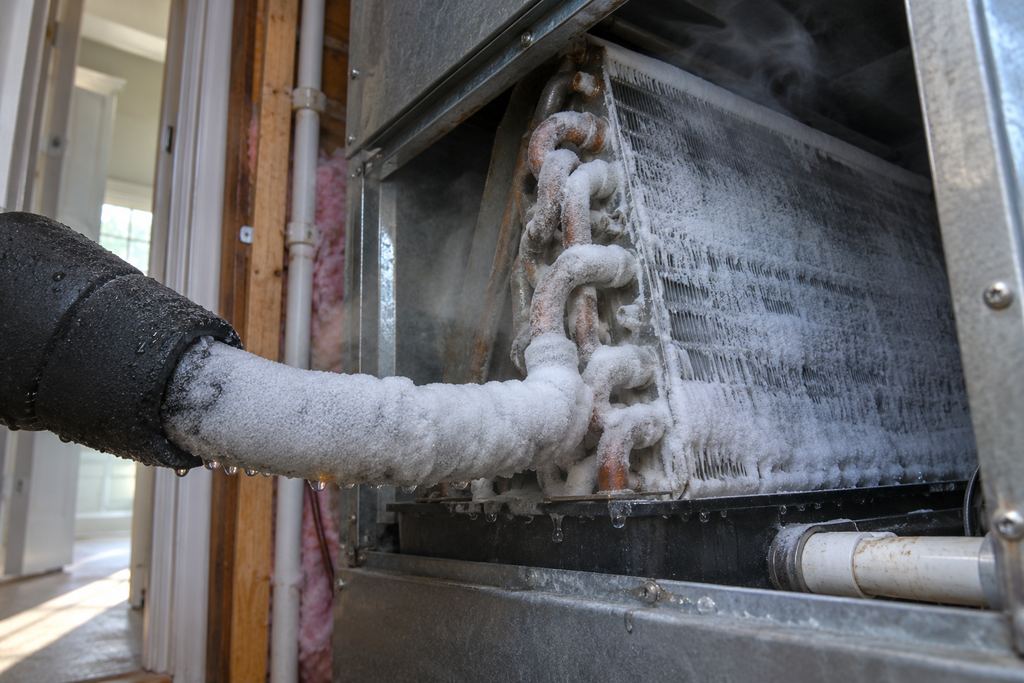
An AC freezing up is a symptom, not a cause. Ice forms when the evaporator coil drops below freezing, which almost always means too little warm air is crossing it or too little refrigerant is flowing through it.
Switch the thermostat from Cool to Off and set the fan to On so room air melts the ice. Put towels near the indoor unit, since the melt can overflow the pan. Replace the filter while it thaws. Allow several hours, longer for a thick block. If the coil ices up again within a day or two after a fresh filter, the system likely has a refrigerant leak, a dirty coil or a blower problem that a technician needs to find.
Thawing a frozen AC without damage
- Stop cooling
Set the thermostat to Off. Running the compressor against a frozen coil can send liquid refrigerant back to it.
- Run the fan
Set the fan to On. Moving air speeds the thaw. Leave the outdoor unit off.
- Protect against melt water
Place towels or a shallow tray by the air handler and check the drain pan as ice melts.
- Change the filter
Install a new filter of the size printed on the old one's frame.
- Wait it out
Do not chip, scrape or use a heat gun on the coil or lines. Fins and tubing damage easily.
- Restart and watch
Once lines are dry, switch back to Cool and check the larger copper line outside after an hour. Fresh frost means the cause is still there.
Signs the coil is icing
- Frost on the insulated suction line: The thicker copper line at the outdoor unit or at the air handler is white or wet.
- Weak airflow at the registers: Ice blocks the coil, so less air gets through.
- Warmer air from the vents: A coated coil cannot absorb heat. See AC blowing warm air.
- Water around the indoor unit: Melting ice can overwhelm the pan. The leaking water guide covers that.
- Long run times with little cooling: The house never reaches the setpoint even though the system runs constantly.
Why an AC keeps freezing up
Not enough air across the coil
The coil needs a steady flow of warm room air to stay above freezing. Anything that cuts that flow lets its temperature sink: a filter packed with dust, furniture over return grilles, several supply registers shut, collapsed flex duct, or a blower motor that is slowing down. This is the most common cause and the one to rule out first.
Low refrigerant
An AC does not consume refrigerant. If the charge is low, there is a leak. Less refrigerant lowers the pressure in the evaporator, and lower pressure means a colder coil that ices over. Leak search and recharge are Section 608 work; details are on refrigerant leak repair.
Dirty evaporator coil
Dust stuck to wet coil fins acts like insulation and blocks air at the same time. A dirty coil often goes with a history of skipped filter changes. Cleaning is covered on evaporator coil cleaning.
Running in cool weather
Many residential systems are not designed to cool when it is below roughly 60 degrees F outside. Night cooling in spring or fall can frost a coil that works fine in summer.
Controls and drain problems
A thermostat stuck calling for cooling, or a fan set to run at too low a speed, can contribute. A clogged drain does not cause ice by itself, but it makes the thaw messier.
Freezing by system type
What to ask the contractor
- Did you measure airflow and static pressure?
It shows whether ducts or the blower are starving the coil. - If refrigerant is low, where is the leak?
A recharge without a leak repair usually means another freeze. - Is your HVAC license current in this state?
Check the number on the state licensing board website. - Can I have the quote in writing?
Leak repair, coil cleaning and recharge should be priced separately. Typical ranges are on refrigerant leak repair cost.
Preventing the next freeze
- Write the filter change date on the frame and stick to the interval.
- Keep returns uncovered and most supply registers open.
- Avoid running cooling on cool nights; open windows or use the fan instead.
- Have the coil and refrigerant charge checked at a spring tune-up.
Frequently asked questions
What should I do first when my AC freezes up?
Turn cooling off, set the fan to On, and let the ice melt completely. Replace the filter while you wait. Do not chip at the ice.
How long does a frozen AC take to thaw?
Light frost can clear in an hour or two with the fan running. A coil packed with ice can take most of a day.
How can I tell if my AC is low on refrigerant?
Repeated icing after a filter change, hissing near the lines, oily spots on fittings and long run times are common clues. Only a certified technician can confirm the charge with gauges.
Can a bad thermostat make an AC freeze?
It can contribute if it never stops calling for cooling, keeping the coil cold for hours. It is less common than an airflow or refrigerant cause.
Why does the outdoor unit wait before restarting after thawing?
A built-in lockout on many systems keeps the compressor idle for about three to five minutes after a stop so refrigerant pressures can balance. Expect that pause after you switch back to Cool.
Related guides and services
Find out why the coil freezes
Tell us where you see ice and whether the filter is new. A local HVAC contractor can contact you about a diagnostic visit. Availability varies by ZIP code and season.
Let us know where you see ice and whether it has happened before. A local contractor can follow up.
Please keep this page open.
- We pair the request with an independent contractor or partner network that works in your ZIP code.
- The contractor gets in touch to go over the details and agree on a visit.
- After checking the system they quote the job, and you choose whether to proceed.
Read how requests are handled.
Online requests are not connected to a contractor network yet. Nothing you typed was sent or saved. Please phone us instead, or try again later.
Call (888) 555-0199