Evaporator Coil Replacement Cost Explained
A failed indoor coil is one of the larger repairs on a central AC, and the quote can vary a lot between contractors. Knowing what drives evaporator coil replacement cost makes those quotes easier to compare.
The coil itself, the refrigerant charge and the labor to recover, braze, evacuate and recharge make up most of the bill. A coil for an R-22 system or an attic installation usually costs more to replace. We do not quote prices; get two or three itemized written quotes and compare them with the cost of a matched system. Trane's 2026 repair article lists evaporator coil replacement at $1,000 to $5,000 or more; This Old House gives $700 to $2,500 or more.
What published estimates say
Trane's May 2026 repair cost article puts evaporator coil replacement at $1,000 to $5,000 or more, and This Old House's 2026 repair guide gives $700 to $2,500 or more. The spread comes from coil size, access to the plenum and the refrigerant charge.
A coil warranty may cover the part but not labor or refrigerant. These are planning numbers, not our prices.
The main cost drivers
Cased or uncased, A-coil or slab, and its capacity. A manufacturer-matched coil often costs more than a universal one.
The system has to be recovered and recharged. R-22 is no longer produced, so it is scarce and expensive, and newer systems use R-410A, R-454B or R-32.
Recovery, removing the old coil, brazing, pressure testing, a deep vacuum and charging take hours, more in tight spaces.
A basement furnace is easier to work on than a cramped attic or a closet with little clearance.
If the new coil is a different height or width, the plenum and drain connections need rework.
A part covered by the maker's warranty may cost you only labor and refrigerant. Check the registration and terms.
How common scenarios compare
No dollar figures. Use this to see why one quote is higher than another.
| Scenario | What usually pushes cost up | What usually keeps it down |
|---|---|---|
| Coil under warranty | Labor rates, refrigerant, after-hours visit | Part supplied at no charge by the maker |
| Out-of-warranty, R-410A system | Matched OEM coil, attic access | Universal coil rated with your outdoor unit, easy access |
| R-22 system | Recovered or reclaimed R-22, or a refrigerant conversion | Small charge, sound outdoor unit |
| Coil plus line set | Long or hidden line set run | Reusable line set that tests tight |
| Coil and outdoor unit together | Two major components | Single matched system price, often with a new warranty |
How a technician tells the coil is bad
Most coils that need replacing are leaking refrigerant. The usual story is a system that keeps losing cooling after a recharge, or a technician who finds low pressures and no obvious leak at the outdoor unit. Leak detection on the coil may use an electronic detector, bubble solution on reachable joints or a nitrogen pressure test with the coil isolated.
Corrosion in the copper tubing can create many tiny leaks spread across the coil. Those cannot be patched in a way that lasts, which is why a coil with formicary corrosion is usually replaced instead of repaired. A single leak at a reachable joint is a different case; ask whether a brazed repair is possible before agreeing to a new coil. See refrigerant leak repair for the leak search itself.
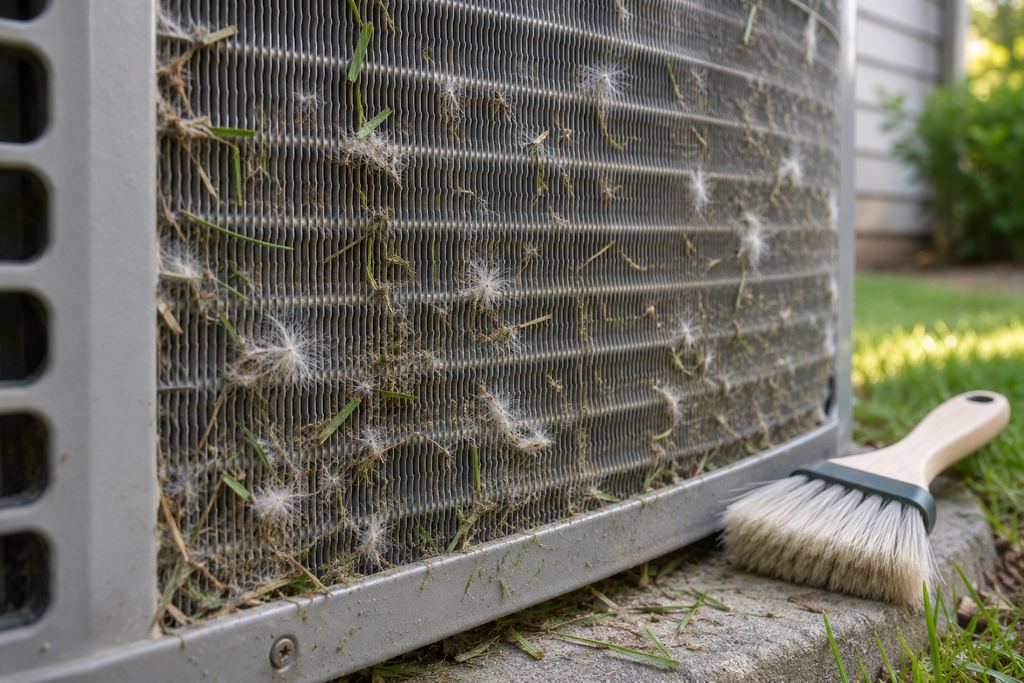
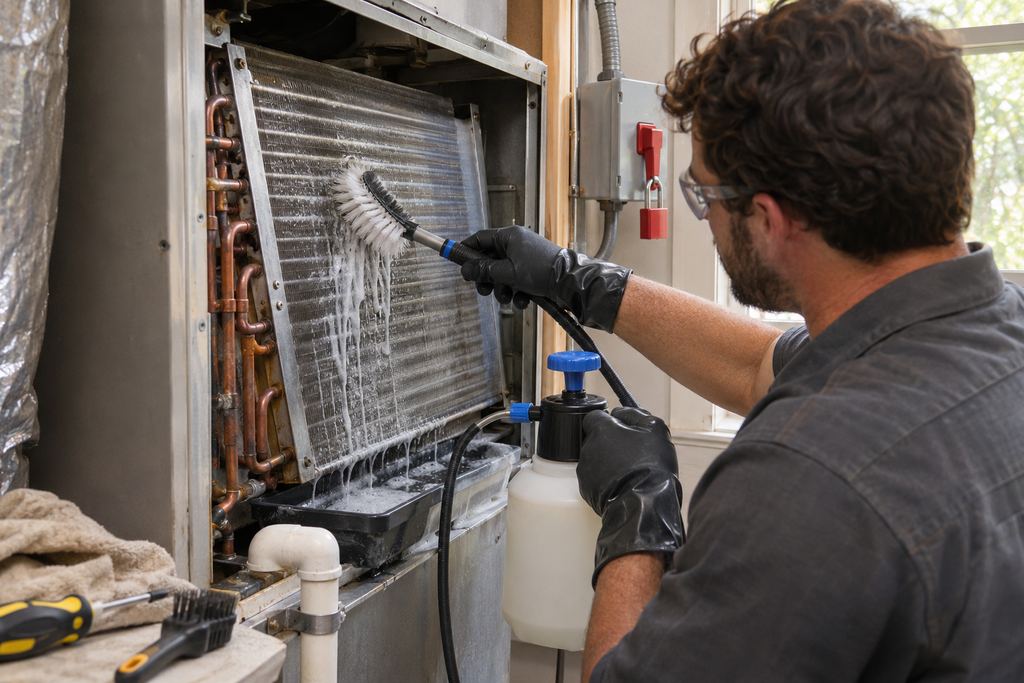
Not every coil problem means a leak. A coil can also be dirty or blocked, which calls for evaporator coil cleaning, not replacement.
What you can observe and what needs testing
Safe checks you can do
No tools beyond a flashlight. Turn the system off at the thermostat before opening any filter or access door.
- Notice whether cooling faded slowly over weeks
- Look for ice on the copper line or coil case, then set the system to fan-only to thaw it
- Check the filter and replace it if dirty
- Find the coil and outdoor unit model numbers on their data plates
- Write down past recharges and dates
Leave these to a licensed technician
These involve high voltage, refrigerant or sealed components. Refrigerant work requires EPA Section 608 certification.
- Measuring pressures, superheat and subcooling
- Leak searching with detectors or a pressure test
- Recovering refrigerant and replacing the coil
- Confirming the new coil and metering device suit the outdoor unit
Sizing and efficiency of the new coil
The coil has to match the capacity of the outdoor unit and the airflow of the blower. Installers check the pairing in the AHRI Directory, which lists certified ratings for specific indoor and outdoor combinations. A coil that is rated with your condenser lets the system reach its listed SEER2 efficiency. An unrated or poorly matched coil can still cool, but it may run less efficiently and may affect warranty coverage.
The metering device matters too. Many coils use a thermostatic expansion valve, and the valve or piston must suit the refrigerant and outdoor unit. Ask the contractor to name it on the quote.
Coil only or the whole system?
- Age of the outdoor unit: A young outdoor unit and a failed coil favor replacing the coil.
- Refrigerant type: R-22 systems tilt toward full replacement.
- Repair history: Several refrigerant or compressor repairs suggest the system is near the end.
- Warranty: A covered coil changes the math sharply.
- Efficiency: A new matched system may cut running costs, which counts in long cooling seasons.
- Rule of thumb: Some owners use the $5,000 rule: system age times repair cost. It is an informal screen, not a DOE or industry standard; confirm the warranty status, ask for a written diagnosis and compare the repair price after any coverage with a replacement bid. Above 5,000, they price replacement. It is a heuristic, not a standard.
What to ask on every quote
- How did you confirm the leak is in the coil?
Look for a test method, not just low pressure. - Is the new coil AHRI-rated with my outdoor unit?
Ask for the reference number. - How much refrigerant is included, and what type?
The quote should state the type and how the charge is set. - Is the coil under warranty?
Ask the contractor to check the serial number with the maker. - What would a matched system cost instead?
Comparing both makes the decision clearer. See AC replacement cost.
Frequently asked questions
What is the $5,000 rule for AC repairs?
Multiply the age of the system by the repair price. If the number is over 5,000, some people start pricing a replacement. It leaves out refrigerant type, efficiency and condition, so use it only as a first filter.
What is usually the most expensive AC part to replace?
The compressor, followed by the indoor or outdoor coil. Both involve refrigerant recovery and recharging. Our compressor cost section covers that repair.
How do I know my evaporator coil is bad?
Repeated loss of cooling after a recharge, ice on the coil, or a technician's leak test pointing at the coil are the common signs. A dirty coil causes some of the same symptoms, so ask for testing before agreeing to replacement.
How long do evaporator coils last?
Many last as long as the rest of the system. Corrosion, chemical exposure in the house and poor maintenance can shorten that. There is no fixed lifespan to plan on.
Can a leaking coil be repaired instead of replaced?
A single leak at a reachable joint can sometimes be brazed. Leaks spread across the tubing from corrosion usually cannot be fixed reliably.
Is replacing the coil worth it on an older system?
Price both a coil and a matched system. If the outdoor unit is old or uses R-22, the full system may be the better use of money.
Related guides and services
Compare evaporator coil quotes
Tell us what the technician found and the age of the system. A local contractor can follow up to confirm the diagnosis and quote the coil, and a matched system if you ask.
Tell us what the technician found. A local contractor confirms the diagnosis and quotes in writing.
Please keep this page open.
- We pair the request with an independent contractor or partner network that works in your ZIP code.
- The contractor gets in touch to go over the details and agree on a visit.
- After checking the system they quote the job, and you choose whether to proceed.
Read how requests are handled.
Online requests are not connected to a contractor network yet. Nothing you typed was sent or saved. Please phone us instead, or try again later.
Call (888) 555-0199