AC Repair and Air Conditioning Service, Matched to Local Contractors
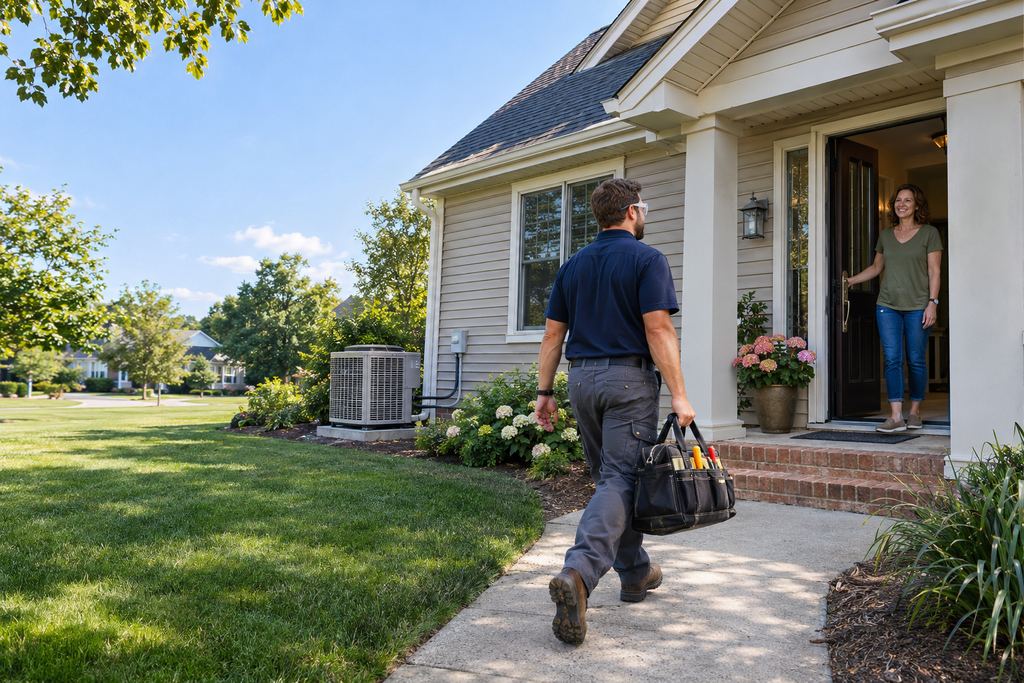
Describe what your air conditioner is doing and add your ZIP code. HVAC Service Near Me passes the request to an independent HVAC company that works near you.
Vents pushing warm air, a condenser that hums and never kicks on, a puddle beside the furnace closet: one sentence about it is enough. We do not run trucks. The contractor who takes the request quotes, schedules and does the job.
- One form covers breakdowns, tune-ups, new systems and replacement quotes
- Prices and appointment times come from the contractor, not from us
- Plain explanations of each fault, so the visit makes sense
Enter your ZIP code and a short description. A contractor who serves your area follows up to confirm details and schedule.
Please keep this page open.
- We pair the request with an independent contractor or partner network that works in your ZIP code.
- The contractor gets in touch to go over the details and agree on a visit.
- After checking the system they quote the job, and you choose whether to proceed.
Read how requests are handled.
Online requests are not connected to a contractor network yet. Nothing you typed was sent or saved. Please phone us instead, or try again later.
Call (888) 555-0199Pick the symptom closest to yours
Every symptom page walks through probable causes, homeowner-safe checks and the point where a technician has to take over.
Inside a typical air conditioning repair
Air conditioning repair is detective work followed by a fix. A split central system lives in two places: a condenser outside holding the compressor and its fan, and an air handler or furnace indoors holding the evaporator coil and blower. Trouble in either place produces the same complaint upstairs, a house that stays hot, so a good technician measures before replacing anything.
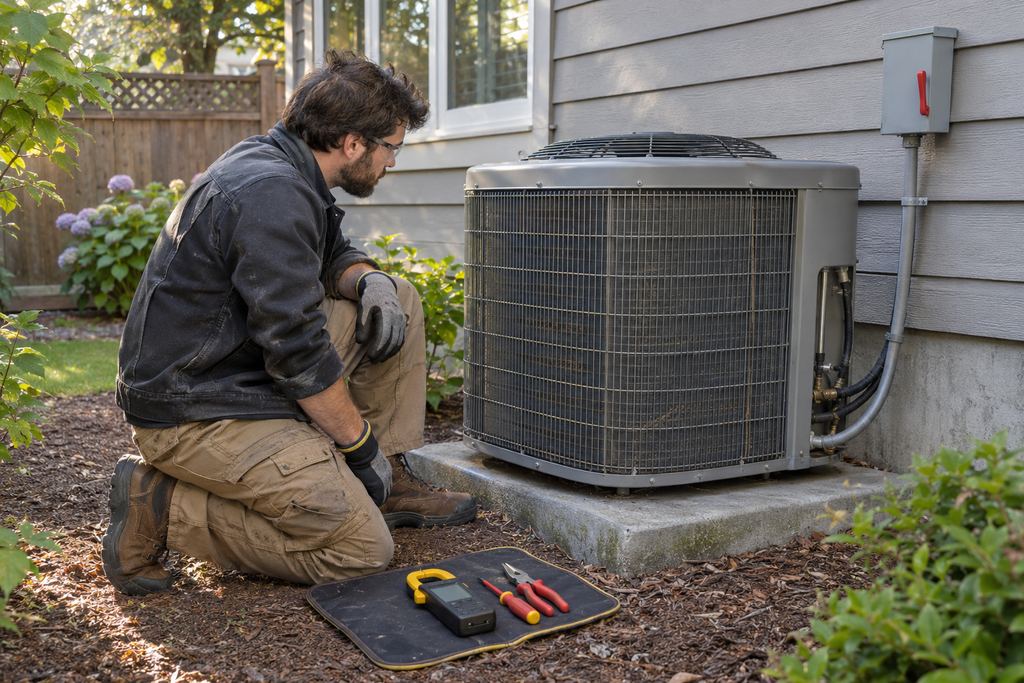
Expect the visit to cover incoming power, thermostat signals, the capacitor and contactor, both fan motors, temperature drop across the indoor coil, refrigerant pressures and airflow through filter and ducts. Small electrical parts wear out often and swap quickly. Leaks, cracked coils and dead compressors are slower and pricier jobs, and they are usually where the fix-or-replace talk starts. Want the same measurements without a breakdown? Book an AC inspection or diagnostic visit instead.
Checks you can make first, and parts to leave for the pro
Safe checks you can do
No tools beyond a flashlight. Turn the system off at the thermostat before opening any filter or access door.
- Make sure the thermostat reads Cool with a setpoint under the indoor temperature; swap its batteries if the screen is dim or blank.
- Slide out the filter. Light that cannot pass through it means it is due for replacement.
- At the panel, a breaker marked AC or condenser that sits in the middle position can be reset once. Not twice.
- Rake away leaves and move bikes, bins or lawn furniture back from the condenser.
- Frost or ice on the copper piping means switch to Fan or Off and wait for it to melt completely.
Leave these to a licensed technician
These involve high voltage, refrigerant or sealed components. Refrigerant work requires EPA Section 608 certification.
- Opening the condenser's electrical compartment, where the capacitor and contactor sit.
- Measuring or adding refrigerant, which federal law reserves for people holding EPA Section 608 certification.
- Any breaker that trips a second time, plus melted or darkened wiring.
- Swapping motors, coils or the compressor.
- Drain work that goes past the steps printed in your owner's manual.
Smell something burning or electrical, see smoke or sparks, or watch the breaker drop again after its single reset? Kill the system at the thermostat and at the panel, then phone a professional. With smoke or flames, get out of the house first and call 911 from outside. In extreme heat, a person who becomes confused, faints or has hot dry skin may have heat stroke: dial 911 and get them into shade or a cooler room. See the NWS heat safety guidance for symptoms.
AC repair cost: what published estimates show
A repair is priced after the diagnosis, so the figure depends on which part failed. For a national reference, This Old House's AC repair cost guide (updated March 2026) puts air conditioner repairs between $100 and $1,000, with most homeowners paying $150 to $650 for common fixes such as a capacitor or contactor. Trane's 2026 repair cost article uses a wider span of $100 to $5,000 or more, because it counts compressor and coil replacement as repairs, and lists a service call at roughly $50 to $200. These are national planning figures from those publishers, not prices from HVAC Service Near Me, and they leave out permits and after-hours premiums. The written quote from the local contractor is the number that counts.
Most repair invoices carry the same few lines: the trip or diagnostic charge, the part, labor billed by the hour or as a flat rate from a price book, refrigerant per pound when the system needed charging, and small items such as a new disconnect or a filter. Asking for those lines separately makes two quotes easy to compare.
Common AC repairs by relative size
Relative job size from general trade practice, not prices. The contractor sets the actual amount.
| Repair | Relative size | What moves the price |
|---|---|---|
| Capacitor | Small | Part type and after-hours rate. See capacitor replacement cost. |
| Contactor or fuse | Small | Part and labor time |
| Clogged condensate drain | Small | Access to the line and pan |
| Thermostat | Small to medium | Basic swap versus wiring for a smart or communicating model |
| Condenser or blower motor | Medium | Motor type, especially variable-speed ECM motors |
| Refrigerant leak search and repair | Medium to large | Leak location, refrigerant type and recharge amount |
| Evaporator coil | Large | Coil cost, refrigerant recovery and labor |
| Compressor | Large | Part, refrigerant, labor and warranty. See compressor replacement cost. |
Why two AC repair quotes can differ
The contractor prices the job after an inspection; HVAC Service Near Me never sets it. These variables explain why two quotes for the same symptom can be far apart.
Capacitors and contactors are inexpensive parts with short labor. Blower motors, coils and compressors sit at the other end of the scale.
New R-22 production and import ended in the US on January 1, 2020. Existing systems can still be serviced with recycled, reclaimed or previously produced R-22, and the EPA says there is no requirement to replace a working R-22 unit. Supply is limited and prices move, so whether to repair or replace depends on the diagnosis and written quotes.
Nights, weekends and holidays frequently carry premium rates. Ask for the rate while booking.
Crawling through a hot attic or carrying parts onto a roof takes longer than working in a basement or beside a pad.
Plenty of companies bill a visit fee up front. Find out whether it is credited if you approve the repair.
When a unit is still covered by the manufacturer, the part may be free while labor is not. Keep the registration paperwork handy.
Central AC, heat pumps, ductless mini-splits and packaged units use different parts and procedures, so the same fault is priced differently on each.
Repairing versus replacing an aging system
A shortcut you may hear from technicians is the $5,000 rule: age in years times the quoted repair, compared against 5,000. Above that line, it is worth pricing a new system too. It is an informal screen, not a DOE or trade standard, so check warranty coverage first, then get the fault diagnosed and compare real quotes for the repair and for a new system. As an example, $300 on a six-year-old unit scores 1,800, so a repair usually looks reasonable. A $1,800 compressor quote on a 15-year-old R-22 system scores 27,000, and that conversation looks very different.
Other signs also justify pricing a replacement: a service call every summer, upstairs bedrooms that never catch up, or a leaking coil on an old unit. Equipment sold since January 1, 2023 carries SEER2 ratings, and federal minimums run higher in southern and southwestern states. Weighing new equipment? Read about AC replacement, see what a new AC installation involves, and browse the cost guides for the factors behind each job.
Fewer emergency calls next summer
Plenty of July failures begin as something minor in April. A packed filter, a condenser coil coated in cottonwood fluff or a sluggish drain line all add strain week after week. One spring visit lets a technician wash the coils, flush the condensate line, load-test capacitors and catch a weak part while the weather is mild. Heat pumps that warm the home in winter typically get a second visit each autumn. Between appointments, swap or wash the filter as often as your household demands; homes with shedding pets may need monthly changes. The AC maintenance page covers the checklist.
Vetting the company that calls you back
Requests go to independent businesses. Screen them with the same questions you would put to any contractor.
- What is your license number?
Most states run a board that licenses HVAC or mechanical contractors; a few leave it to cities or counties. Look the number up on that board's website rather than trusting a photo of a card. - Can you send proof of insurance?
General liability and workers' compensation matter most for roof, attic and replacement jobs. - Will I get the price on paper first?
The quote should list parts, labor and any visit fee before anyone picks up a tool. - Does the tech hold EPA Section 608 certification?
It is a federal requirement for refrigerant handling. - How is the repair warrantied?
Ask about labor coverage and whether the new part carries its own manufacturer warranty.
How a service request works
HVAC Service Near Me is a referral service. We don't send our own technicians. We connect you with independent local contractors.
- Describe the job
Type your ZIP code, pick a service and add a line or two about the problem or project.
- We pass it on
An independent HVAC contractor or partner network that works in your area and does that kind of job receives it.
- You hear back
The contractor gets in touch to check the details and set a time to come out.
- The choice is yours
After a diagnosis the contractor gives you a quote. Price, timing and warranty are agreed directly between the two of you.
Equipment, brands and coverage
Independent companies in the network commonly handle central air, heat pumps, ductless mini-splits and packaged rooftop or slab units, but each one chooses its own specialties. Know your brand? The brand pages cover warranty registration and frequent service questions; HVAC Service Near Me has no affiliation with any manufacturer. Coverage depends on which contractors accept work in a given ZIP code and shifts through the year, which is why the form, not a map, tells you what is open where you live. Running a store, office or restaurant? Start at commercial AC service.
Frequently asked questions
What does AC repair actually include?
Work that brings cooling back after a failure. Typical jobs: a new capacitor, contactor or fan motor, a cleared condensate drain, a leak located and fixed, or a compressor swapped. Cleaning a system that still works is maintenance and is normally booked as a tune-up.
Could a clogged filter be the whole problem?
Sometimes, yes. Restricted airflow lets the indoor coil drop below freezing, ice builds up and cooling fades. Put in a fresh filter, run Fan or Off until the ice is gone, and request service if the house still does not cool.
How often does a residential AC need service?
Yearly, ahead of hot weather, is standard advice for central air. Heat pumps that handle winter heating are commonly seen twice a year, spring and fall.
Where does indoor water from an AC come from?
Usually a blocked condensate line or a cracked pan under the coil. Meltwater from an iced coil can overflow as well. Shut the system down if water reaches wiring, then read AC leaking water.
Is an AC recharge enough?
Refrigerant circulates in a sealed loop and does not wear out. Low charge means a leak somewhere, so a top-off without a leak search just postpones the next bill. Only someone with EPA Section 608 certification may handle the refrigerant.
Does emergency AC repair cost more?
Usually, because night, weekend and holiday calls carry after-hours labor rates and sometimes a higher trip charge. Ask for both the regular and the after-hours rate when the contractor calls back. If heat is putting someone in danger, call 911 first.
Are the technicians employed by HVAC Service Near Me?
No. HVAC Service Near Me is a referral service. Each request is forwarded to an independent contractor or partner network covering your area, which then quotes, books and performs the work. Details are on how it works.
Related guides and services
Describe the problem, get a local call back
Write a line about the symptom, mention the equipment if you know it, and enter a ZIP code. An HVAC company that takes work in your area reaches out to confirm and book. What is available changes with location and time of year.
Enter your ZIP code and a short description. A contractor who serves your area follows up to confirm details and schedule.
Please keep this page open.
- We pair the request with an independent contractor or partner network that works in your ZIP code.
- The contractor gets in touch to go over the details and agree on a visit.
- After checking the system they quote the job, and you choose whether to proceed.
Read how requests are handled.
Online requests are not connected to a contractor network yet. Nothing you typed was sent or saved. Please phone us instead, or try again later.
Call (888) 555-0199