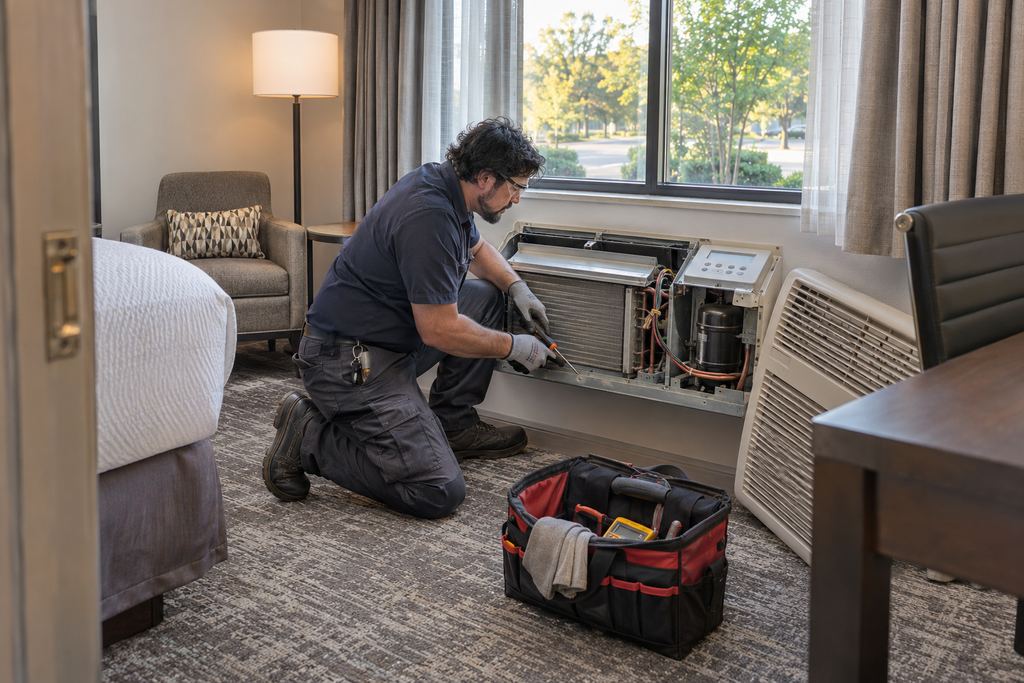
PTAC Installation for Apartments, Hotels and Additions
PTAC installation comes in two flavors. Dropping a new chassis into an existing wall sleeve is a short job; cutting a new opening, framing it, running a dedicated circuit and setting the sleeve is real construction. HVAC Service Near Me can pass your project to an independent local contractor who handles packaged terminal units.
- Many brands share a 42 by 16 inch sleeve, but check the manual
- Units come in 208/230V and 265V versions
- New wall openings usually call for structural and electrical work
Say whether a sleeve is already in the wall, how many units you need and the voltage if you know it. A local contractor can follow up.
Please keep this page open.
- We pair the request with an independent contractor or partner network that works in your ZIP code.
- The contractor gets in touch to go over the details and agree on a visit.
- After checking the system they quote the job, and you choose whether to proceed.
Read how requests are handled.
Online requests are not connected to a contractor network yet. Nothing you typed was sent or saved. Please phone us instead, or try again later.
Call (888) 555-0199Existing sleeve or new opening?
A packaged terminal air conditioner, or PTAC, is a self-contained unit that sits in a metal sleeve through an exterior wall. The sleeve stays in the building; the chassis slides in and out. That design is why the first question an installer asks is whether there is already a sleeve in place.
Many PTAC manufacturers build to a common sleeve size of roughly 42 by 16 inches, so a new chassis from one brand often fits an older sleeve from another. Often is not always. Depth, grille style and drain kits differ, and the installation manual lists which sleeves are approved. When a sleeve is rusted, out of level or the wrong depth, it is usually replaced along with the unit.
A new opening means cutting masonry or siding, adding a header if the wall is load bearing, setting and sealing the sleeve with a slight outward pitch, and fitting an exterior grille. In multifamily buildings this work typically needs a permit and coordination with building management. For an overview of how these units work, see the PTAC unit guide.
Power supply options
| Voltage | How it connects | Where it is common |
|---|---|---|
| 208/230V | Plug-in cord with a matching receptacle on a dedicated circuit, amperage set by the unit | Apartments, hotels and residential additions |
| 265V | Typically hard-wired through a junction box or subbase | Commercial buildings with 277/480V service |
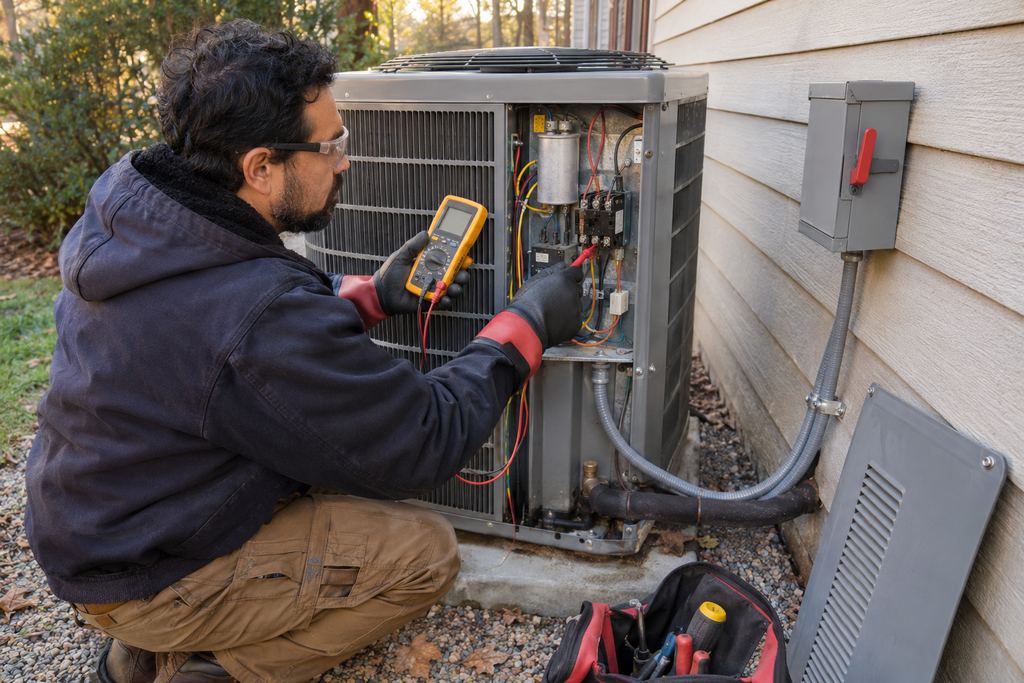
How a PTAC is installed
- Survey
The contractor measures the opening or sleeve, checks the wall type, the electrical supply and where condensate will go.
- Sleeve and grille
A new or existing sleeve is leveled side to side with a slight pitch to the outside, sealed to the wall and fitted with the exterior grille.
- Electrical
An electrician provides the receptacle or hard-wire connection on a dedicated circuit sized for the unit's heater and compressor.
- Chassis
The chassis slides into the sleeve, is secured, and the indoor front panel and any drain kit go on.
- Start-up and controls
Cooling and heating are tested, and the installer sets up wall thermostat or front-panel control and any building management settings.
Sizing and heat options
PTACs are commonly sold in capacities from about 7,000 to 15,000 Btu/h. Size depends on the room, window area, exposure and how many people use it. A hotel room facing west may need more capacity than an interior studio of the same size. Installers who do many units at once may run a load calculation per room type.
Heat comes either from electric resistance strips or from a heat pump version, called a PTHP, that also uses resistance heat as backup when it is cold outside. The U.S. Department of Energy sets federal efficiency standards for both PTACs and PTHPs, so new units meet a minimum level. Ask the installer to compare running costs if the building heats with these units in winter.
Questions for the installer
- Will my existing sleeve work?
Ask them to name the approved sleeve in the new unit's manual. - Who does the electrical work and permit?
Some contractors bring an electrician; others expect you to arrange it. - How is condensate handled?
Units can drain outside through the sleeve or to an internal drain where codes require it. - What happens to the old unit?
Refrigerant has to be recovered before an old PTAC is scrapped, by a technician with Section 608 certification.
Related PTAC pages
If a unit is already in the wall but not working, start with PTAC repair. If you are swapping old chassis for new ones in existing sleeves, PTAC replacement covers that decision. For rooms where a wall unit is not ideal, a ductless mini split installation is a quieter alternative. The PTAC systems section collects all of it.
How a service request works
HVAC Service Near Me is a referral service. We don't send our own technicians. We connect you with independent local contractors.
- Describe the job
Type your ZIP code, pick a service and add a line or two about the problem or project.
- We pass it on
An independent HVAC contractor or partner network that works in your area and does that kind of job receives it.
- You hear back
The contractor gets in touch to check the details and set a time to come out.
- The choice is yours
After a diagnosis the contractor gives you a quote. Price, timing and warranty are agreed directly between the two of you.
Frequently asked questions
How much does it cost to install a PTAC?
It depends mostly on whether a sleeve exists. A chassis into a good sleeve costs far less than a new wall opening with framing, a sleeve, a grille and a new circuit. Ask for a written quote that separates the unit, labor, electrical and wall work.
How is a PTAC installed?
A sleeve is set through the exterior wall with a slight outward pitch and sealed, an exterior grille is fitted, a dedicated circuit is provided, and the chassis slides in and is secured.
Can a homeowner install a PTAC?
Sliding a new chassis into an approved, existing sleeve with the right receptacle is within reach for some owners if the manual allows it. Cutting a wall opening or adding a circuit should be done by professionals, usually with a permit.
What is the $5000 rule for AC units?
It is an informal guide: multiply the unit's age by the repair cost, and if the result is over 5,000, a replacement quote is worth comparing. For PTACs, the price of a new chassis often makes the choice simpler.
Related guides and services
Start your PTAC project
Tell us how many units, whether sleeves exist and the building type. A contractor who installs packaged terminal units can follow up.
Say whether a sleeve is already in the wall, how many units you need and the voltage if you know it. A local contractor can follow up.
Please keep this page open.
- We pair the request with an independent contractor or partner network that works in your ZIP code.
- The contractor gets in touch to go over the details and agree on a visit.
- After checking the system they quote the job, and you choose whether to proceed.
Read how requests are handled.
Online requests are not connected to a contractor network yet. Nothing you typed was sent or saved. Please phone us instead, or try again later.
Call (888) 555-0199