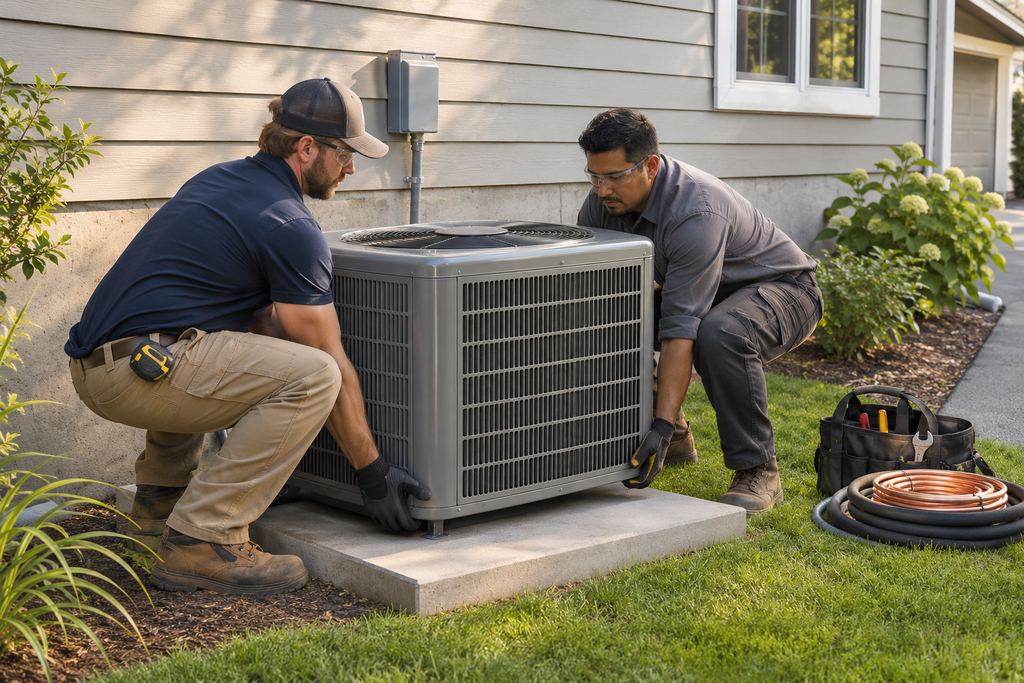
Air Conditioner Installation for Homes
Equipment brochures sell efficiency numbers, but the crew that sets the system decides whether you ever see them. Identical condensers can deliver very different comfort and bills depending on sizing, line set work and the state of the ducts. Plan the project here, then ask HVAC Service Near Me to pass your request to independent installers in your area.
- Cooling load math comes before picking a model
- Split, heat pump, ductless and single-cabinet systems side by side
- Interview questions that reveal how carefully a crew works
Tell us about the home and the system you have now, if any. A local installer follows up to schedule a site visit.
Please keep this page open.
- We pair the request with an independent contractor or partner network that works in your ZIP code.
- The contractor gets in touch to go over the details and agree on a visit.
- After checking the system they quote the job, and you choose whether to proceed.
Read how requests are handled.
Online requests are not connected to a contractor network yet. Nothing you typed was sent or saved. Please phone us instead, or try again later.
Call (888) 555-0199From first call to first cool night
Residential jobs tend to move through these stages. How fast depends on the crew's calendar, what the supply house has in stock and how quickly your town issues permits.
- Walk-through
Expect a tape measure in every room, questions about which bedrooms run hot, a look at attic insulation and window exposure, and a check of the existing ducts, electrical panel and possible condenser spots.
- Cooling load
The installer runs ACCA Manual J, a room-by-room heat gain estimate. It is how a 2,000 square foot house ends up with 2.5 tons instead of the 4 a rule of thumb might suggest.
- Proposal on paper
Look for model numbers of every piece, tonnage, SEER2, which refrigerant, any duct or wiring changes, the permit, hauling the old unit, and warranty terms in plain language.
- Permit
Plenty of towns want a mechanical permit, and sometimes an electrical one, before new cooling equipment goes in. Contractors normally file it for you.
- Install day
Swapping like for like on a split system is frequently a single long day. Add a new pad, new circuit or duct changes and it stretches.
- Startup
The line set is pulled into a deep vacuum, refrigerant is released or weighed in, and the tech verifies charge, airflow and the temperature drop at the coil before programming the thermostat.
- Final steps
An inspector may stop by. Afterward, register every component with the manufacturer within its deadline so the longer parts coverage applies.
Matching the system to the house
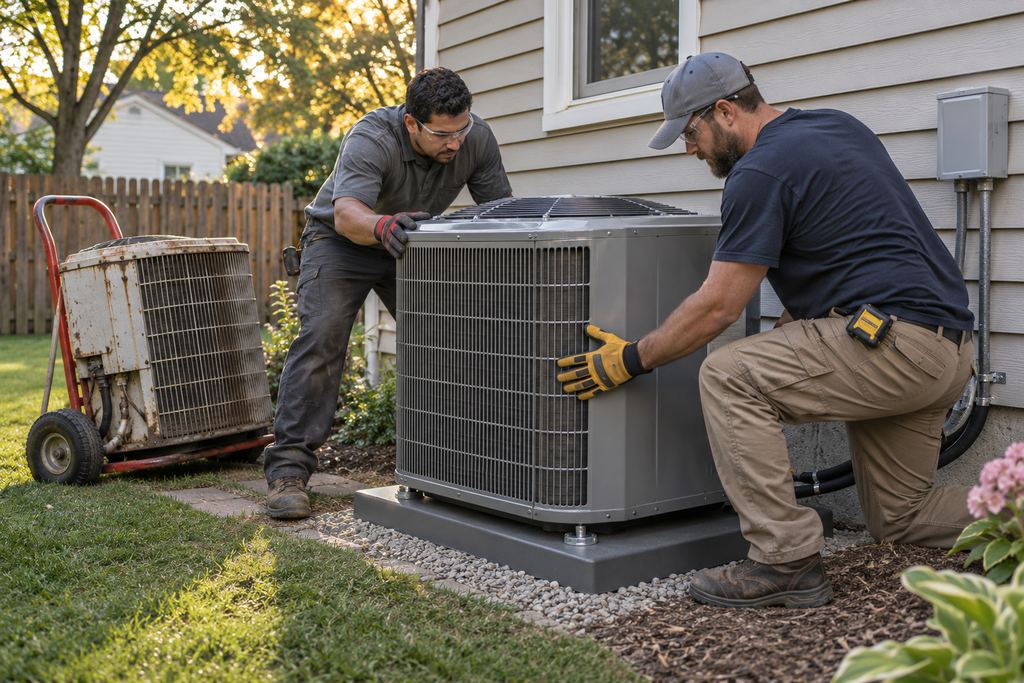
AC installation cost
Carrier's central air conditioner price guide (October 2026) puts central AC at $3,000 to $15,000 or more including installation. That range leaves out a furnace, an evaporator coil and ductwork changes. Carrier also estimates about 4 to 8 hours of labor to set an outdoor unit and 8 to 14 hours for a full system. HVAC Service Near Me does not set prices, so treat these as national planning figures; the written local quote is the real number.
Where your job lands depends on what already exists. Replacing central AC on sound ducts is the most predictable job. Adding central air to a forced-air furnace means a new coil, line set, pad, condensate drain and circuit. A house with no ducts needs new runs through attics, closets or soffits, the largest and least predictable scope; price a ductless layout on the mini-split installation cost section too.
A few items rarely appear in online calculators but do appear on invoices: a bigger circuit or panel upgrade in an older home, a condensate pump when the coil sits below any drain, a secondary drain pan and float switch for an attic install, new copper when the old lines are undersized or damaged for an A2L refrigerant, and separate electrical and mechanical permit fees in some towns. None of these is padding when it is needed, but each should be named on the bid, with a reason, before you sign.
What moves an installation quote
HVAC Service Near Me neither sells equipment nor prices jobs. The installer quotes after seeing the house, and these choices move the total.
Proper load math occasionally proves a smaller unit is enough, and smaller costs less.
Single-stage, two-stage and variable-speed compressors climb in price, and in comfort, roughly in that order.
Sound ducts get reused. Leaky or undersized runs mean sealing, resizing or new trunk lines.
Homes getting central air for the first time often need a dedicated circuit, an outdoor disconnect or more panel capacity.
A coil in a 130 degree attic or a condenser craned onto a roof takes more labor than equipment in a basement with the yard right outside.
New copper may be needed for a newer refrigerant or a new condenser spot, along with a fresh pad or wall brackets.
Permit fees and disposal of the old system ought to be separate lines you can compare.
Installers have more open dates in April or October than in a July heat wave, which leaves time to compare bids.
SEER2 minimums, refrigerants and rebates
Federal efficiency testing switched to SEER2 for equipment made from January 1, 2023, with minimums that change by region. In the northern region a split AC has to hit 13.4 SEER2 or better. Across the South and Southwest, splits below 45,000 Btu/h need 14.3 SEER2 at minimum. A legitimate bid only lists equipment legal to install where you live.
Refrigerant is shifting as well. Under the EPA AIM Act transition, manufacturers are moving from R-410A to lower-impact A2L blends such as R-454B and R-32. Ask which one your proposed system runs on, and whether the crew plans fresh copper or intends to reuse the old lines. On money: the federal 25C credit no longer applies to equipment placed in service after December 31, 2025, so look for state or utility offers through the ENERGY STAR rebate finder before signing anything.
Doing it yourself: where the line sits
Safe checks you can do
No tools beyond a flashlight. Turn the system off at the thermostat before opening any filter or access door.
- Window units, and most portables, are built for owner setup. Use the included bracket kit and follow the manual.
- Pick a thermostat wall that stays out of direct sun and away from supply vents.
- Prepare level, well-drained ground for the condenser and trim shrubs back.
- Pull a year of utility bills and jot down which rooms are uncomfortable before the walk-through.
Leave these to a licensed technician
These involve high voltage, refrigerant or sealed components. Refrigerant work requires EPA Section 608 certification.
- Any refrigerant connection. Brazing, evacuating and charging a split system is federally restricted to people holding EPA Section 608 certification.
- Line-voltage wiring, breakers and disconnects.
- Manual J, duct design and permit filings.
- Kits sold as DIY mini-splits still need electrical work, and some manufacturers void coverage without pro installation. Read the warranty before buying.
First-time install versus swapping an old system
When central air already exists and is giving out, the project is a replacement, and it begins with the fix-or-replace math on our AC replacement page. One shortcut installers like is the informal $5,000 rule, where age multiplied by the repair estimate above 5,000 is a cue to price new equipment too. Think of it as an informal screen that no DOE or industry standard sets; check the warranty, get a written diagnosis and compare the net repair quote with a real replacement quote before deciding. A genuine first install, in a house that has never had AC, is a bigger project: ducts get added or a ductless layout is chosen, and the panel may need more capacity. In both cases, insist on a fresh load calculation rather than copying the tonnage off the old nameplate.
Questions that reveal how an installer works
- Can I see the Manual J numbers?
A bid sized only from the old unit's label may simply repeat the original installer's guess. - What is the AHRI number for this pairing?
That certificate ties the outdoor unit and indoor coil together and confirms the efficiency listed in the bid. - Which items are in the price?
Line set, pad, disconnect, thermostat, duct changes, permit, haul-away and startup readings. - Whose license is on the job?
Search it on the state or local board's site, and request an insurance certificate. - How long is labor covered?
Manufacturer parts coverage usually hinges on registration. The workmanship warranty is the installer's own promise, so get its term on paper.
Living with the new system
Schedule service starting the first year; certain manufacturers request maintenance records if you ever file a warranty claim. Keep two feet or so of open space around the condenser and change filters on time. See AC maintenance for what a visit covers. If you plan to spread the payment, the AC financing page lists what to compare. Which installers you hear from depends on who accepts requests in your ZIP code.
How a service request works
HVAC Service Near Me is a referral service. We don't send our own technicians. We connect you with independent local contractors.
- Describe the job
Type your ZIP code, pick a service and add a line or two about the problem or project.
- We pass it on
An independent HVAC contractor or partner network that works in your area and does that kind of job receives it.
- You hear back
The contractor gets in touch to check the details and set a time to come out.
- The choice is yours
After a diagnosis the contractor gives you a quote. Price, timing and warranty are agreed directly between the two of you.
Frequently asked questions
How much does it cost to get an AC installed?
Carrier's October 2026 price guide puts central AC at $3,000 to $15,000 or more including installation, before any furnace, coil or duct changes. Tonnage, efficiency tier, duct repairs, new wiring and access decide where your home lands, so collect two or more written bids built on a load calculation. HVAC Service Near Me posts no prices of its own since it performs no work.
Why do two install quotes differ so much?
They usually describe different work. One may include a new coil, line set, duct sealing and the permit, the other only the outdoor unit. Line up the scopes before comparing totals.
Is replacing an AC cheaper than a first-time installation?
Usually, because ducts, wiring and the pad are already there. A first install has to add them. See AC replacement cost for the swap side.
What is the $5,000 rule?
A quick screen for aging systems: years of age times the repair quote. Over 5,000, a replacement bid is worth getting. It is folklore, not a standard, and it ignores comfort complaints and efficiency gains.
Can I install a central air conditioner myself?
In most places, no. The refrigerant connections require EPA Section 608 certification, and local codes usually call for permits on the mechanical and electrical work. Window units are the main exception.
How many days does installation take?
A straight swap of a split system commonly fits in one day. Ductwork, new circuits or a first-ever install can run several days, not counting permit and inspection scheduling.
Will an installer put in equipment I buy myself?
Some will. Many decline, and those that agree may limit their labor warranty. Settle this before you order a unit online or from a big-box store.
How do I know what size AC I need?
A load calculation that weighs insulation, glass area, sun exposure and local design temperatures gives the answer. Square-foot shortcuts tend to oversize, which brings short cycling and a clammy house.
Related guides and services
Start an installation request
Share a few details about the house, the current system if any, and what bothers you about it. HVAC Service Near Me forwards it to an independent installer covering your area, and they call to book a walk-through.
Tell us about the home and the system you have now, if any. A local installer follows up to schedule a site visit.
Please keep this page open.
- We pair the request with an independent contractor or partner network that works in your ZIP code.
- The contractor gets in touch to go over the details and agree on a visit.
- After checking the system they quote the job, and you choose whether to proceed.
Read how requests are handled.
Online requests are not connected to a contractor network yet. Nothing you typed was sent or saved. Please phone us instead, or try again later.
Call (888) 555-0199