AC Not Cooling: Find the Cause Before You Call
An AC not cooling the house is one of the most common summer calls, and a fair share of them end at the thermostat or the filter. The rest come down to the outdoor unit, refrigerant, ducts or a system that is simply too small for the heat.
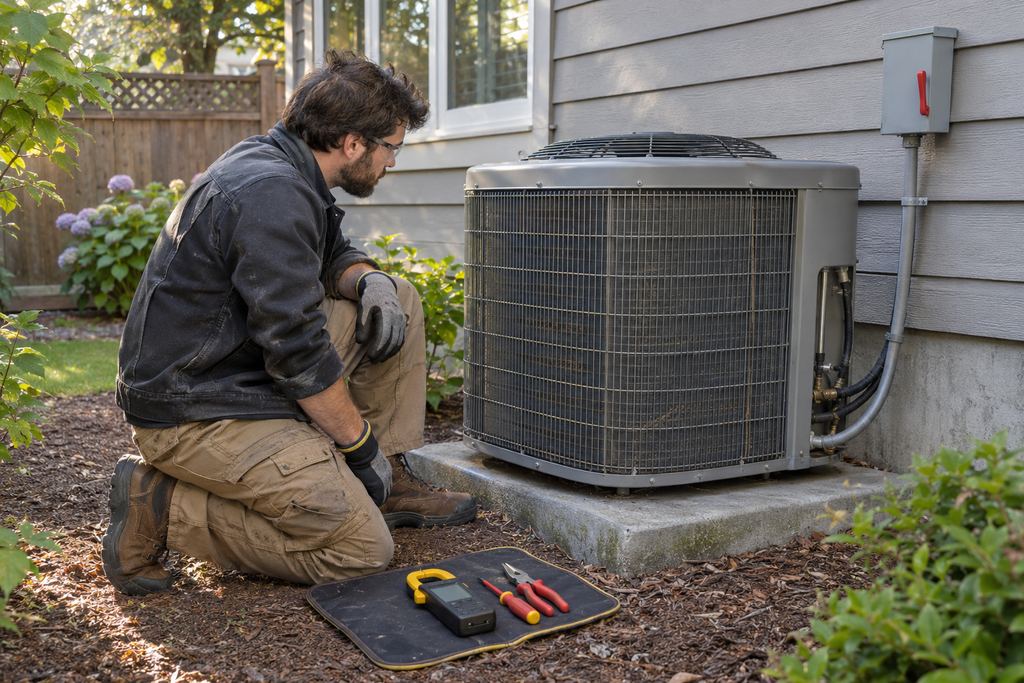
Check in this order: thermostat on Cool with the setpoint below room temperature, a clean filter, open registers and returns, the outdoor unit running with its fan spinning, and no ice on the copper lines. If the air handler fan runs but the condenser is silent or humming, or if the lines frost over, turn the system off and call a technician. If everything runs and the house still lags on the hottest afternoons, capacity, ducts or a dirty outdoor coil are the likely reasons.
Pin down your version of the problem
The way it fails narrows the causes.
- Fan running, air not cold at all: The compressor is not running. Usually power, a capacitor, contactor or the thermostat. See AC blowing warm air.
- Air is cool but the house never reaches the setpoint: Dirty filter or coils, low refrigerant, duct leaks, or a system undersized for the heat.
- Cooling fades in the afternoon: The outdoor coil cannot shed heat fast enough, often because it is dirty or the fan is weak.
- Some rooms cool, others do not: Duct problems, closed or blocked registers, or poor return air.
- Weak airflow and ice on lines: Airflow restriction or low refrigerant. See AC freezing up.
- Water by the indoor unit: A backed up drain or melting ice. See AC leaking water.
Fifteen minute homeowner pass
- Thermostat
Cool mode, Auto fan, and a target a few degrees under what the display reads now. A faded screen wants new batteries.
- Filter
Slide it out and hold it toward a window. Matted gray media goes in the trash.
- Registers and returns
Open every closed register and drag the sofa off the big return grille in the hallway.
- Breakers
Panels usually have two AC breakers, one indoor and one outdoor. One reset is fine; a repeat trip means hands off.
- Outdoor unit
With cooling called for, the top fan should whirl and the cabinet should hum steadily. Rake away clippings and leaves piled against the sides.
- Lines and coil
Feel the fat insulated pipe. Cold and sweating is good; white frost means cooling off, fan on, wait for the thaw.
Common causes, explained
Restricted airflow
A clogged filter, blocked returns or a dirty evaporator coil cut the air moving across the coil. The system runs longer, cools less, and may freeze.
Dirty outdoor coil or weak condenser fan
The condenser has to push heat outside. Dirt, cottonwood or grass clippings packed into the fins, or a fan that turns slowly, lower its ability to reject heat. Cooling fades as the afternoon gets hotter.
Electrical parts
A failed capacitor or contactor can stop the compressor or fan from starting while the indoor blower keeps running. Background is on capacitor replacement.
Low refrigerant
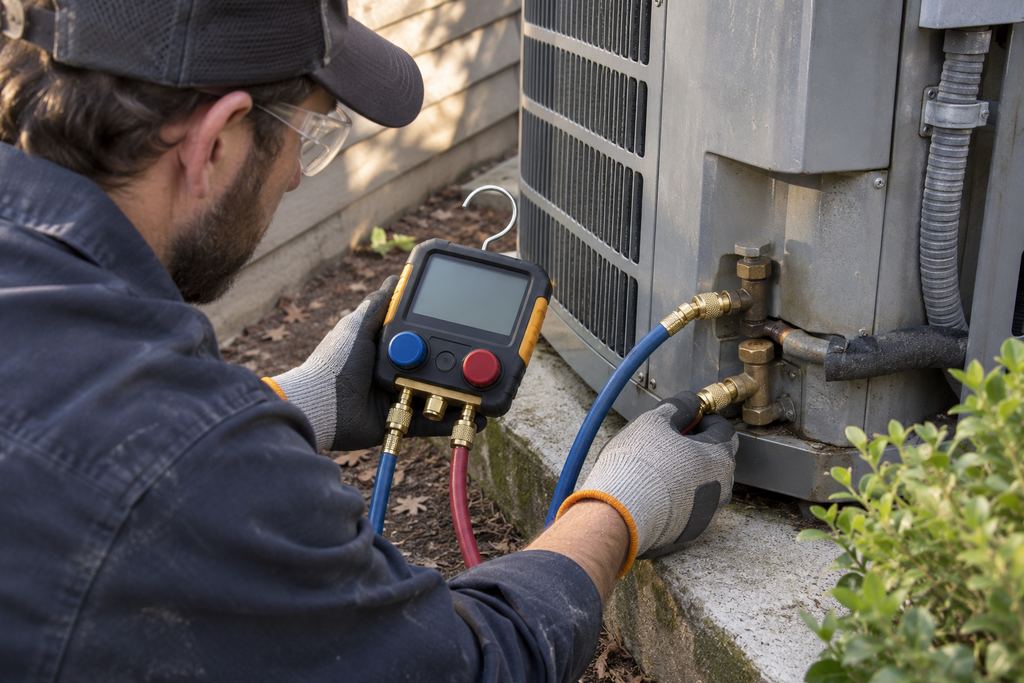
Air conditioners do not use up refrigerant, so a low charge means a leak. Signs include ice on the lines, hissing and long run times. Leak search and recharge require EPA Section 608 certification; see refrigerant leak repair. Systems built for R-22 are harder to service since production of R-22 ended in 2020; newer equipment uses R-410A or A2L refrigerants such as R-454B or R-32.
Duct leaks
Leaky or bare runs through a baking summer attic spill chilled air into the rafters instead of your bedrooms.
Thermostat problems
Sun on the wall, a lamp underneath or a loose wire at the subbase will fool the control into stopping early or not calling at all.
Not cooling by system type
Your checks vs. technician work
Safe checks you can do
No tools beyond a flashlight. Turn the system off at the thermostat before opening any filter or access door.
- Mode, setpoint and batteries.
- Replacing the filter.
- Opening registers and clearing returns.
- A single breaker reset.
- Raking debris off the condenser area.
- Thawing ice with fan only.
Leave these to a licensed technician
These involve high voltage, refrigerant or sealed components. Refrigerant work requires EPA Section 608 certification.
- Testing capacitors, contactors and motors.
- Measuring refrigerant pressures and repairing leaks.
- Cleaning evaporator and condenser coils thoroughly.
- Measuring airflow and static pressure, repairing ducts.
- Load calculation and sizing review.
Is the system big enough?
During a scorching week even well matched equipment can run without a break and still sit two or three degrees warm. That alone is not a fault. Residential systems are sized with a load calculation such as ACCA Manual J against a local design temperature, so a heat wave beyond that temperature can outpace them.
Different trouble: a system that used to keep up and no longer does, or one that was never able to cool upstairs rooms. That points to a loss of capacity, such as a refrigerant leak or dirty coils, or to duct and sizing problems worth a load calculation.
Repair or replace
Usually the answer is a part swap, a coil wash or a leak fix. Start pricing a new system if a compressor died on equipment past its prime, if the condenser still runs on R-22, or if this is the third paid visit in two summers. Get both numbers on paper and set them side by side. Price factors are on AC repair cost.
Frequently asked questions
Should I turn off my AC if it is not cooling?
Yes when the condenser sits silent, hums without spinning, or frost is building on the pipes; each of those can cook a compressor. Weak but steady cooling with dry lines can stay on while you line up a visit.
What is the quickest thing to try first?
Swap the filter. It takes two minutes, costs little, and rules out the simplest cause. Then confirm thermostat mode, look at both breakers, and walk outside to see whether the condenser fan turns.
I changed the setting and nothing happened outside. Broken?
Probably not. A protective timer on many thermostats and condenser boards holds the compressor for roughly three to five minutes after its last stop. Give it five before you worry.
Could it just be low on Freon?
Possibly. Frosted suction pipes, a faint hiss, endless run cycles and lukewarm supply air all fit. Freon is really a trade name; whatever your system holds, a low level means a leak, and only a Section 608 certified tech can measure it and seal it.
It runs from breakfast to bedtime and still falls behind. Why?
Grimy coils, a slow leak, leaky attic ducts or a unit that was undersized from day one. In a record heat wave a few degrees of lag is expected even from healthy equipment.
Does it help to set the thermostat very low?
No. A lower setpoint does not cool faster; it just makes the system run longer. Set it to the temperature you want.
Related guides and services
Book a diagnosis for the warm house
List the checks you already made and describe the condenser's behavior. An independent cooling company near you may call back to arrange a visit; timing depends on ZIP code and how busy the season is.
Tell us the thermostat setting, the indoor temperature and what the outdoor unit is doing. A local independent contractor can follow up.
Please keep this page open.
- We pair the request with an independent contractor or partner network that works in your ZIP code.
- The contractor gets in touch to go over the details and agree on a visit.
- After checking the system they quote the job, and you choose whether to proceed.
Read how requests are handled.
Online requests are not connected to a contractor network yet. Nothing you typed was sent or saved. Please phone us instead, or try again later.
Call (888) 555-0199