Window Air Conditioners: Choosing, Installing and Fixing One
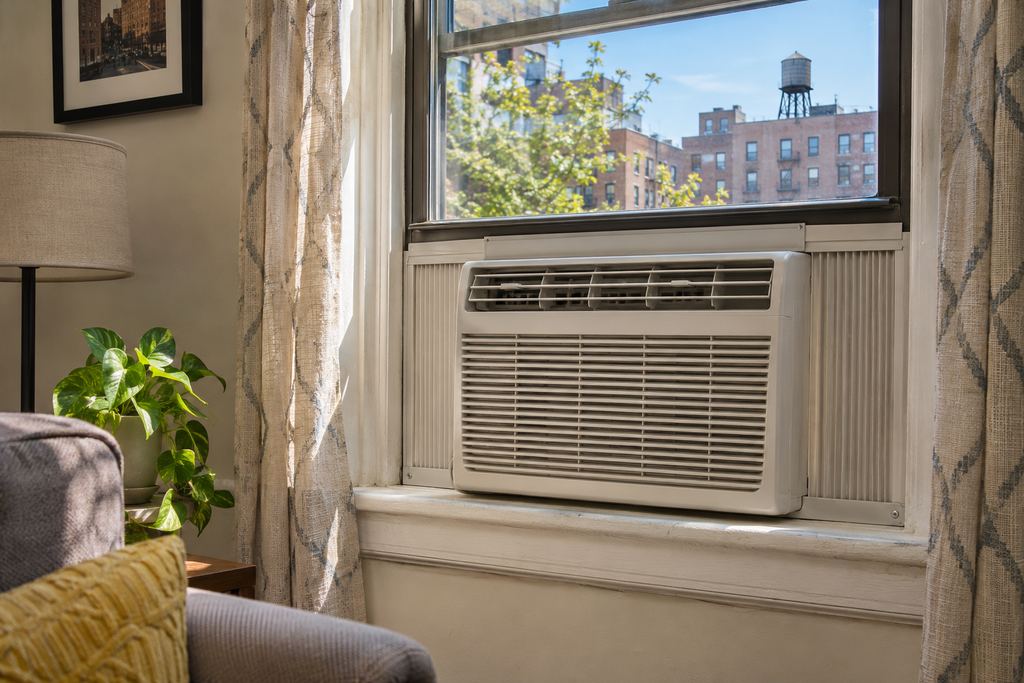
A window air conditioner packs a compressor, two coils and two fans into one box that sits in the lower half of a sash. Its cold face points into the room, the hot side hangs outdoors, and a standard 115 V outlet powers most models. Getting the size right and sealing the window properly matter more to comfort than any feature on the box.
Measure the room, use the ENERGY STAR chart for a starting capacity, and adjust for sun, people and kitchens. For an ordinary bedroom of 150 to 250 square feet, the chart lands on 6,000 Btu/h. Choose the window style that fits your sash (double-hung, slider or casement), mount it level so it drains, and run the cord directly to a grounded receptacle.
Matching capacity to the room
Grouped from the ENERGY STAR room air conditioner sizing chart, which assumes 8-foot ceilings. Pick the lower figure for the smaller end of each range.
| Typical space | Floor area (sq ft) | Btu/h range |
|---|---|---|
| Small bedroom or home office | 100 to 250 | 5,000 to 6,000 |
| Large bedroom | 250 to 350 | 7,000 to 8,000 |
| Living room or studio | 350 to 550 | 9,000 to 12,000 |
| Open living and dining area | 550 to 1,000 | 14,000 to 18,000 |
| Large open floor or loft | 1,000 to 1,500 | 21,000 to 24,000 |

Window unit styles
The right style depends on your window, how much light you want to keep and how much noise you will tolerate.
How to choose a good window air conditioner
There is no single right model, but a few specs separate the good ones. Start with the yellow EnergyGuide sticker and its CEER number: higher CEER, smaller electric bill for equal cooling. Units carrying the ENERGY STAR mark exceed the federal efficiency floor. Check the noise rating if the unit will be in a bedroom, and check the cord length and plug type, since larger units may need a 230 V outlet. Washable filters with an easy slide-out tray make upkeep more likely to happen.
Entry-level 5,000 Btu/h boxes can be found close to $100 at times, but prices change with the year, season and retailer. They are fine for a small room with limited sun. A room larger than the chart suggests will get a unit that runs nonstop and never quite catches up.
Running costs depend on how many rooms you cool. One efficient window unit in the room you use costs less to run than central air cooling the whole house. Cooling three or four rooms with window units can cost as much as a modern central system or a ductless mini split, with more noise.
Installing a window unit so it seals and drains
- Check the window and outlet
Measure the opening width and height, and confirm a grounded outlet within reach of the cord. Skip extension cords and power strips; owner manuals warn against both.
- Fit the support
Use the included brackets or a sill support rated for the unit's weight. Heavy units need two people.
- Set it level
ENERGY STAR says a level cabinet lets condensate drain the way the designers intended. Follow the manual; some models want a very slight tilt to the outside.
- Seal the gaps
According to ENERGY STAR, a sloppy install lets through about as much air as a hole of 6 square inches. Use the side panels, foam strips and weatherstripping to close every gap.
- Secure the sash
Lock the window down on the unit with the bracket or a block so it cannot be pushed up from outside.
Running it efficiently
- Setpoint: Pick the warmest setting you can live with.
- Heat sources: Move lamps and televisions away so their heat does not fool the sensor.
- Humid days: Use a low fan speed so the coil pulls more moisture.
- Filter: Rinse it about twice a month in midsummer.
- Off-season: Remove the unit or fit an insulated cover to stop drafts.
- Coil: Keep the outdoor fins clear of leaves and lint.
Troubleshooting a window AC safely
Safe checks you can do
No tools beyond a flashlight. Turn the system off at the thermostat before opening any filter or access door.
- Make sure the panel says Cool and the target temperature sits under the current room reading.
- Clean or replace the filter.
- If the plug head shows a tripped light, push its reset button one time.
- Look at the breaker panel door and reset that circuit one time if needed.
- Ice on the front coil: switch to Fan, wait for it to melt, and wash the filter before trying Cool.
- Water dripping indoors: check that the unit is level as the manual describes.
Leave these to a licensed technician
These involve high voltage, refrigerant or sealed components. Refrigerant work requires EPA Section 608 certification.
- Humming with no start, or air that never turns cold.
- Burning smells, scorched plugs or repeated trips.
- Opening the cabinet to reach the capacitor, wiring or fan motor.
- Refrigerant leaks or low charge; opening the sealed circuit is legal only for technicians holding EPA Section 608 certification.
Repair or replace?
Because most window units cost little to buy, paying for compressor or leak work rarely adds up. A failed fan motor, control board or drain problem can still justify a repair on a big or recent unit, especially a heat pump or inverter model. Once a repair quote nears half of what a new comparable unit costs, buying new usually comes out ahead. Common symptoms have their own guides: window AC freezing up and window AC leaking water. For a technician visit, see window AC repair.
How a service request works
- Describe the job
Type your ZIP code, pick a service and add a line or two about the problem or project.
- We pass it on
An independent HVAC contractor or partner network that works in your area and does that kind of job receives it.
- You hear back
The contractor gets in touch to check the details and set a time to come out.
- The choice is yours
After a diagnosis the contractor gives you a quote. Price, timing and warranty are agreed directly between the two of you.
Frequently asked questions
Which costs less to run: central air or a window unit?
For a single occupied room, the window unit usually wins because central air cools every room at once. Once you are running window units in most rooms, the savings mostly disappear and the noise adds up.
What is a good window AC to buy?
Look for the right capacity for your room, a high CEER rating, ENERGY STAR certification, a noise level you can live with and a cabinet shape that suits your sash. No single brand or model is right for every room.
Is 6,000 Btu/h enough for a bedroom?
Yes for most bedrooms. ENERGY STAR pairs 6,000 Btu/h with 150 to 250 square feet. Step up one size if afternoon sun pours in or two or more people sleep there.
Are there decent window units under $100?
Occasionally, in the smallest 5,000 Btu/h class, though pricing shifts by season and store. Keep those for spaces of roughly 150 square feet or less.
Is an extension cord safe for a window unit?
Manufacturers instruct against it. Plug the unit directly into a grounded outlet that matches its plug.
Related guides and services
Get help with a window unit
Describe the unit, the symptom and whether it needs fixing or fitting. HVAC Service Near Me routes the request to an independent contractor nearby when your ZIP code has coverage.
Tell us the unit size, the problem and whether you need repair or installation.
Please keep this page open.
- We pair the request with an independent contractor or partner network that works in your ZIP code.
- The contractor gets in touch to go over the details and agree on a visit.
- After checking the system they quote the job, and you choose whether to proceed.
Read how requests are handled.
Online requests are not connected to a contractor network yet. Nothing you typed was sent or saved. Please phone us instead, or try again later.
Call (888) 555-0199