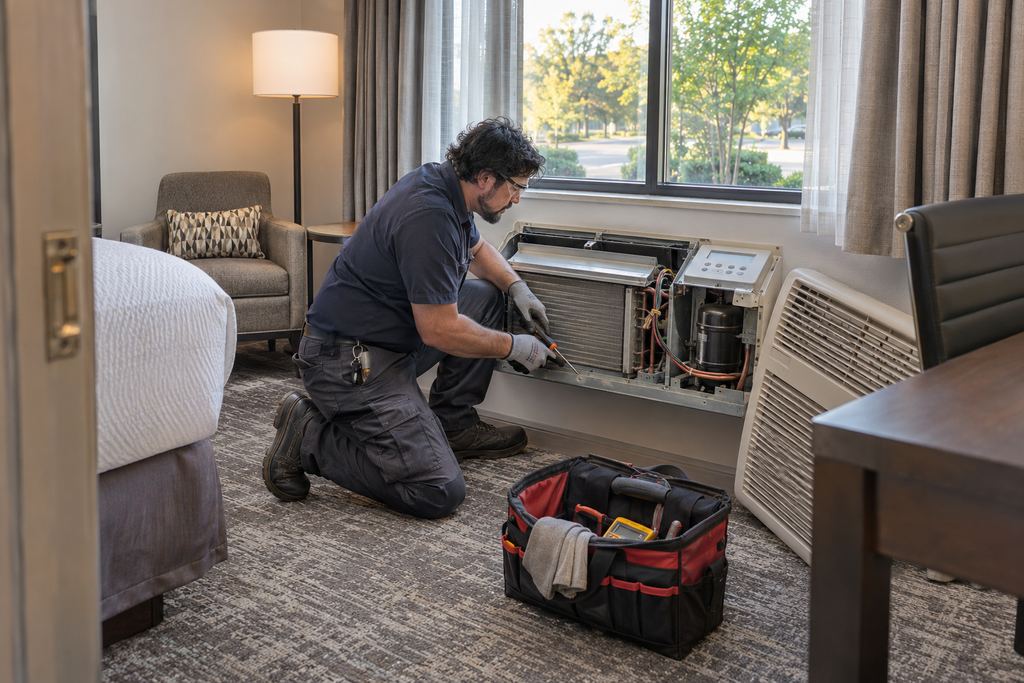
Through the Wall Air Conditioners: A Practical Owner's Guide
A through the wall air conditioner is a room unit built to live permanently in an exterior wall. It slides into a metal sleeve, breathes only through its back grille, and leaves the window free. Apartments, older row houses and additions with no ductwork use them where a window unit would block light or a fire escape.
Wall units cool one room and some add heat. They look like window units, but their cabinet has no side vents, so all outdoor air enters and leaves through the rear. That is why a window unit should never be pushed into a wall sleeve. Size the unit from room area with adjustments for sun, people and kitchens, and match the new chassis to the existing sleeve.
Wall unit, window unit or PTAC?
| Through the wall | Window AC | PTAC | |
|---|---|---|---|
| Venting | Rear grille only | Rear and side louvers | Rear grille only |
| Opening | Sleeve in wall | Window sash | Larger wall sleeve, usually under a window |
| Power | Mostly 115 V; larger ones 230 V | Mostly 115 V | Usually 208/230 V or 265 V |
| Heat | Cool-only or with heat strip or heat pump | Mostly cool-only | Nearly always offers heat |
| Common in | Apartments, condos, homes | Homes and rentals | Hotels, senior living, apartments |
The sleeve decides what you can buy
The sleeve is a metal or composite box set into the wall, with the exterior grille on the outside face. Most of the time you are replacing a chassis that already sits in a sleeve, and that sleeve controls the choice. Many current wall units fit openings roughly 24 to 27 inches wide, but each brand publishes its own dimensions and some older sleeves fit nothing currently made.
Measure the inside of the sleeve (width, height and depth), note the brand stamped on it if any, and check how the rear grille is attached. Some manufacturers sell their units without a sleeve so you can reuse the old one, and others require their own. If the old sleeve is rusted, bent or out of level, replacing it is the better long-term fix, and that usually means opening the wall around it.
Cutting a brand-new hole in an exterior wall is a structural job. A contractor has to frame the opening with a header, keep the slope right for drainage and flash the exterior so rain stays out. Brick and block walls add masonry work. A permit may apply.
Sizing by room area
The ENERGY STAR room air conditioner chart assumes an 8-foot ceiling.
| Room size (sq ft) | Capacity (Btu/h) |
|---|---|
| 300 to 350 | 8,000 |
| 350 to 400 | 9,000 |
| 400 to 450 | 10,000 |
| 450 to 550 | 12,000 |
| 550 to 700 | 14,000 |
Adjust the number before you buy
Add about 10 percent if the room gets strong sun most of the day. Take 10 percent off if it is heavily shaded.
Add 600 Btu/h for every person beyond two who regularly uses the room.
If the unit serves a kitchen, add 4,000 Btu/h for cooking heat.
A wall unit throws air in one direction. A long or L-shaped room may stay warm at the far end even when the math says the size is right.
Larger units and heat models may need a 230 V circuit. Match the plug on the new unit to the outlet; do not use an adapter or extension cord.
Replacing a wall unit, start to finish
- Read the old label
Find the Btu/h rating, voltage, amperage and whether it heats. Photograph the plug.
- Measure the sleeve
Inside dimensions at front and back. Compare with the manufacturer's sleeve chart.
- Pull the old chassis
Units are heavy and awkward. Two people, or a contractor, should lift it out.
- Clean and inspect the sleeve
Clear debris, check for rust and confirm a slight outward slope so condensate drains outside.
- Fit and seal
Slide in the new chassis, install the rear grille if needed, and seal the gap around the front with the supplied gasket or trim.
- Test
Run cooling for a while and watch for water on the floor or rattles from the cabinet.
Seasonal care
A few minutes a month keeps a wall unit quieter and colder.
- Filter: Rinse or vacuum it every two to four weeks in summer.
- Front grille: Keep furniture and curtains clear so air can return.
- Outdoor face: Check from outside for leaves, nests or a bent grille.
- Drain: Water dripping indoors usually means the sleeve has lost its outward tilt or the base is clogged.
- Winter: For cool-only units, fit an insulated cover inside to stop drafts.
- Coil cleaning: Every year or two, have the chassis pulled and the coils cleaned.
Cost, lifespan and repair versus replace
The unit price depends on capacity, heat options and efficiency rating (room units carry a CEER figure on the EnergyGuide label). The installed price depends mostly on the wall: dropping a new chassis into a good sleeve is quick, while a new opening through brick is a much larger job. Ask each contractor for a written, itemized quote that separates the unit, the sleeve, wall work, electrical and haul-away.
Owners often report wall units lasting around a decade, though that is a rough expectation rather than a rated figure. Once an older unit needs a compressor or a sealed-system repair, replacement is usually the cheaper path. If the room needs quieter or more efficient cooling, ask about a wall-mounted ductless unit, which uses only a small hole for the line set. For full jobs, see through-the-wall AC installation.
When hiring, check that the contractor holds the trade license your state requires, carries liability insurance, and will pull any permit the job needs.
Frequently asked questions
What is the difference between a window AC and a through the wall AC?
Window units pull outdoor air through side louvers, so those sides must be outdoors. Wall units vent only from the back and are built to sit flush in a sleeve. A window unit placed in a wall sleeve will overheat. More detail is in the window air conditioner guide, and the larger commercial cousin is covered in the PTAC unit guide.
Are wall units quieter than window units?
They are about the same, because both have the compressor inside the cabinet in the room. A solid sleeve and a good gasket cut rattle and outside noise. A ductless mini-split is far quieter indoors.
How much does it cost to install a through the wall AC?
It depends on whether a sleeve exists, the wall material, electrical work and the unit itself. Get written quotes; a chassis swap and a new masonry opening are very different jobs.
How long should a through the wall air conditioner last?
Around ten years is a common owner expectation. Filter care, coil cleaning and a properly sloped sleeve all help it last.
Can I put a window unit in a wall sleeve?
No. It needs air through its side vents, which a sleeve blocks. The compressor will run hot and the unit can fail early.
Related guides and services
Get help with a wall unit
Tell us whether a sleeve is already in place, the room size and the wall material. HVAC Service Near Me passes the details to an independent local contractor where one serves your ZIP code.
Say whether there is an existing sleeve, the room size and what you want the unit to do.
Please keep this page open.
- We pair the request with an independent contractor or partner network that works in your ZIP code.
- The contractor gets in touch to go over the details and agree on a visit.
- After checking the system they quote the job, and you choose whether to proceed.
Read how requests are handled.
Online requests are not connected to a contractor network yet. Nothing you typed was sent or saved. Please phone us instead, or try again later.
Call (888) 555-0199