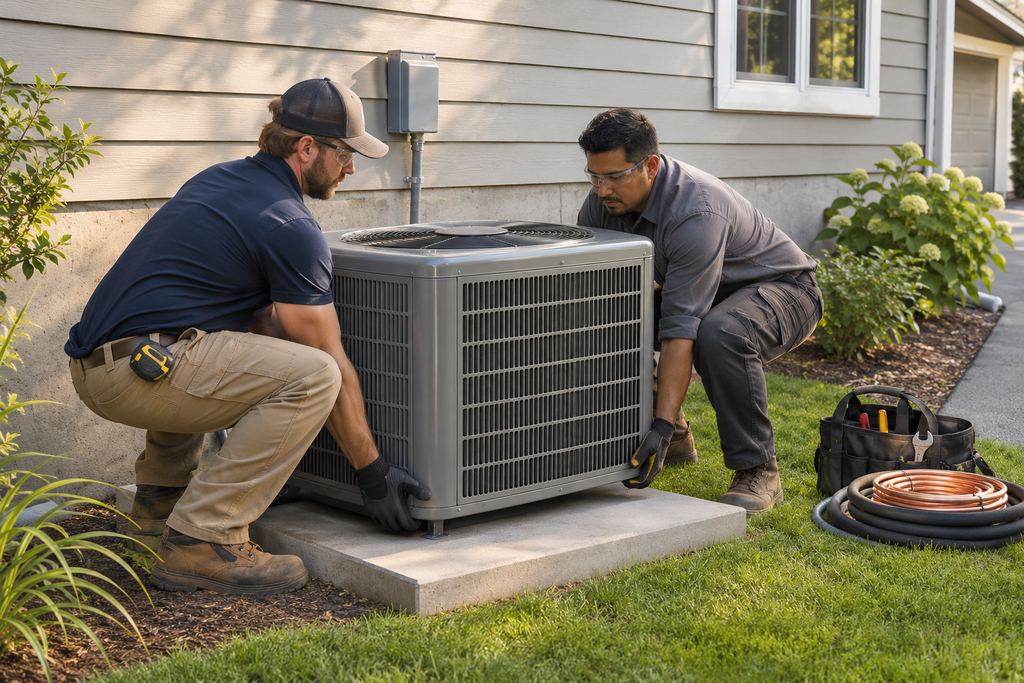
Central Air Conditioning: Parts, Types, Sizing and Quotes
Central air conditioning cools the whole house from one system: a fan pushes air across a cold coil and a network of ducts delivers it to every room. If your home already has ducts for a furnace, adding or replacing central air is usually the most direct way to cool all of it.
Central air is any ducted system that conditions the entire home from one indoor coil and blower. The most common layout is a split system with a condenser outside and a coil on the furnace or air handler inside. Cost depends mostly on whether ducts already exist, the capacity the load calculation calls for and the efficiency tier you choose, so get written quotes from more than one contractor.
The difference between an air conditioner and central air
Every air conditioner removes heat and moisture from indoor air and moves that heat outside. The word central describes how the cool air is distributed. A window unit or a single wall head cools the room it sits in. A central system pulls air from return grilles around the house, cools it in one place and sends it back through supply registers in each room.
That shared duct network is both the strength and the weak point. One thermostat runs everything, the equipment stays out of sight and filtration happens in one spot. Leaky or undersized ducts, though, waste a share of what the equipment produces. Before you replace the outdoor unit, ask the contractor to look at the ducts as well; our page on air duct sealing explains what that check involves.
Where the parts of a split central system sit
Four ways to get central cooling
They all use ducts. They differ in where the hardware lives and how the house is heated.
Sizing comes from a load calculation, not square footage
Capacity is measured in tons, and one ton equals 12,000 Btu per hour of heat removal. Rules of thumb that assign a ton per so many square feet ignore insulation, window area, orientation, duct location and local design temperatures. Two 2,000 square foot houses on the same street can need different equipment.
The industry method is ACCA Manual J for the heat load, Manual S for picking equipment that matches it and Manual D for the ducts. Ask each bidder whether they ran a Manual J and request a copy. An oversized unit cools the air quickly and shuts off before it has pulled much moisture out, so the house feels damp and the compressor cycles more than it should. An undersized one runs nonstop on the hottest afternoons and may still fall behind.
Efficiency ratings and the federal minimum
Since January 1, 2023, central systems are rated in SEER2, a figure from an updated DOE test procedure that assumes more realistic duct pressure than the old SEER rating. A split AC sold for the northern states must reach at least 13.4 SEER2. In the South and Southwest, split ACs under 45,000 Btu per hour must reach 14.3 SEER2.
Higher ratings cost more up front and pay back faster where the cooling season is long. A rating only applies to the matched outdoor unit, coil and sometimes furnace listed together in the AHRI directory, so ask for the AHRI reference number on the quote. Federal, state and utility incentives change often; check current offers with the ENERGY STAR rebate finder rather than counting on any one program.
Central air or a ductless system?
A mini split is also a split system, just without the duct network. This is how the two compare in a typical house.
| Factor | Central ducted system | Ductless mini split |
|---|---|---|
| Good match | Homes that already have ducts in good shape | Homes without ducts, additions, rooms that run hot |
| Control | One thermostat per system or zone | A remote or thermostat for each head |
| What you see indoors | Supply and return grilles | A head on the wall, ceiling or floor |
| Main efficiency risk | Duct leakage in attics and crawlspaces | Heads oversized for small rooms |
| Learn more | Central AC installation | Ductless mini split guide |
What moves the price of a central air project
Published averages hide wide swings. These items explain most of the difference between two quotes.
Reusing sound ducts is far cheaper than adding a new trunk and branches through finished walls.
Larger tonnage and higher SEER2 models cost more. Two-stage and variable-speed units sit at the top.
A new condenser may need a dedicated circuit, a disconnect near the unit or panel upgrades.
A new coil must match the outdoor unit. An old furnace with a weak blower may need replacing too.
Many jurisdictions require a mechanical permit. Tight attics and rooftop work add labor.
Brands, refrigerant and the installer
Carrier, Trane, Lennox, Rheem, Goodman and many other manufacturers sell central systems in several efficiency tiers. Inside a tier, the quality of the installation usually matters more than the badge: correct charge, clean brazing, a deep vacuum, sealed duct connections and proper airflow. Ask how the contractor verifies each of those.
New equipment uses R-410A or one of the newer A2L refrigerants such as R-454B or R-32 under the EPA technology transitions rule. Anyone who opens the refrigerant circuit must hold EPA Section 608 certification. If your current system still runs on R-22, plan on replacing both the outdoor unit and the indoor coil rather than mixing old and new parts. The AC replacement cost section covers that decision in more detail.
Questions to put to every bidder
- Did you run a load calculation?
Ask for the Manual J summary and the tonnage it supports. - What is the AHRI number for this combination?
It confirms the SEER2 rating for the exact pairing quoted. - What happens to the ducts?
Find out whether they will be tested, sealed, resized or left alone. - Who pulls the permit?
The contractor normally does; the inspection protects you as well. - How are warranty registration and labor coverage handled?
Manufacturer parts terms often depend on registration. Labor coverage is set by the installer.
Frequently asked questions
What should I expect to pay for new central air?
There is no honest single number. A replacement on existing ducts costs much less than a first-time install that needs ductwork, and efficiency tier and electrical work add to either. Collect two or three itemized quotes and compare them line by line; our central AC installation cost section lists the factors.
How do I estimate central AC for a 2,000 square foot house?
Use square footage only as a rough starting point. The tonnage a bidder proposes should come from a Manual J load calculation for your house, and the final price then depends on ducts, efficiency and access.
Is central AC or a split AC better?
Most central air is a split system, so the real comparison is ducted versus ductless. Ducted central air suits homes with good existing ducts. Ductless heads suit homes without ducts or rooms the central system never reaches well.
Can I add central air to a house that has radiators?
Yes, but ducts must be added, often through closets, attics or high-velocity small tubing. Many owners of such homes compare that cost with a multi-head ductless system.
How long does a central system last?
Lifespans vary widely with climate, run hours and maintenance. Annual service and clean filters help, and the window air conditioner guide covers a stopgap if one room needs cooling while you decide.
Related guides and services
Get quotes on central air
Say whether the house has ducts and how it is heated today. A local contractor can measure the load and quote the equipment that fits.
Tell us whether the home already has ducts and what heats it now. Availability varies by ZIP code and season.
Please keep this page open.
- We pair the request with an independent contractor or partner network that works in your ZIP code.
- The contractor gets in touch to go over the details and agree on a visit.
- After checking the system they quote the job, and you choose whether to proceed.
Read how requests are handled.
Online requests are not connected to a contractor network yet. Nothing you typed was sent or saved. Please phone us instead, or try again later.
Call (888) 555-0199