How a Split System Air Conditioner Works and What It Costs
A split system air conditioner puts the noisy, heat-rejecting parts outside and the air-moving parts inside, joined by a pair of copper tubes and a thin low-voltage cable. It is the standard setup in most American houses with central air, and the same idea scaled down is what a ductless mini split uses.
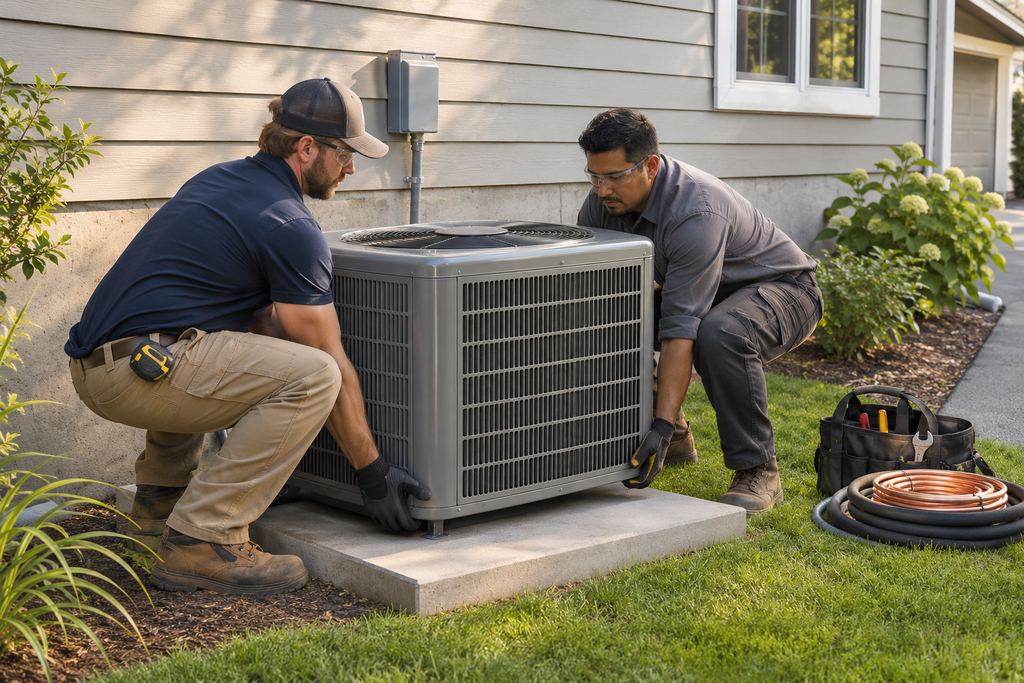
Outdoor condenser and indoor coil linked by a line set
The two halves and what each does
Outside, the condenser holds the compressor, a large coil and a fan on top. The compressor squeezes refrigerant vapor into a hot, high-pressure gas, and the coil sheds that heat into the yard. Indoors, the evaporator coil rides above the furnace or lives in an air handler cabinet. Liquid refrigerant expands in that coil, turns cold, and the blower pushes house air across it and out through the ducts.
Splitting the system this way keeps compressor noise outdoors and lets the indoor coil share the furnace blower and ductwork. It also means the two halves must be matched. A new outdoor unit paired with an old indoor coil can fall short of the efficiency printed on the brochure, and if the refrigerant types differ the pairing will not work at all. AHRI publishes certified ratings for matched combinations, which is the place to confirm a quoted pairing.
Split system types
Split versus packaged equipment
If your home has no room indoors for a coil and air handler, a packaged unit may be the alternative.
| Feature | Split system | Packaged unit |
|---|---|---|
| Where the parts are | Condenser outside, coil and blower inside | Everything in one outdoor or rooftop cabinet |
| Indoor space needed | Closet, basement, attic or furnace | Only ducts |
| Typical homes | Most houses with basements or attics | Manufactured housing, slab houses, many Arizona homes |
| More information | This page | Packaged air conditioner guide |
Efficiency ratings and refrigerant
The efficiency label changed on January 1, 2023, when SEER2 replaced SEER. Its test assumes higher duct resistance, closer to what a real house has. Federal rules split the country into regions: a split AC sold for a northern state needs 13.4 SEER2 or more, while one under 45,000 Btu/h installed in the Southeast or Southwest needs 14.3 SEER2 or more. Higher ratings cut running cost, though the gain depends on how many hours you cool each year.
The refrigerant inside has shifted as well. Manufacturers stopped producing R-22 in 2020, R-410A filled most systems after that, and the EPA rule on technology transitions under the AIM Act pushes newly built equipment toward mildly flammable A2L blends, R-454B and R-32 being the two you will see on spec sheets. Opening that sealed loop is restricted to technicians holding EPA Section 608 certification.
Why two quotes for the same house differ
HVAC Service Near Me does not price jobs. Each contractor quotes the house in front of them, and the items below account for most of the gap.
The right tonnage comes out of a Manual J calculation. Copying the old unit's size repeats any past mistake.
A one-speed compressor is the budget option. Units that can slow down carry a higher price and hold temperature more steadily.
Replacing only the condenser is cheaper but often leaves a mismatched system. Many quotes include a new coil.
New equipment cannot fix ducts that leak into the attic or choke airflow; repairs there sometimes come first.
An old line set may be reused after flushing, or replaced if it is damaged, too small or used for a different refrigerant.
Most cities want a mechanical permit. The installer also has to recover the old charge before scrapping the old condenser.
Brands and how to compare them
Many manufacturers build split systems, and several familiar names share factories and parts. Rather than chase a badge, compare the matched AHRI rating for the precise condenser and coil model numbers, the parts and labor warranty and what registration it requires, and whether the installer stocks parts for that line. Local contractors who service several brands can explain which ones they see failing and which they can support. No manufacturer pays for or endorses this page.
Before collecting bids, skim what goes into AC installation cost so you can spot missing line items. Homeowners weighing ducted cooling for the first time may want the central air conditioning overview too.
Frequently asked questions
Is a split system the same as central air?
Usually, yes. The typical American central air setup is split, with ducts carrying air from the indoor coil. Packaged cabinets are the main exception.
Is swapping just the condenser an option?
It can be, when the existing coil is sound and built for the same refrigerant. Otherwise efficiency and warranty may suffer. Ask the contractor to show the AHRI certificate for the exact pair.
What SEER2 rating should I look for?
Start from the legal floor for your region (13.4 in northern states, 14.3 for most southern split units) and pay for more only if long cooling seasons will earn it back.
Are there tax credits for a new split system?
Not at the federal level for new installs: the 25C credit stopped applying to equipment placed in service after December 31, 2025. Utilities and states still run programs, and the ENERGY STAR rebate finder lists them by ZIP code.
Related guides and services
Compare split system quotes
Give the square footage, say whether ducts exist and roughly how old the current equipment is. We route it to an independent contractor near you when one covers the ZIP code.
Tell us the home size, whether you have ducts and what equipment you have now.
Please keep this page open.
- We pair the request with an independent contractor or partner network that works in your ZIP code.
- The contractor gets in touch to go over the details and agree on a visit.
- After checking the system they quote the job, and you choose whether to proceed.
Read how requests are handled.
Online requests are not connected to a contractor network yet. Nothing you typed was sent or saved. Please phone us instead, or try again later.
Call (888) 555-0199