Packaged Air Conditioners: How Package Units Compare
A packaged air conditioner, often called a package unit, puts the compressor, both coils and the blower in a single cabinet outside the building. Supply and return ducts run from that cabinet through a wall, the foundation or the roof.
Package units are common on homes built on slabs or with crawlspaces and no room for an indoor air handler, on mobile and manufactured homes, and on the roofs of shops and offices. Because nothing sits inside, they free up a closet and keep service work outdoors. The tradeoff is that every component faces the weather.
Four kinds of package unit
They look similar from the street. The nameplate tells you which one you have.
Package unit or split system
| Factor | Packaged unit | Split system |
|---|---|---|
| Where the parts are | One outdoor cabinet | Condenser outside, coil and furnace or air handler inside |
| Indoor space used | None beyond ducts | A closet, attic, basement or garage |
| Refrigerant lines | Sealed inside the cabinet | Run between indoor and outdoor units |
| Exposure | All parts outdoors | Only the condenser outdoors |
| More detail | This page | Split system guide |
Efficiency rules for single-package equipment
Federal minimum efficiency standards for single-package equipment are set separately from the standards for split systems, so a package unit and a split AC sold in the same state may face different floors. Ratings appear on the yellow EnergyGuide label and in the AHRI directory, which lists the certified performance of each model. Ask for the AHRI reference on any replacement quote, and check current federal, state and utility incentives through the ENERGY STAR rebate finder.
Residential and commercial package units
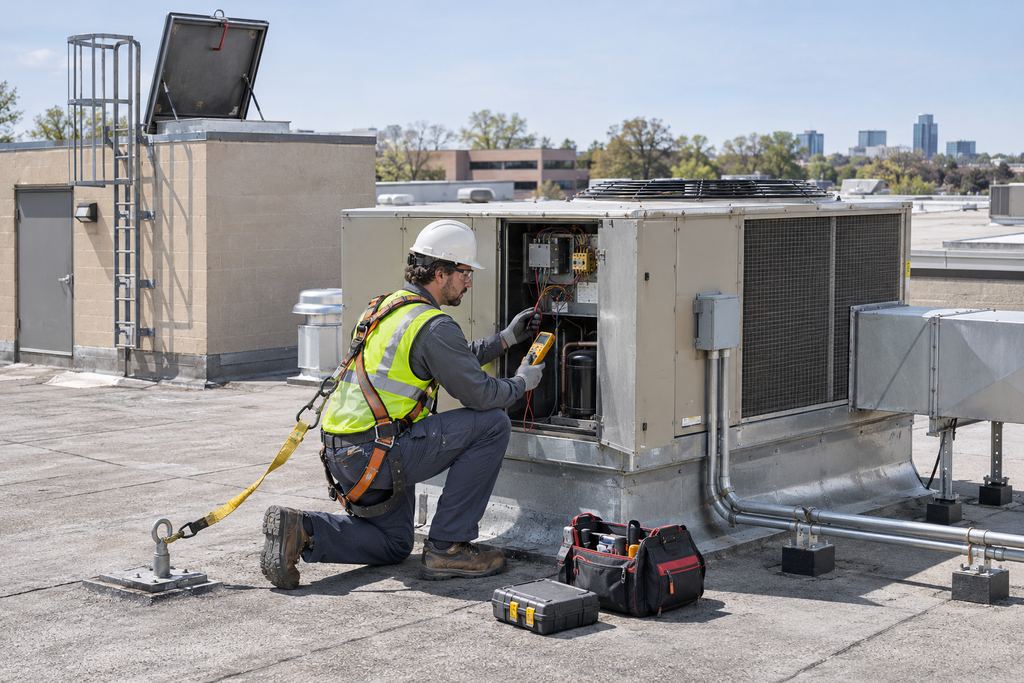
A home unit usually sits on a ground pad, runs on single-phase power and serves one thermostat. Commercial package units, usually called rooftop units, often run on three-phase power, may include an economizer that brings in cool outside air when conditions allow, and connect to building controls. Our rooftop AC unit guide covers those in detail, and rooftop unit maintenance explains the service schedule.
Wear points to watch on a package unit
- Cabinet and panels: Rust, missing screws and loose access panels let water and pests in.
- Duct connections: The joint where ducts meet the cabinet can separate and leak air outside.
- Condensate drain: Algae and debris block the drain trap, and water can back up into the cabinet.
- Coils: Grass clippings, cottonwood and dust cake the outdoor coil faster on ground units.
What decides a replacement price
A gas pack costs more than a cooling-only packaged AC of the same tonnage.
Higher-rated models cost more and save more in long cooling seasons.
Roof units may need a crane, which adds a fixed cost to the job.
A new unit with a different footprint may need an adapter curb or new transitions.
Old units must have refrigerant recovered by an EPA Section 608 certified technician before disposal.
Planning a replacement
Replacement often comes up after a compressor failure, a badly corroded coil or, on gas packs, a cracked heat exchanger. Get at least two written quotes that name the model, tonnage and AHRI rating, and ask whether the existing duct connections and pad or curb can be reused. The AC replacement page explains the visit, and AC replacement cost lists the price factors in more depth. Brands such as Carrier, Trane, Goodman, Rheem and Lennox all build package units; the installer's experience with the model matters as much as the badge.
Frequently asked questions
What is a package unit in HVAC?
It is a self-contained system with all the cooling, and often heating, parts in one outdoor cabinet connected to the home's ducts.
Is a portable air conditioner the same as a packaged unit?
No. A portable air conditioner is a single-room appliance on wheels that vents through a window. A packaged unit is permanent equipment that cools a whole building through ducts. Portables cost far less to buy and far more per room to run.
How do commercial and residential AC units differ?
Commercial units tend to be larger, run on three-phase power, sit on roofs and carry features such as economizers and building control connections. Residential units are smaller and simpler.
How much should a new package unit cost?
The price depends on type, tonnage, efficiency, lifting and duct adapters. Ask for itemized quotes rather than relying on a national average, and compare them against the factors above. The central air guide also covers sizing.
Related guides and services
Get quotes on a package unit
Tell us whether the unit sits on the ground or the roof and how it heats. A local contractor can follow up where available.
Tell us whether the unit sits on the ground or the roof and how it heats. Availability varies by ZIP code.
Please keep this page open.
- We pair the request with an independent contractor or partner network that works in your ZIP code.
- The contractor gets in touch to go over the details and agree on a visit.
- After checking the system they quote the job, and you choose whether to proceed.
Read how requests are handled.
Online requests are not connected to a contractor network yet. Nothing you typed was sent or saved. Please phone us instead, or try again later.
Call (888) 555-0199