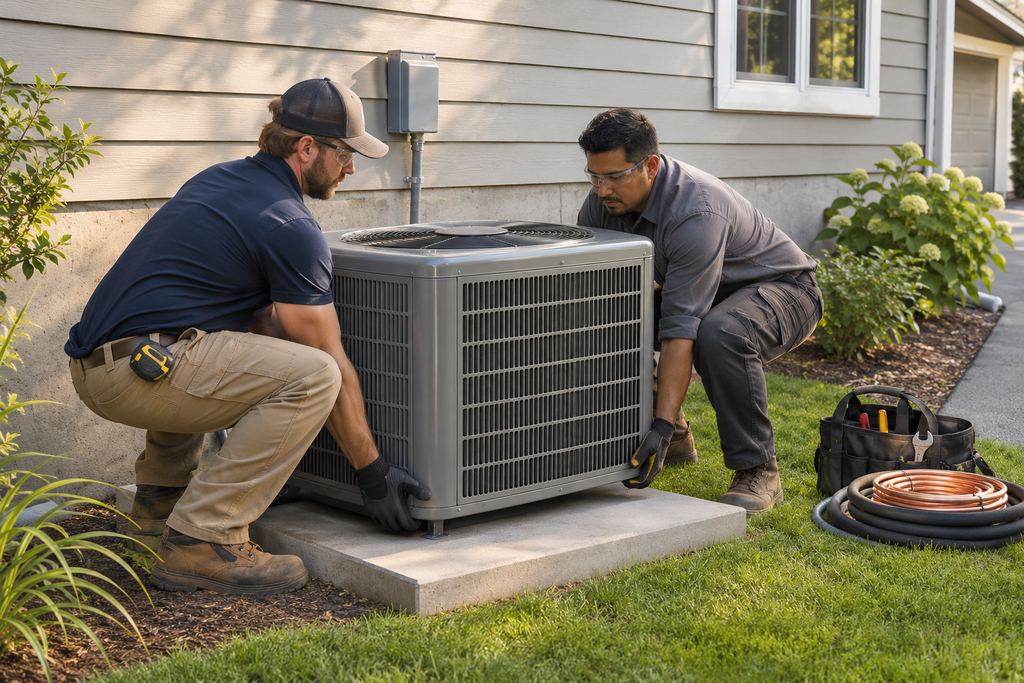
Central Air Conditioner Installation for Your Home
A central air conditioner installation pairs an outdoor condenser with an indoor coil and blower, joined by copper refrigerant lines and fed by your ducts. Tell us about the house, and HVAC Service Near Me passes the request to an independent local installer who can come out and quote it.
- Sizing from a room-by-room load calculation, not a guess
- Duct, electrical and permit scope written into the quote
- Startup readings you can keep for the warranty file
Let us know if the house has ducts and a furnace today. A local installer follows up to arrange a visit.
Please keep this page open.
- We pair the request with an independent contractor or partner network that works in your ZIP code.
- The contractor gets in touch to go over the details and agree on a visit.
- After checking the system they quote the job, and you choose whether to proceed.
Read how requests are handled.
Online requests are not connected to a contractor network yet. Nothing you typed was sent or saved. Please phone us instead, or try again later.
Call (888) 555-0199What the job really involves
Most people picture the outdoor unit, but much of the labor happens indoors. The installer has to set a coil where the blower can push air through it, route a line set and a condensate drain, run low-voltage wiring to the thermostat and bring a dedicated 240-volt circuit out to the condenser. If the home already has a furnace and ducts, the work is usually finished in a day or two. A house with no ducts at all is a larger remodel: an air handler goes in an attic, closet or basement, and a crew builds the supply and return system around it.
Before you commit, read the cost section further down, and look at the larger central air section if you are still choosing between system types.
Setups an installer may propose
What gets settled at the site visit
A sound quote comes after someone walks the house. Expect these questions and measurements.
- Cooling load: Window sizes, insulation, ceiling heights and orientation go into an ACCA Manual J calculation, which sets the tonnage.
- Duct condition: Size of the returns, leaks at joints and whether ducts in a hot attic are insulated. ENERGY STAR recommends sealing and insulating leaky ducts.
- Electrical capacity: Free space in the panel, the breaker size the new unit calls for and the route for the outdoor disconnect.
- Outdoor location: Clearance around the condenser, distance to the coil, noise near bedrooms or a neighbor's window.
- Drainage: Where the coil's condensate will drain, and whether a secondary pan or float switch is needed above a finished ceiling.
How the outdoor and indoor halves connect
Install day, in order
- Protect and remove
Floors are covered and any old unit is disconnected. Refrigerant in old equipment must be recovered by an EPA Section 608 certified technician.
- Set the equipment
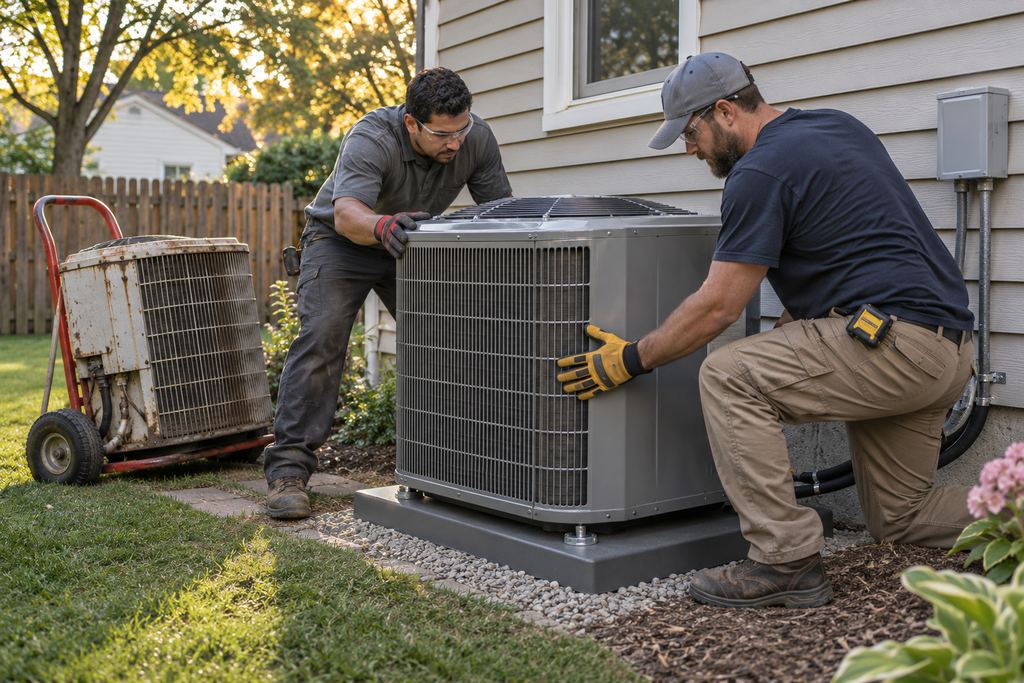
The coil goes on the furnace or air handler, and the condenser on a level pad or brackets.
- Connect lines and drain
The copper line set is brazed or flared, then the drain line is run with a trap where the manual calls for one.
- Pressure test and evacuate
The circuit is pressurized with nitrogen to find leaks, then pulled into a deep vacuum to remove moisture before refrigerant is released.
- Wire and start
High and low voltage are connected, the system is started, and the technician checks the charge, airflow and temperature drop across the coil.
- Inspection
Where a permit was pulled, a city or county inspector signs off on the work.
Replacing a system versus adding one
If central air is already in place and simply worn out, the job is a changeout: the existing ducts, drain and electrical run are usually reused after a check. That is a different conversation, covered on our central AC replacement page. Older systems that still run on R-22 are a common reason to replace instead of repair, because production of that refrigerant stopped in 2020 and the remaining supply keeps getting scarcer.
Whichever case applies, the condenser and indoor coil should be a matched pair listed together in the AHRI directory. A new condenser on an old coil can miss its efficiency rating and cause trouble with the manufacturer warranty.
Central air conditioner installation cost
Carrier's central air conditioner price guide (October 2026) gives $3,000 to $15,000 or more including installation for central air, and says the range leaves out installing a furnace or evaporator coil and modifying ductwork. That makes it a fair guide for a home with sound ducts and a working furnace, and a low one for a home that needs new ducts. This Old House's 2026 duct guide prices duct replacement separately at about $16 to $19 per linear foot. These are planning numbers from named publishers, not HVAC Service Near Me prices.
A full bid names the brand and model of every piece so you can check the AHRI match, shows how the size was picked, describes duct work in plain words, says who handles wiring, the permit and the final inspection, includes haul-away with the old refrigerant recovered, and puts startup checks, warranty registration and the labor warranty in writing. For a home without ducts, also price a ductless layout in the mini-split installation cost section.
Where the money goes
Most homes land somewhere between roughly 1.5 and 5 tons. More capacity costs more, and an oversized unit handles humidity badly.
New runs, larger returns or sealing leaky joints can equal or pass the price of the equipment itself.
A dedicated outdoor circuit, a disconnect at the condenser and, in some older homes, a bigger or newer panel.
Single-stage, two-stage and variable-speed models at different SEER2 levels sit at different price points.
Length of the copper run, holes through siding or foundation, a fresh pad or wall brackets.
A mechanical permit is required in most places. The fee is set by the city or county, not the contractor.
Questions to ask before signing
- Will you run a Manual J and give me the result?
A size picked from square footage alone is a shortcut. - What happens to my ducts?
Ask whether anything will be tested, sealed, resized or replaced. - Who pulls the permit?
It should be the installer, and the inspection should be part of the job. - Which refrigerant does the new unit use?
Make sure the coil and line set are approved for it. - What does your labor warranty cover, and for how long?
Get it in writing next to the manufacturer parts terms.
How a service request works
HVAC Service Near Me is a referral service. We don't send our own technicians. We connect you with independent local contractors.
- Describe the job
Type your ZIP code, pick a service and add a line or two about the problem or project.
- We pass it on
An independent HVAC contractor or partner network that works in your area and does that kind of job receives it.
- You hear back
The contractor gets in touch to check the details and set a time to come out.
- The choice is yours
After a diagnosis the contractor gives you a quote. Price, timing and warranty are agreed directly between the two of you.
Frequently asked questions
Is central AC hard to install?
For a homeowner, yes. The job mixes refrigerant work that legally requires EPA Section 608 certification, 240-volt wiring, brazing, vacuum and charging procedures and often a permit. For a trained crew in a house with ducts, it is routine work that usually takes a day or two.
How much will a 1,500 square foot house cost to fit with central air?
The answer turns on the ducts. With a furnace and ducts in usable shape, the job sits near the range in Carrier's October 2026 guide; the same floor area with no ducts needs an air handler and a full distribution system on top. Ask for a load calculation and several itemized bids instead of trusting a per-square-foot figure.
What is the three minute rule for air conditioners?
After the compressor shuts off, it should rest for roughly three to five minutes before starting again so pressures inside the system can even out. Many thermostats and control boards build in that delay automatically, which is why a unit may not restart the instant you lower the setting.
What mistakes should be avoided when installing a heat pump or AC?
The common ones are oversizing, skipping the load calculation, reusing a mismatched indoor coil, leaving leaky ducts alone, poor drain routing and skipping the evacuation step before charging. Each one shows up later as comfort complaints, water damage or a shorter life for the compressor.
Are wall mounted units a better choice than central air?
For a home without ducts, or for one or two rooms, a ductless wall unit can cost less and avoid duct losses. For a whole house with good ducts, central air usually makes more sense. Compare both on our mini split installation page and the wall-mounted air conditioner guide.
How long does a central air installation take?
A changeout or an add-on to an existing furnace with sound ducts often fits in one or two days. New ductwork can stretch the job to several days, and permit inspection timing depends on your city or county.
Is installation cheaper in a particular season?
Contractors tend to have open calendars in spring and fall, between the heating and cooling rushes. That makes it easier to line up several site visits, and some shops offer off-season pricing. Ask about it, but do not let a promotion deadline rush you.
Related guides and services
Start planning your central air install
Tell us whether the house has ducts and what heats it now. An independent local installer can follow up to set a site visit.
Let us know if the house has ducts and a furnace today. A local installer follows up to arrange a visit.
Please keep this page open.
- We pair the request with an independent contractor or partner network that works in your ZIP code.
- The contractor gets in touch to go over the details and agree on a visit.
- After checking the system they quote the job, and you choose whether to proceed.
Read how requests are handled.
Online requests are not connected to a contractor network yet. Nothing you typed was sent or saved. Please phone us instead, or try again later.
Call (888) 555-0199