Portable Air Conditioners: Sizing, Setup and Honest Tradeoffs
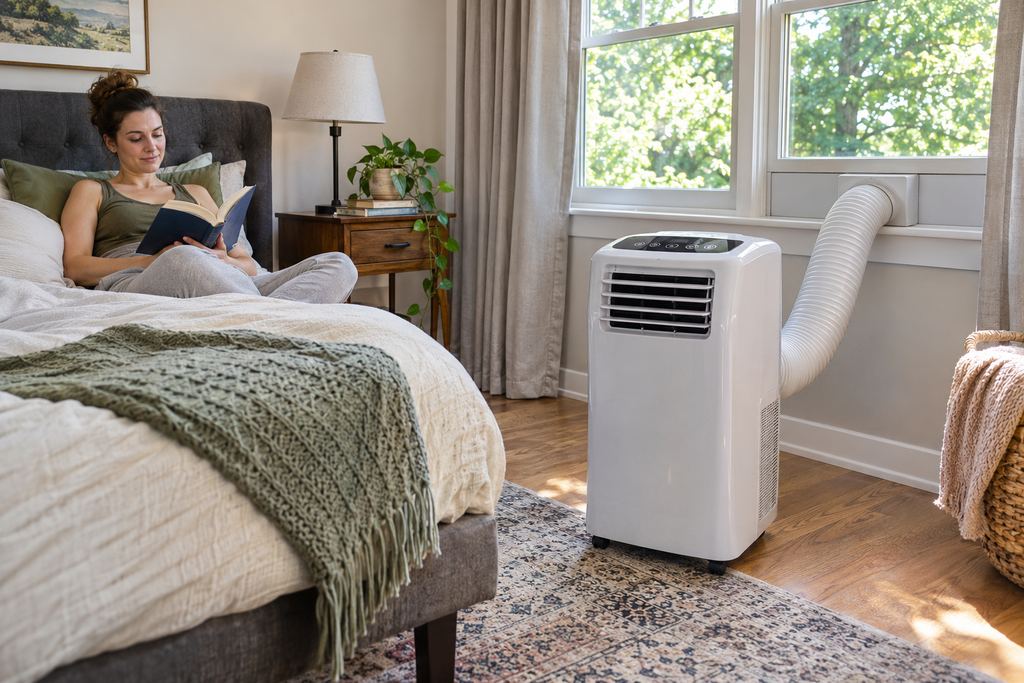
Portable air conditioners roll on casters, cool a single room and dump the heat they collect through an exhaust hose clipped into a window. Nothing is bolted in place, so renters and owners of windows that cannot hold a window unit often choose them.
Size the unit with the ENERGY STAR room chart, compare models by their DOE seasonally adjusted capacity (SACC) rather than the larger headline number, and choose a dual-hose design if you can. It will run louder and use more power than a similar-size window model. We found no national price range we could verify for portable units; This Old House's 2026 guide lists a portable AC tune-up at $65 to $85.
What published estimates say
Portable air conditioner prices change with capacity, hose design and retailer, and we found no national range from a cost publisher that we could verify. This Old House's 2026 tune-up guide lists a portable AC tune-up at $65 to $85. Compare models by their SACC rating and estimated yearly energy cost on the label.
Your written local quote is the real number.
How much capacity a room needs
Figures follow the ENERGY STAR room AC sizing chart, shown here by unit size. Odd sizes such as 7,000 or 9,000 Btu fill the gaps.
| Unit size (SACC, Btu/h) | Room it suits |
|---|---|
| 6,000 | A small bedroom of 150 to 250 sq ft |
| 8,000 | A 300 to 350 sq ft bedroom |
| 10,000 | Rooms of 400 to 450 sq ft |
| 12,000 | Living rooms of 450 to 550 sq ft |
| 14,000 | Open spaces of 550 to 700 sq ft |

Two capacity numbers on the box
Many portables list a large ASHRAE capacity and a smaller SACC figure. SACC, the seasonally adjusted cooling capacity, comes from the DOE test procedure and accounts for the heat that leaks back in through the hose and the warm air drawn into the room. It is typically well below the ASHRAE number and is the better guide to how a unit will perform. When a box says 14,000 Btu ASHRAE and 9,000 Btu SACC, size it as a 9,000 Btu unit.
Efficiency is shown as CEER, the same metric used for window units. A higher CEER means less electricity for the same cooling, which is the most direct answer to which portable is cheapest to run.
Single hose or dual hose
Portable or window unit
| Question | Portable AC | Window AC |
|---|---|---|
| Cooling for the money | Lower | Higher |
| Noise in the room | Compressor indoors, so you hear it | Loud parts hang outside |
| Installation | Window kit, no lifting into the frame | Must be lifted and secured in the window |
| Building rules | Rarely an issue because nothing hangs outside | Some buildings ban units that hang out of windows |
| Floor space | Takes a few square feet | None |
How a portable stacks up against a window unit
For pure cooling per dollar and per kilowatt-hour, a window air conditioner usually wins, because its hot side stays outdoors. A portable makes sense when the window will not take a window unit, when building rules forbid one or when you need to move cooling between rooms. If you are cooling the same rooms every summer and own the home, a ductless mini split is quieter and more efficient, though it costs much more up front.
Setup and running tips
- Skip extension cords: Manuals and electrical safety groups say to use a wall outlet directly, with no cord or power strip in between.
- Seal the window kit: Close gaps around the panel with the foam supplied, or the unit will fight hot air coming in.
- Close the room: A portable sized for a bedroom cannot also cool an open hallway.
- Empty or drain condensate: Many models evaporate most of it; in humid weather the tank may fill and shut the unit off. Use the drain port as the manual describes.
- Clean the filter: A clogged filter cuts airflow and capacity. During hot spells, rinse it about twice a month.
When to get help
If the fan works yet the air coming out is barely cool, start with the checks on portable AC not cooling. Water on the floor is covered in portable AC leaking water. A burning smell, a hot plug or a tripping breaker means unplug it and stop using it. Repairs to sealed refrigerant parts are often not worth the cost on a small unit; a technician can tell you whether portable AC repair makes sense.
Frequently asked questions
Are portable ACs noisy?
They are louder than window units and mini splits since the compressor shares the room with you. Compare published sound levels and look for models with a sleep mode that lowers fan speed.
How do I find a portable that costs little to run?
Look for the top CEER rating among units with the SACC capacity your room calls for. An undersized unit that runs nonstop can cost more than a correctly sized one.
Do portable units need to vent outside?
Yes. All the heat removed from the room has to go somewhere, so the hose must exhaust outdoors through a window, sliding door or wall vent.
Can a portable cool more than one room?
Not well. It cools the room it sits in. For several rooms, look at a window unit per room or a through-the-wall option.
Related guides and services
Get a portable unit looked at
Share the brand, the symptom and roughly when you bought it. Where a local contractor services portables, they can reply to set up a visit.
Tell us the make, what it is doing and how old it is. Availability varies by ZIP code.
Please keep this page open.
- We pair the request with an independent contractor or partner network that works in your ZIP code.
- The contractor gets in touch to go over the details and agree on a visit.
- After checking the system they quote the job, and you choose whether to proceed.
Read how requests are handled.
Online requests are not connected to a contractor network yet. Nothing you typed was sent or saved. Please phone us instead, or try again later.
Call (888) 555-0199