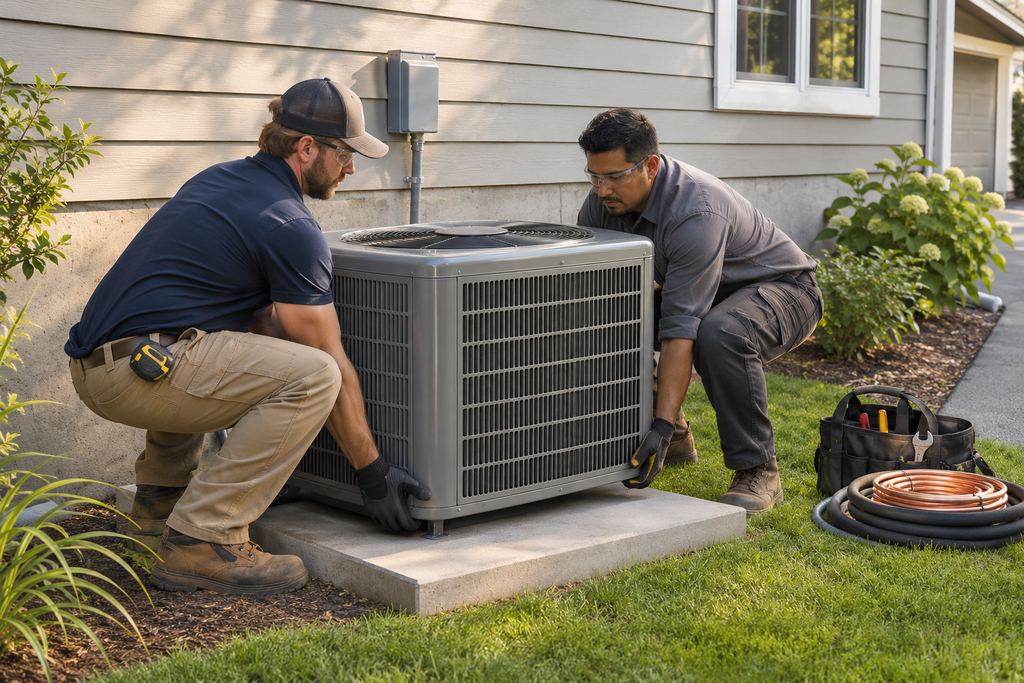
Split System Air Conditioner Installation
Every split system AC pairs a condenser outside with a coil and blower inside, tied together by copper lines and control wire. A good install depends on four things: a size based on the house, two halves rated as a set, tidy line work and a methodical start-up. HVAC Service Near Me hands your install request to an independent installer in your area for a quote.
- Capacity should come from Manual J, not a square-foot guess
- Climate regional SEER2 minimums have applied since January 1, 2023
- The person charging the system must hold EPA Section 608 certification
Tell us the home's size, whether you have ducts and what is there now. A local installer can contact you to set up an estimate visit.
Please keep this page open.
- We pair the request with an independent contractor or partner network that works in your ZIP code.
- The contractor gets in touch to go over the details and agree on a visit.
- After checking the system they quote the job, and you choose whether to proceed.
Read how requests are handled.
Online requests are not connected to a contractor network yet. Nothing you typed was sent or saved. Please phone us instead, or try again later.
Call (888) 555-0199Which kind of split system?
Getting the size right
Square-foot rules of thumb are fine for a first conversation and a weak basis for a purchase. For homes, the accepted method is ACCA Manual J. It uses insulation levels, glass area and which way it faces, drafts, how high the ceilings are, local design temperatures and the number of occupants to estimate how much cooling the house actually needs.
Too much capacity drops the temperature fast and stops before the coil has wrung water out of the air, so rooms feel damp and the compressor wears from constant starts. Go too small and the unit never catches up during a heat wave. If an installer quotes a size without measuring anything, ask how they arrived at it. Ducts deserve a look at the same visit. Leaks and tight runs can rob a brand new condenser of much of the comfort you paid for.
Federal SEER2 minimums for new split AC
| Climate region | Lowest allowed rating, split AC below 45,000 Btu/h |
|---|---|
| North | 13.4 SEER2 |
| Southeast | 14.3 SEER2 |
| Southwest | 14.3 SEER2 |
Efficiency, matching and refrigerant
Those numbers are the legal floor. Higher SEER2 equipment, often built around multi-stage or inverter compressors, can lower bills and handle humidity better, at a higher purchase price. Payback hinges on how hot your summers are, what you pay per kWh and the hours the system logs each year.
The rating only holds if the outdoor unit and indoor coil are a tested pair. AHRI publishes a directory of certified matched combinations, and it is worth looking up the exact model numbers on your quote at ahrinet.org. Refrigerant is the other reason the halves travel together. The EPA technology transitions rule under the AIM Act pushes new home equipment toward R-454B, R-32 and similar low-GWP blends, and those cannot share a circuit with an R-22 or R-410A coil. Plan on a new indoor coil along with the condenser, and on the installer testing or replacing the copper.
Install day, in order
- Prep and removal
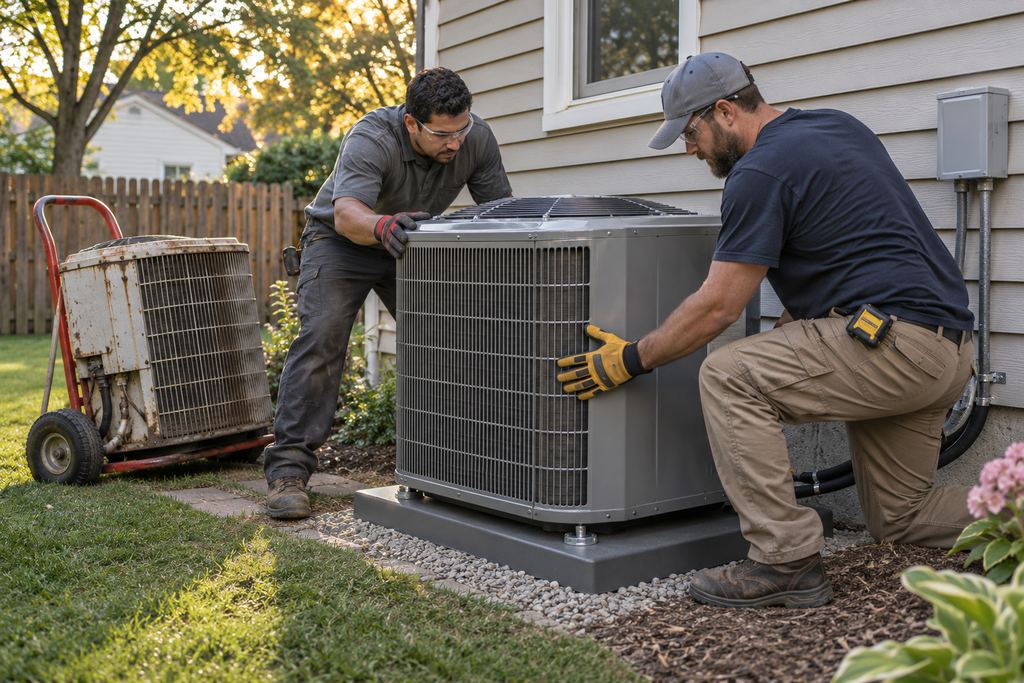
A technician holding Section 608 certification pumps the old charge into a recovery tank, then the crew pulls out the old condenser and coil.
- Outdoor unit
The new condenser goes onto a level pad or wall bracket, spaced from walls and shrubs as the manual requires.
- Inside equipment
The new coil is mounted on the furnace, or a new air handler is placed, and a backup drain pan or float switch is added where code calls for one.
- Lines and wiring
Line sets are brazed or flared, the low-voltage control wire is run, and the electrical disconnect is wired.
- Prove it tight, then dry it out
Nitrogen pressure goes in first to prove the joints are tight, then a vacuum pump pulls it down until moisture and air are gone.
- Charge and start-up
Refrigerant charge is verified against the manufacturer's method, and airflow, temperatures and thermostat operation are checked.
Comparing quotes
Put quotes side by side on the same items: both model numbers, the AHRI reference, copper and wiring scope, the permit, haul-away and what the warranty covers. For general price drivers, see AC installation cost. Further reading sits in the split system guide and the split system section.
How a service request works
HVAC Service Near Me is a referral service. We don't send our own technicians. We connect you with independent local contractors.
- Describe the job
Type your ZIP code, pick a service and add a line or two about the problem or project.
- We pass it on
An independent HVAC contractor or partner network that works in your area and does that kind of job receives it.
- You hear back
The contractor gets in touch to check the details and set a time to come out.
- The choice is yours
After a diagnosis the contractor gives you a quote. Price, timing and warranty are agreed directly between the two of you.
Frequently asked questions
Is a DIY split AC install allowed?
You can clear the area and handle prep, but the law reserves brazing, evacuating and charging the refrigerant side for people holding EPA Section 608 certification. A few ductless kits ship with pre-charged lines for owner installs, but many manufacturer warranties require a professional install, so read the terms before buying.
How much does a split AC cost to install?
Tonnage, efficiency tier, duct and electrical changes and regional labor all move the number. Itemized written quotes from two or three installers tell you more than any national figure.
Why does a new split system wait a few minutes before restarting?
That pause, often called the three minute rule, lets refrigerant pressure even out across the compressor before the next start. Most thermostats and outdoor boards build it in, so a short delay after changing the setpoint is normal.
How many days should I plan for?
Swapping a condenser and coil in the same spots usually wraps up in one working day. Add time for duct changes, relocating the air handler or a panel upgrade.
Will the old ductwork work with the new system?
Not always. Have the installer check leakage, sizing and insulation. Fixing the worst sections can improve comfort as much as the new unit does.
Related guides and services
Plan your split system installation
Send square footage, the age of the current equipment and whether ducts exist. An installer near you can then book a measuring visit.
Tell us the home's size, whether you have ducts and what is there now. A local installer can contact you to set up an estimate visit.
Please keep this page open.
- We pair the request with an independent contractor or partner network that works in your ZIP code.
- The contractor gets in touch to go over the details and agree on a visit.
- After checking the system they quote the job, and you choose whether to proceed.
Read how requests are handled.
Online requests are not connected to a contractor network yet. Nothing you typed was sent or saved. Please phone us instead, or try again later.
Call (888) 555-0199