Rooftop AC Units: Packaged Building Systems and RV Models
The phrase rooftop AC unit covers two very different machines. On a store, office or many Southwest houses it means a packaged unit that holds the whole cooling system in one cabinet and feeds the ducts from above. On a camper it means a compact 12 V or 120 V air conditioner bolted over a roof vent opening.
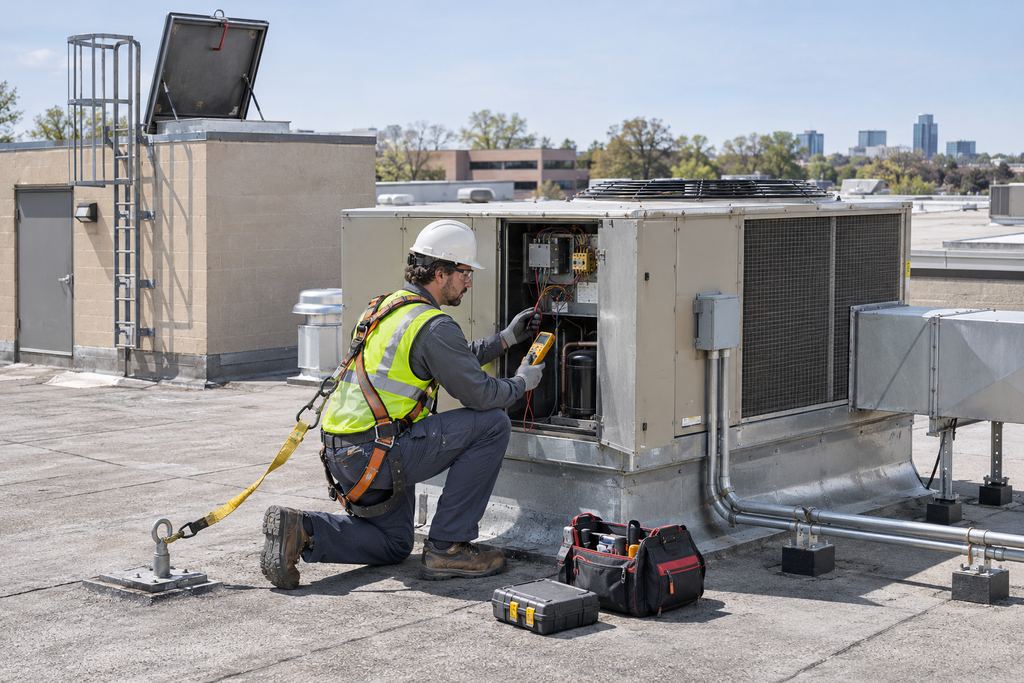
A building rooftop unit (often called an RTU) contains the compressor, both coils, fans and controls in one weatherproof cabinet, with supply and return ducts dropping through the roof. An RV rooftop AC is a smaller self-contained unit sized for a single living space. Both are sized by cooling load, and both need a trained technician for refrigerant or electrical work.
Which rooftop unit do you have?
How a packaged rooftop system moves air
In a split system the compressor sits outside and the indoor coil sits in a closet or attic. A rooftop packaged unit puts both halves in the same box. Return air from the building travels up a duct into the cabinet, passes through the filter and over the cold evaporator coil, and a blower pushes it back down the supply duct. On the other side of an internal wall, the condenser fan pulls outdoor air across the hot coil and throws the heat upward.
Many commercial units also carry an economizer, a set of dampers that brings in outdoor air for free cooling when the weather allows. Gas-fired units add a heat exchanger and burner. Heat pump units reverse the refrigerant flow for heating. You can read more about the ground-level version in the packaged air conditioner guide.
Why so many Arizona homes have the AC on the roof
Much of the Phoenix and Tucson housing stock was built on slab foundations with no basement and little attic space. A low-slope roof gives the builder a flat place to set one packaged unit, run short ducts straight down and keep the yard clear. The trade-off is a cabinet that sits in direct sun all summer, a roof penetration that must stay sealed, and a service visit that needs a ladder and roof access.
How a rooftop unit is sized
Tonnage is not picked from square footage alone. For buildings, it comes from a load calculation.
- Measure the load
Residential jobs use ACCA Manual J. Commercial buildings use ACCA Manual N, which accounts for occupants, lighting, kitchen equipment and ventilation air.
- Check the curb and roof
A replacement unit must fit the existing roof curb or come with an adapter curb, and the roof must carry its weight. A crane is often part of the job.
- Match utilities
Voltage, phase, gas supply and the condensate route have to line up with what is already on the roof.
- Confirm airflow
The new blower must suit the existing ducts. Too much air causes noise; too little causes frozen coils.
Sizing an RV rooftop air conditioner
RV units come in a narrow range, commonly around 13,500 and 15,000 Btu/h, and are matched to the 14 by 14 inch roof vent opening most trailers have. Longer rigs often run two units. The limit is usually power, not space: a 30 amp campground hookup may only carry one unit at a time, and running on a generator or battery bank needs a soft-start device or a unit designed for low startup draw. Check the RV maker's manual before swapping models, and use an RV service shop for the install.
Rooftop unit maintenance checklist
Building owners usually contract this twice a year: before cooling season and before heating season.
- Filters: Change on a fixed schedule. Rooftop filters face more dust than indoor ones.
- Condenser coil: Rinse or chemically clean. Cottonwood, roof debris and grease from kitchen exhaust coat coils fast.
- Belts and bearings: Belt-drive blowers need tension checks and belt replacement as they wear.
- Condensate: Clear the drain and trap so water does not back up into the cabinet or onto the roof deck.
- Economizer: Check that dampers move and sensors read correctly. A stuck-open damper wastes energy.
Owner checks and technician work
Safe checks you can do
No tools beyond a flashlight. Turn the system off at the thermostat before opening any filter or access door.
- Confirm the thermostat setting and that the schedule is not in an unoccupied mode.
- Check the breaker for the unit once.
- Replace filters if the unit has a reachable filter rack and the manual allows it.
- Note any alarm code on the thermostat or building controls.
Leave these to a licensed technician
These involve high voltage, refrigerant or sealed components. Refrigerant work requires EPA Section 608 certification.
- Going on the roof and opening the cabinet. Roof work carries fall risk.
- Electrical diagnosis, motors, contactors and capacitors.
- Gas burner and heat exchanger inspection.
- Refrigerant work, which requires EPA Section 608 certification.
- Replacing a unit, which may involve a crane, curb adapter and permit.
Repair, replace or plan ahead
Some owners apply the informal $5,000 rule: unit age times repair price, and above 5,000 consider replacement. Use it only as an informal screen; it is not a DOE rule or an industry standard; check warranty coverage first, then get the fault diagnosed and compare real quotes for the repair and for a new system before you choose either path. For rooftop equipment, also weigh crane cost, curb condition and whether the roof itself is due for work, since doing both together avoids a second lift. Get written quotes for repair and for rooftop AC installation so you can compare. For business sites, a contractor offering commercial AC repair can also look at multi-unit maintenance plans.
Frequently asked questions
Why do people in Arizona put AC units on the roof?
Many homes there sit on slabs with shallow attics and low-slope roofs. A packaged unit on the roof needs only short ducts and frees up yard space. Sun exposure and roof leaks around the curb are the downsides.
Why does my AC wait a few minutes before restarting?
Wait a few minutes after the compressor stops before it restarts, so pressures can even out. Most thermostats and unit controls enforce this delay automatically.
What is the $5,000 AC rule?
Multiply the unit's age by the repair quote. If the result is over 5,000, replacement often makes more sense. It is a rough guide from the trade, not a rule any code enforces.
Can a home HVAC company fix my RV rooftop AC?
Some will, many will not. RV air conditioners have their own parts, mounting and power systems, so an RV dealer or mobile RV technician is usually the right call.
Related guides and services
Find help with a rooftop unit
Share the building type, how many units sit on the roof and what they are doing. HVAC Service Near Me sends the request to an independent local contractor where coverage exists.
Tell us the building type, number of units and what is happening. Availability varies by ZIP code.
Please keep this page open.
- We pair the request with an independent contractor or partner network that works in your ZIP code.
- The contractor gets in touch to go over the details and agree on a visit.
- After checking the system they quote the job, and you choose whether to proceed.
Read how requests are handled.
Online requests are not connected to a contractor network yet. Nothing you typed was sent or saved. Please phone us instead, or try again later.
Call (888) 555-0199