HVAC Maintenance That Catches Problems Before They Cost More
HVAC maintenance is a scheduled checkup of your heating and cooling equipment: cleaning, measuring and tightening the parts that wear out quietly. A yearly visit before each system's busy season is the common recommendation. Send a request and independent local contractors can schedule a tune-up.
- Check the filter monthly and change it at least every three months
- Cooling in spring, heating in fall
- Commercial equipment often follows a quarterly plan
Tell us your system type, its approximate age and when it was last serviced.
Please keep this page open.
- We pair the request with an independent contractor or partner network that works in your ZIP code.
- The contractor gets in touch to go over the details and agree on a visit.
- After checking the system they quote the job, and you choose whether to proceed.
Read how requests are handled.
Online requests are not connected to a contractor network yet. Nothing you typed was sent or saved. Please phone us instead, or try again later.
Call (888) 555-0199What a tune-up typically covers
| Area | Cooling visit | Heating visit |
|---|---|---|
| Airflow | Filter, blower wheel, evaporator coil condition | Filter, blower, duct connections at the furnace |
| Outdoor or burner side | Condenser coil cleaning, fan motor, debris | Burners, igniter, flame sensor, heat exchanger inspection |
| Electrical | Capacitor, contactor, connections, amp draw | Control board, limit switches, connections |
| Refrigerant or combustion | Operating pressures and temperatures by a Section 608 certified tech | Venting, draft and gas pressure checks |
| Drainage | Condensate line and pan | Condensate drain on high-efficiency furnaces |
| Controls | Thermostat calibration and settings | Thermostat, safety shutoffs |
Between visits: what owners can safely do
Safe checks you can do
No tools beyond a flashlight. Turn the system off at the thermostat before opening any filter or access door.
- Check the filter every month and replace it at least every three months, sooner with pets or dust
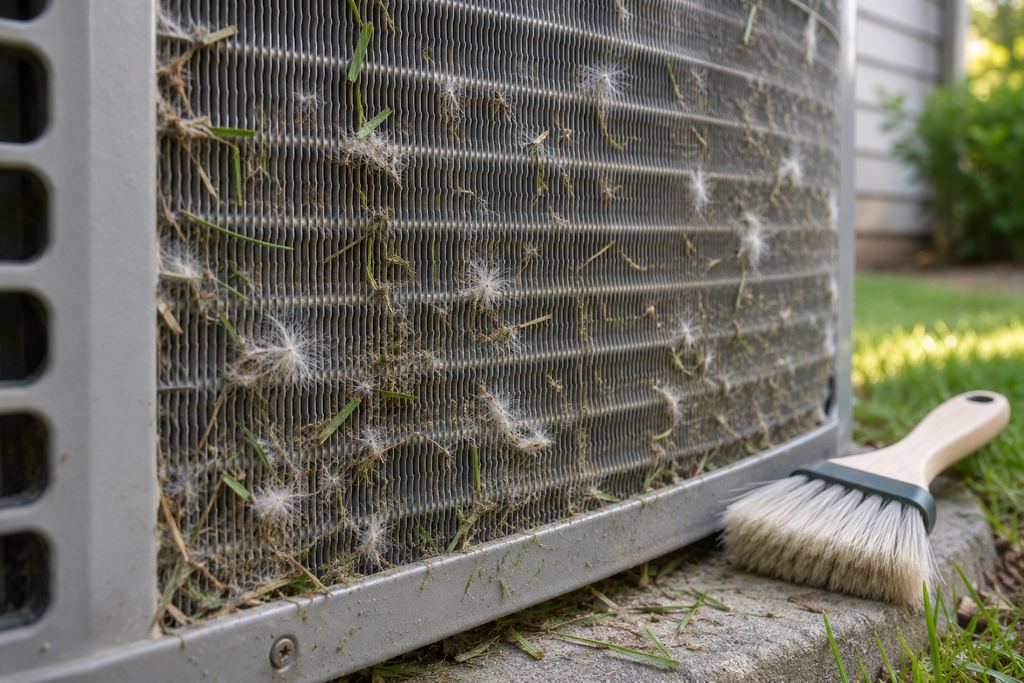
- Pull weeds, leaves and stored items away from the outdoor unit so air can move freely around it
- Make sure supply and return vents are open and unblocked
- Flush the condensate line only as the owner's manual describes
- Test smoke and carbon monoxide alarms, and replace their batteries
Leave these to a licensed technician
These involve high voltage, refrigerant or sealed components. Refrigerant work requires EPA Section 608 certification.
- Cleaning the evaporator coil or blower wheel
- Testing capacitors, motors and electrical components
- Checking refrigerant, which requires EPA Section 608 certification
- Inspecting the heat exchanger and gas burners
- Combustion and venting tests
Maintenance by system type
Getting a heating system ready for winter
Book the furnace or heat pump visit in early fall, before the first cold snap fills schedules. Put in a fresh filter, clear leaves and anything stored around the furnace, check that the outdoor heat pump is level and free of debris, and confirm carbon monoxide alarms work. On the first cool day, run the heat briefly. A short burning dust smell is normal at startup; a smell that lingers, or any gas odor, is not.
What affects the price of maintenance
HVAC Service Near Me does not set prices. These are the factors behind the numbers you will be quoted.
Two zones or an AC plus a furnace means more time than one unit.
Annual plans often bundle visits with scheduling priority or repair discounts. Read what is actually included.
A system that has not been serviced in years may need deeper cleaning.
Rooftop access, number of units and contract frequency drive commercial pricing.
Questions before you sign a maintenance plan
- Exactly which tasks are on the checklist?
Ask for it in writing for both heating and cooling visits. - Are coil cleaning and drain service included?
Some plans charge these as extras. - What happens if a part fails during the visit?
Will you get a price before any repair? - Is the contractor licensed and insured?
Verify through your state or local licensing board. - Can the plan be cancelled?
Check renewal and cancellation terms.
When maintenance turns up a bigger problem
A tune-up sometimes reveals worn parts, a refrigerant leak or a cracked heat exchanger. Get the finding and the repair price in writing. For the next step, see HVAC repair or, for older equipment, HVAC replacement. Commercial owners comparing service contracts can look at commercial AC repair to understand what falls outside a maintenance agreement.
How a service request works
HVAC Service Near Me is a referral service. We don't send our own technicians. We connect you with independent local contractors.
- Describe the job
Type your ZIP code, pick a service and add a line or two about the problem or project.
- We pass it on
An independent HVAC contractor or partner network that works in your area and does that kind of job receives it.
- You hear back
The contractor gets in touch to check the details and set a time to come out.
- The choice is yours
After a diagnosis the contractor gives you a quote. Price, timing and warranty are agreed directly between the two of you.
Frequently asked questions
How much does HVAC maintenance cost?
It depends on how many systems you have, a single visit versus a plan, the system's condition and local labor rates. Ask what the checklist includes and compare that, not only the price.
Can I do HVAC maintenance myself?
Partly. Filter changes, clearing around the outdoor unit, keeping vents open and testing alarms are owner tasks. Electrical, refrigerant, burner and heat exchanger checks belong to a technician.
How do I prepare my HVAC system for winter?
Schedule a heating tune-up in early fall, replace the filter, clear the area around the furnace and outdoor unit, test CO alarms and run the heat once before it gets cold.
How often should HVAC be serviced?
Once a year per system before its main season is common advice. Heat pumps often get two visits. Commercial rooftop units are commonly serviced quarterly or seasonally.
Is a tune-up worth it if nothing seems wrong?
Many failures, such as a weak capacitor or a dirty flame sensor, give little warning. A visit can catch them while they are inexpensive to fix and keep efficiency up.
Related guides and services
Request an HVAC tune-up
Tell us your system type, its approximate age and when it was last serviced. Independent local contractors can follow up to schedule. Availability varies by ZIP code and season.
Tell us your system type, its approximate age and when it was last serviced.
Please keep this page open.
- We pair the request with an independent contractor or partner network that works in your ZIP code.
- The contractor gets in touch to go over the details and agree on a visit.
- After checking the system they quote the job, and you choose whether to proceed.
Read how requests are handled.
Online requests are not connected to a contractor network yet. Nothing you typed was sent or saved. Please phone us instead, or try again later.
Call (888) 555-0199