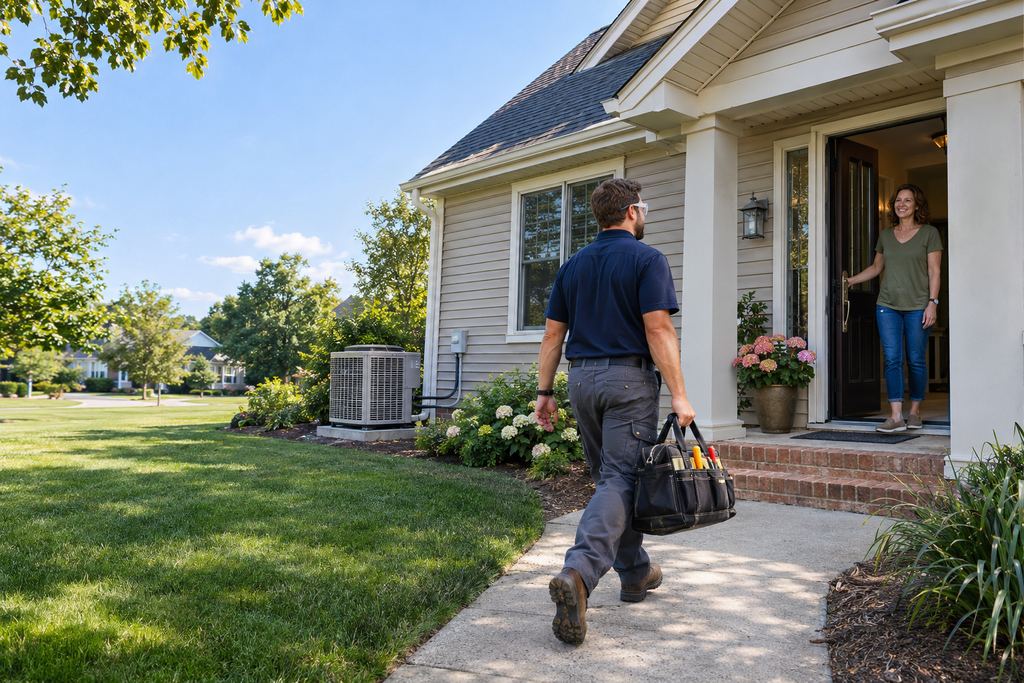
AC Installation in Raleigh, From Load Calculation to Startup
Most AC installation jobs in Raleigh happen in houses built since the 1990s, and a big share of them hang the upstairs air handler in an attic that tops 130 degrees in July. That shapes everything from equipment choice to how the condensate is drained. HVAC Service Near Me sends your project details to an independent Triangle installer for a site visit and a written bid.
- Room-by-room sizing, not a square-foot guess
- Attic safety pan and drain done right
- Permit from the correct town or county
Square footage, current system and whether there are ducts help the installer plan.
Please keep this page open.
- We pair the request with an independent contractor or partner network that works in your ZIP code.
- The contractor gets in touch to go over the details and agree on a visit.
- After checking the system they quote the job, and you choose whether to proceed.
Read how requests are handled.
Online requests are not connected to a contractor network yet. Nothing you typed was sent or saved. Please phone us instead, or try again later.
Call (888) 555-0199The Wake County house, from the installer's side
Wake County grew quickly from the 1990s on, so many homes are two-story builds with one system for the ground floor, often in a crawl space, garage or closet, and a second in the attic for the bedrooms. When one of those is replaced or a new one is added, the installer has to work in an attic that can exceed 130 degrees on a summer afternoon. Plan the install for a morning start if you can, and expect the crew to talk about ventilation and attic access.
Raleigh summers are hot and sticky, with July highs around 90 degrees and frequent heat advisories from the National Weather Service office here. A new system should be judged on how well it dries the air as well as on how cold the vents blow.
How a Raleigh installation usually unfolds
- Site visit and load calculation
The installer measures rooms, notes insulation, windows and duct layout, and runs an ACCA Manual J calculation to size each system.
- Written bid
Equipment model numbers, efficiency rating, refrigerant type, duct work, electrical, permit and removal of old equipment, each on its own line.
- Permit
The contractor applies to the office that covers your address: the City of Raleigh inside city limits, or Wake County, Cary, Garner or another town for their own areas.
- Install day
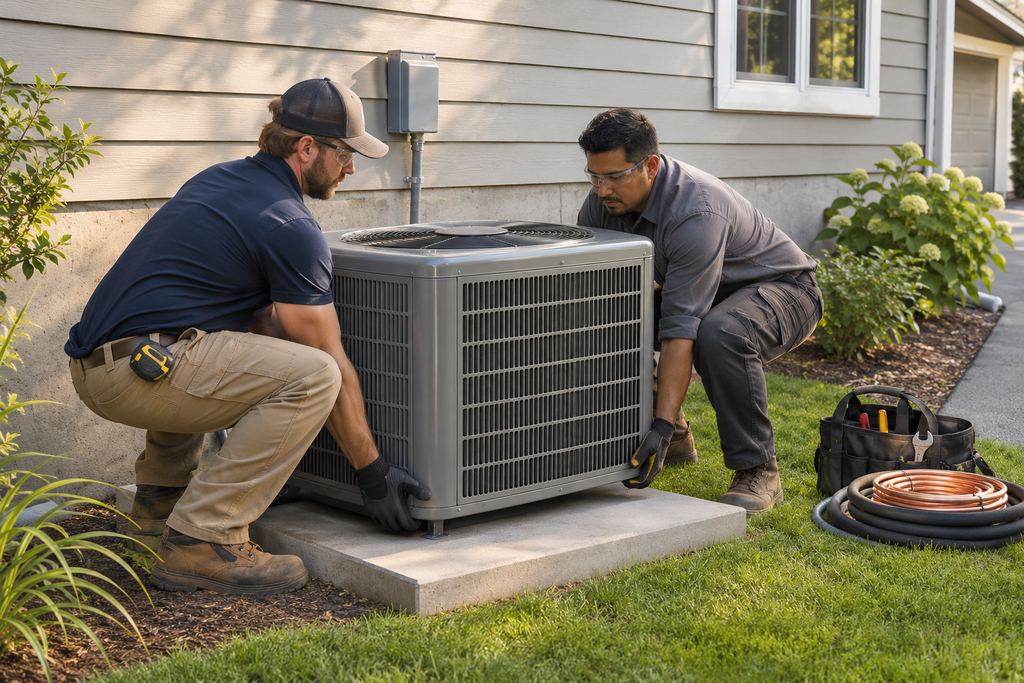
Old equipment out, refrigerant recovered, new outdoor unit set on a level pad, new coil or air handler in place, line set brazed, pressure tested and evacuated.
- Startup
Refrigerant charged to the manufacturer's spec by a Section 608 certified technician, airflow set, thermostat configured and the drain tested with water.
- Inspection and handoff
Inspector signs off on the permit, and you receive the startup readings and warranty registration information.
Line items to expect in the bid
- Matched equipment: Outdoor unit and indoor coil or air handler rated together, at or above the Southeast minimum of 14.3 SEER2 for split AC under 45,000 Btu/h.
- Current refrigerant: New systems use A2L refrigerants such as R-454B or R-32 under the EPA AIM Act transition. The bid should name which.
- Attic drain protection: A secondary pan under the attic unit with its own drain or a float switch that stops cooling before water reaches the ceiling.
- Duct connections: Sealed plenums and transitions, and a note on any duct runs being replaced or added.
- Electrical: Disconnect, whip and breaker sized to the new equipment.
- Thermostat: A thermostat compatible with the system's staging, set up for heat pump or gas heat as needed.
Checking a Triangle installer
- What license group and class do you hold?
The North Carolina State Board of Examiners of Plumbing, Heating and Fire Sprinkler Contractors issues heating licenses in groups. H-2 and H-3 cover forced-air systems by size, and Class II licenses are limited to single-family detached homes. Verify the number at nclicensing.org. - Will you pull the permit in your company's name?
A contractor who asks you to pull it as the homeowner is shifting responsibility to you. - Who does the work?
Ask whether the crew are employees or subcontractors and who will be on site. - What do you leave behind?
Ask for the Manual J summary, startup readings and warranty registration confirmation.
After the install: keeping it running
New equipment still needs a yearly check. In Raleigh that means a spring visit before the first heat advisory, with the coil cleaned, the attic drain flushed and the float switch tested. Heat pump owners often add a fall visit. Change filters on the schedule the installer gives you, which tends to be more often during spring pollen.
The federal 25C tax credit does not apply to equipment placed in service after December 31, 2025, so do not build it into your budget. Look for state or utility offers through the ENERGY STAR rebate finder.
If your current system has failed suddenly in a heat wave, an emergency AC repair request in Raleigh may get you cooling while you plan the installation. If it is fixable, a standard Raleigh AC repair may be all you need. For the service in general, see AC installation.
How a service request works
HVAC Service Near Me is a referral service. We don't send our own technicians. We connect you with independent local contractors.
- Describe the job
Type your ZIP code, pick a service and add a line or two about the problem or project.
- We pass it on
An independent HVAC contractor or partner network that works in your area and does that kind of job receives it.
- You hear back
The contractor gets in touch to check the details and set a time to come out.
- The choice is yours
After a diagnosis the contractor gives you a quote. Price, timing and warranty are agreed directly between the two of you.
Other AC services in Raleigh
- Emergency AC Repair in Raleigh and the Triangle
- Raleigh AC Repair for Attic, Crawl Space and Closet Systems
AC Installation in other North Carolina cities
Frequently asked questions
How long does an AC installation take in Raleigh?
Replacing one system on existing ducts is often a one-day job. Two systems, new duct work or a change from gas to a heat pump can take two or more days. The permit inspection is a separate appointment.
Should both systems be replaced together?
Not necessarily. If one is much newer, replacing only the failed one is reasonable. If both are the same age, doing them together can save on labor and keep the equipment matched.
Who issues the permit in Cary or Garner?
Those towns run their own permitting. The City of Raleigh covers addresses inside its limits, and Wake County handles unincorporated areas. Your installer should know which applies.
Is a bigger unit better for Raleigh heat?
No. An oversized system cools quickly, shuts off and leaves humidity behind. Correct sizing from a Manual J calculation is what keeps a Raleigh house comfortable.
Related guides and services
Plan a Raleigh installation
Share the home's square footage, how many systems it has now and whether the ducts are staying. An installer can use that to set up a visit.
Square footage, current system and whether there are ducts help the installer plan.
Please keep this page open.
- We pair the request with an independent contractor or partner network that works in your ZIP code.
- The contractor gets in touch to go over the details and agree on a visit.
- After checking the system they quote the job, and you choose whether to proceed.
Read how requests are handled.
Online requests are not connected to a contractor network yet. Nothing you typed was sent or saved. Please phone us instead, or try again later.
Call (888) 555-0199