
AC Installation in Greensboro, North Carolina
AC installation in Greensboro is shaped by two things outsiders tend to miss: plenty of houses here were built with no ductwork at all, and most sit over a crawl space where the ducts and air handler end up living. Describe your house to HVAC Service Near Me and an independent Triad contractor can follow up with a site visit and a written bid.
- Options for homes with and without ducts
- Crawl space and closed crawl details
- City or county permit, depending on the address
Tell us the home's size, what heats it now and whether there are ducts.
Please keep this page open.
- We pair the request with an independent contractor or partner network that works in your ZIP code.
- The contractor gets in touch to go over the details and agree on a visit.
- After checking the system they quote the job, and you choose whether to proceed.
Read how requests are handled.
Online requests are not connected to a contractor network yet. Nothing you typed was sent or saved. Please phone us instead, or try again later.
Call (888) 555-0199Greensboro houses and why they matter to the installer
Greensboro grew around its textile mills, and much of the older mill-era housing was built without central ducts. Owners of those houses often get by with window units or have added a few ductless heads over the years. Adding air conditioning to one of them is a real design job: where do the ducts go, or do you skip them entirely?
Newer neighborhoods on the edges of the city and out toward the county line mostly have ducted systems, often a heat pump or a gas furnace with an AC coil. Across both groups, crawl space foundations are common in Piedmont North Carolina. The installer will be on hands and knees under your floor, checking clearance for the air handler, the condition of the vapor barrier and how much of the existing duct can be saved.
For a general explanation of the service beyond Greensboro, read the AC installation overview.
System types that fit Greensboro homes
The right choice depends on the house, not the brochure.
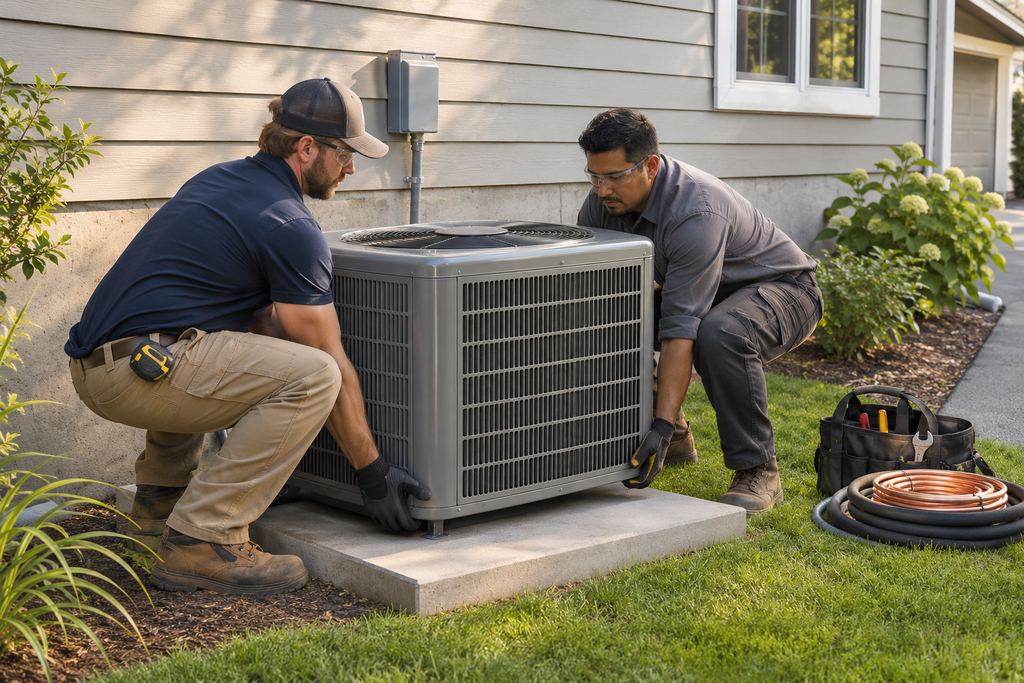
Sizing for hot summers and colder nights
The Triad sits inland, so July highs run in the upper 80s with plenty of humidity, while winter nights drop lower than they do on the coast, and an ice storm can knock out power for a day or more. A heat pump here has to be sized for both seasons, and the backup heat matters more than it would near the coast.
Capacity should come from an ACCA Manual J load calculation, done room by room, using your actual insulation, windows and air leakage. For a house that has never had ducts, the calculation also drives the duct design or the number and size of mini-split heads. Ask to see the numbers. A bid that names a tonnage after a two-minute walk through the living room skipped this step.
What a Greensboro installation should cover
Use this list to compare written bids side by side.
- Load calculation and equipment selection: Written Manual J result, then outdoor and indoor model numbers that the manufacturer lists as a matched set.
- Duct design or head layout: New duct routes sized to the load, or a mini-split head plan with each room's capacity.
- Crawl space work: Air handler mounted with clearance, ducts sealed at joints, insulation on runs in unconditioned space, and a plan if the vapor barrier is torn.
- Condensate handling: A drain line that slopes to daylight or a condensate pump, plus a safety switch where water could damage the structure.
- Refrigerant lines and charge: New line set or a cleaned, pressure-tested old one, a deep vacuum, and charging by a technician with EPA Section 608 certification. New equipment uses refrigerants such as R-454B or R-32.
- Electrical: Dedicated circuit, outdoor disconnect and any panel capacity check the equipment requires.
- Permit and inspection: Mechanical permit from the right office and a passed inspection before final payment.
- Startup paperwork: Measured airflow, temperature split and pressures, plus help registering the manufacturer warranty.
What shifts the price of a Greensboro install
We do not set prices; contractors do. These items explain most of the spread between bids.
Building a full duct system in a house that has none is often the largest single line.
Low clearance, standing water or damaged insulation add labor before equipment goes in.
Each mini-split head and each extra zone adds equipment and wiring.
Split AC systems in the Southeast must meet at least 14.3 SEER2. Two-stage and variable-speed models sit above that floor and cost more.
Older houses sometimes need panel work before a new outdoor unit can be connected.
Fees vary by jurisdiction. They belong in the bid.
Brands and what really matters
HVAC Service Near Me is not tied to any equipment maker. Most installers carry two or three brands, and good results come more from correct sizing, sealed ducts and a careful charge than from the logo on the cabinet. Compare bids on model numbers, efficiency ratings, the length and conditions of the manufacturer's parts warranty (check the registration deadline), and whether the installer adds its own labor warranty in writing.
Questions to put to a Greensboro installer
- Which license do you hold?
The North Carolina State Board of Examiners of Plumbing, Heating and Fire Sprinkler Contractors issues heating licenses in groups: H-1 covers hydronic systems, while H-2 and H-3 cover forced-air systems by size. Class I and Class II set further limits, with Class II restricted to single-family detached homes. Look up the number at nclicensing.org. - Which office issues my permit?
Inside city limits, the City of Greensboro issues mechanical permits. Elsewhere in the county it is Guilford County. The installer should know which applies to your address and pull it. - How will you handle the crawl space?
Ask about duct sealing, insulation and where the air handler will sit. - What happens if the old system fails before install day?
Some contractors can set up temporary cooling or move the date. Ask, especially in July. - What is excluded from the price?
Drywall or plaster patching, electrical panel work and crawl space repairs are common exclusions.
New install, replacement or a repair first?
If the house already has central air and the system is simply worn out, the job is a replacement and the duct question is mostly settled. If it is under about ten years old and one part has failed, a repair in Greensboro is probably the cheaper step. And whatever you install, plan for yearly maintenance in Greensboro, because crawl space air handlers collect dust and moisture faster than attic ones.
If an older adult, an infant or anyone with a medical condition is in a hot house, move them somewhere cool now. Confusion, fainting or a body that stops sweating can mean heat stroke: call 911.
How a service request works
HVAC Service Near Me is a referral service. We don't send our own technicians. We connect you with independent local contractors.
- Describe the job
Type your ZIP code, pick a service and add a line or two about the problem or project.
- We pass it on
An independent HVAC contractor or partner network that works in your area and does that kind of job receives it.
- You hear back
The contractor gets in touch to check the details and set a time to come out.
- The choice is yours
After a diagnosis the contractor gives you a quote. Price, timing and warranty are agreed directly between the two of you.
Other AC services in Greensboro
- Greensboro AC Maintenance for Crawl Space and Heat Pump Systems
- Air Conditioning Repair in Greensboro
- Greensboro AC Replacement: Choosing the Next System
AC Installation in other North Carolina cities
Frequently asked questions
Can a mill house in Greensboro get central air?
Usually yes, but the method varies. Ducts can sometimes run through the crawl space with floor registers, or through the attic. When that is impractical, a ductless mini-split or a small-duct system avoids most demolition.
Is a heat pump warm enough for a Triad winter?
A correctly sized modern heat pump keeps heating below freezing, and backup heat covers the coldest nights. During an ice storm outage, no electric system runs, so some owners keep a gas furnace as the heat source.
How long does an installation take?
Replacing equipment on existing ducts often takes a day. Adding ducts to a house that has none, or installing several mini-split heads, can take several days. The inspection comes after.
Do I need the City or Guilford County for the permit?
It depends on whether your address is inside Greensboro city limits. High Point and other towns have their own offices. The contractor should confirm and apply.
We run three window units now. Is a whole-house system worth it?
It depends on how many rooms you cool and how long you plan to stay. Window units are cheap to replace one at a time but noisy and leaky around the sash. A ducted or ductless system costs more at the start, removes humidity more evenly and frees up the windows. Ask the installer to price both a ductless layout and a ducted option so you can compare.
Why do quotes for the same house differ so much?
Bids often include different scopes: one adds duct sealing and crawl space work, another reuses everything. Ask each installer for an itemized list so you compare the same job.
Related guides and services
Plan a new Greensboro system
Let us know roughly how big the house is, what heats it now and whether there are any ducts. A local installer can then arrange a visit and a written bid.
Tell us the home's size, what heats it now and whether there are ducts.
Please keep this page open.
- We pair the request with an independent contractor or partner network that works in your ZIP code.
- The contractor gets in touch to go over the details and agree on a visit.
- After checking the system they quote the job, and you choose whether to proceed.
Read how requests are handled.
Online requests are not connected to a contractor network yet. Nothing you typed was sent or saved. Please phone us instead, or try again later.
Call (888) 555-0199