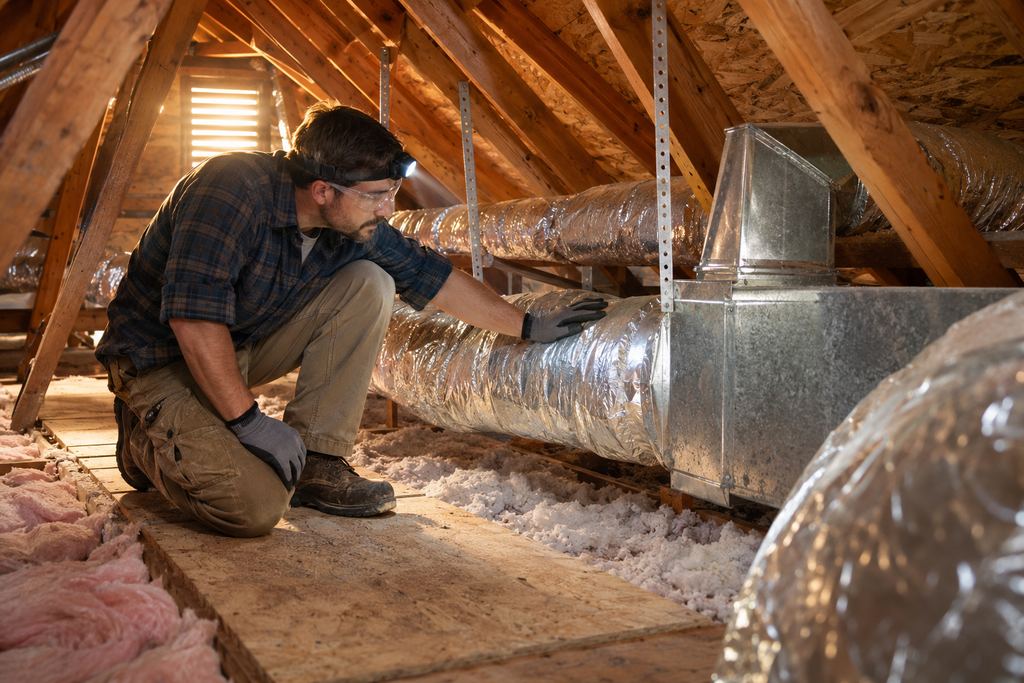
Duct Leakage Testing With a Calibrated Fan
Leaks hide behind insulation and drywall, so eyeballing ducts tells you little. A leakage test replaces the guess with a figure: a calibrated fan pushes the ducts to a set pressure, and however much air it takes to keep that pressure steady is the amount slipping out through gaps. With that figure you can decide whether sealing is worth buying and later prove that it worked.
- Measured result instead of a guess
- Before-and-after proof for sealing work
- Required for many new systems under local energy codes
Tell us why you want the test: comfort, bills, code or a home sale. A contractor in your area follows up.
Please keep this page open.
- We pair the request with an independent contractor or partner network that works in your ZIP code.
- The contractor gets in touch to go over the details and agree on a visit.
- After checking the system they quote the job, and you choose whether to proceed.
Read how requests are handled.
Online requests are not connected to a contractor network yet. Nothing you typed was sent or saved. Please phone us instead, or try again later.
Call (888) 555-0199What happens during a duct leakage test
- Prep
The technician or energy rater turns off the system, removes the filter if needed and tapes over every supply register and return grille.
- Connect the fan
A calibrated fan, which raters often call a duct blaster after one well-known product, is clamped to the air handler cabinet or fitted into a large return opening.
- Pressurize
The fan raises the ducts to a test pressure, commonly 25 pascals, a small pressure similar to what the system sees in operation.
- Read
Whatever flow keeps the ducts at that pressure counts as leakage, written as CFM25: cubic feet per minute measured at 25 pascals.
- Leakage to outside, if needed
With a blower door running at the same time to pressurize the house, the test separates leaks into the living space from leaks to the attic, crawl space or outdoors.
- Report
Results are often compared with a code limit, which is usually expressed relative to the home's conditioned floor area.
Two kinds of results
| Test | What it measures | Why it matters |
|---|---|---|
| Total leakage | All air escaping the ducts at test pressure, wherever it goes | Required by many codes for new or replaced ducts; good for checking sealing quality |
| Leakage to outside | Only the air lost outside the conditioned space | Closer to the actual energy cost, since air leaking indoors still conditions the house |
Who orders a duct test, and why
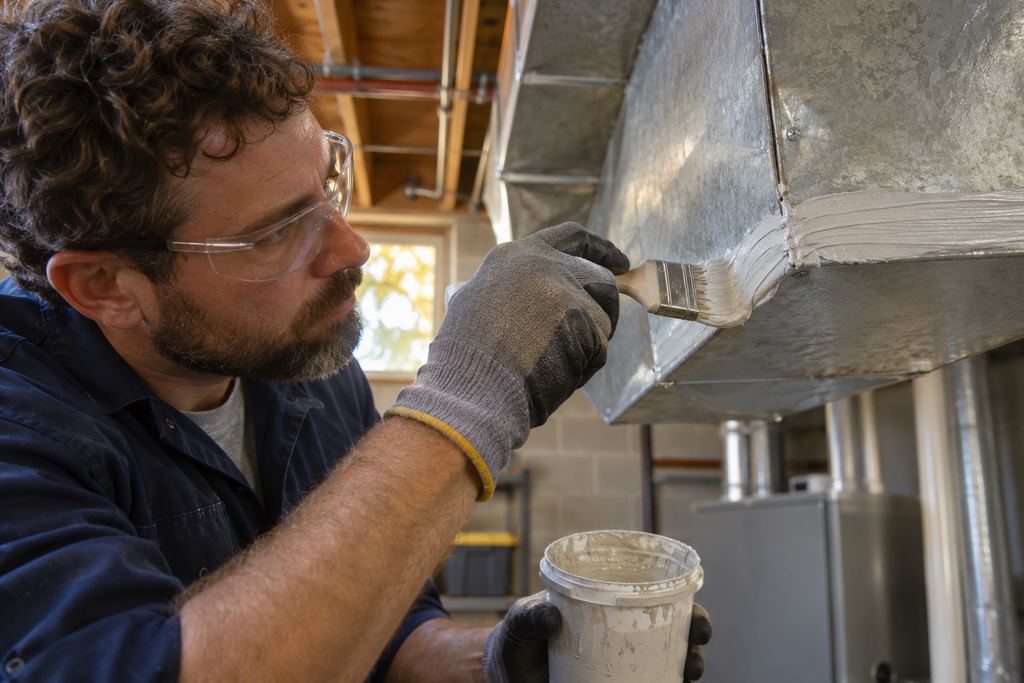
New construction and many duct replacements fall under energy codes based on the International Energy Conservation Code, and many of those require a duct leakage test. Local adoption varies, so ask your contractor or building department. Homeowners order tests for other reasons: rooms that never cool, high bills, dust, or to confirm that duct sealing worked. Home energy raters often run duct tests as part of an energy rating.
Ask who will perform the test and whether they hold training for it, such as RESNET rater credentials or equivalent, because results depend on setup. If the number is high, the next step is duct repair or sealing, followed by a retest.
Simple checks versus a real test
Safe checks you can do
No tools beyond a flashlight. Turn the system off at the thermostat before opening any filter or access door.
- Look for disconnected or torn ducts in an accessible attic or basement.
- Feel for air at joints while the blower runs; a strong draft means a big leak.
- Look for dirty streaks on insulation around duct joints, a sign of air moving through.
- Compare temperatures at registers near and far from the equipment.
Leave these to a licensed technician
These involve high voltage, refrigerant or sealed components. Refrigerant work requires EPA Section 608 certification.
- Pressurized testing with a calibrated duct fan.
- Leakage to outside with a blower door.
- Code compliance reports.
- Sealing and retesting.
How a service request works
HVAC Service Near Me is a referral service. We don't send our own technicians. We connect you with independent local contractors.
- Describe the job
Type your ZIP code, pick a service and add a line or two about the problem or project.
- We pass it on
An independent HVAC contractor or partner network that works in your area and does that kind of job receives it.
- You hear back
The contractor gets in touch to check the details and set a time to come out.
- The choice is yours
After a diagnosis the contractor gives you a quote. Price, timing and warranty are agreed directly between the two of you.
Frequently asked questions
How can I tell if my ductwork is leaking?
Clues include warm rooms far from the equipment, dust building up quickly, visible gaps or disconnections, and dirty spots on insulation at duct joints. A pressurized test is the only way to measure it.
How much does an HVAC duct leak test cost?
It depends on whether you need total leakage only or leakage to outside, and whether it is part of a larger job. Ask for the price in writing; HVAC Service Near Me does not set it.
When is leakage to the outdoors tested instead of total leakage?
When you want to know the energy impact, since air leaking to the outside is lost, or when a code or program calls for it. It needs a blower door running together with the duct fan.
What is the 2 foot rule for ductwork?
People usually mean how far flex duct may sag between hangers, though usage varies. It is folklore rather than code, and it has nothing to do with how a leakage test is run.
Related guides and services
Request a duct leakage test
Say what prompted the test: uneven rooms, high bills, a code inspection or a pending sale. HVAC Service Near Me sends it on to an independent contractor or rater near you.
Tell us why you want the test: comfort, bills, code or a home sale. A contractor in your area follows up.
Please keep this page open.
- We pair the request with an independent contractor or partner network that works in your ZIP code.
- The contractor gets in touch to go over the details and agree on a visit.
- After checking the system they quote the job, and you choose whether to proceed.
Read how requests are handled.
Online requests are not connected to a contractor network yet. Nothing you typed was sent or saved. Please phone us instead, or try again later.
Call (888) 555-0199