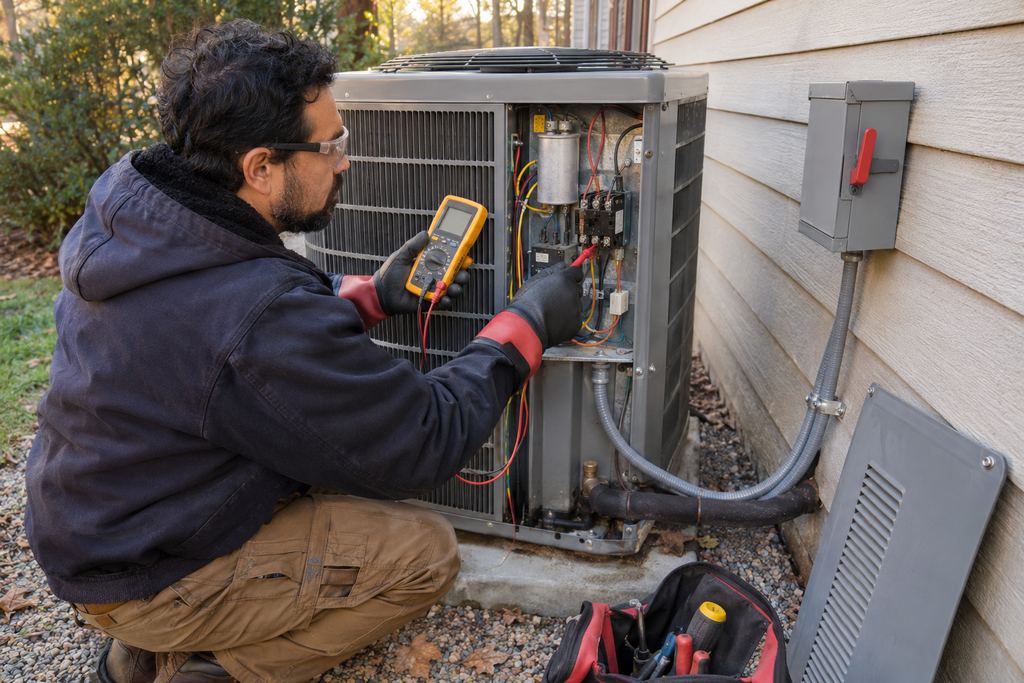
Why Your AC Keeps Shutting Off Before the House Cools
When an AC keeps shutting off on its own, the pattern matters more than the shutdown. A system that runs two minutes and stops is a different problem from one that quits after an hour on the hottest afternoon or goes dead and stays dead.
Very short cycles of a few minutes usually trace to a thermostat problem, a frozen or dirty coil, low refrigerant, or a system too large for the house. Shutdowns on hot afternoons often point to an overheating compressor, a dirty condenser coil or a failing capacitor. A system that shuts off and will not restart may have tripped a float switch, a breaker or a high pressure switch. Replace the filter and check the thermostat first; repeated stops after that need a technician.
Match the shutdown pattern to a likely cause
| What you see | Common causes |
|---|---|
| Runs a few minutes, stops, starts again soon | Short cycling: thermostat placement or settings, iced coil, low refrigerant, oversized system |
| Stops after running a while on hot days | Compressor overheating on its overload, dirty condenser coil, weak capacitor, condenser fan problem |
| Stops and stays off, thermostat still on | Float switch tripped by a clogged drain, high or low pressure switch, blown fuse in the air handler |
| Stops and the breaker is tripped | Electrical fault, failing compressor or motor; do not keep resetting |
| Thermostat screen goes blank | Dead batteries, loose wiring, a tripped float switch on some setups, or a control transformer problem |
The main causes in plain terms
Thermostat issues
A thermostat near a supply register, in direct sun, or next to a lamp or TV reads the wrong temperature and ends cycles early. Weak batteries and loose wires can also cut power to the call for cooling.
Airflow and ice
A clogged filter or blocked returns can freeze the coil. Some systems shut off on a low temperature or low pressure switch when that happens. Ice on the copper lines is the clue; see AC freezing up.
Overheating outdoors
The condenser has to dump heat outside. If its coil is caked with dirt or cottonwood, or the fan is slow, pressure and temperature climb until a safety cuts the compressor. It restarts once it cools, then trips again. Outdoor coil cleaning is covered on condenser cleaning.
Drain problems
A float switch in the drain pan or line shuts the system off when water backs up. The AC looks dead until the water clears.
System size
An oversized AC cools the air near the thermostat fast and stops before it has run long enough to pull humidity out. Rooms feel cold and clammy. Contractors size systems with a load calculation such as ACCA Manual J, and that is the way to confirm it.
Electrical
Weak capacitors, failing contactors, and breakers that trip point to electrical work for a technician. If the breaker trips more than once, leave it off and read AC tripping breaker.
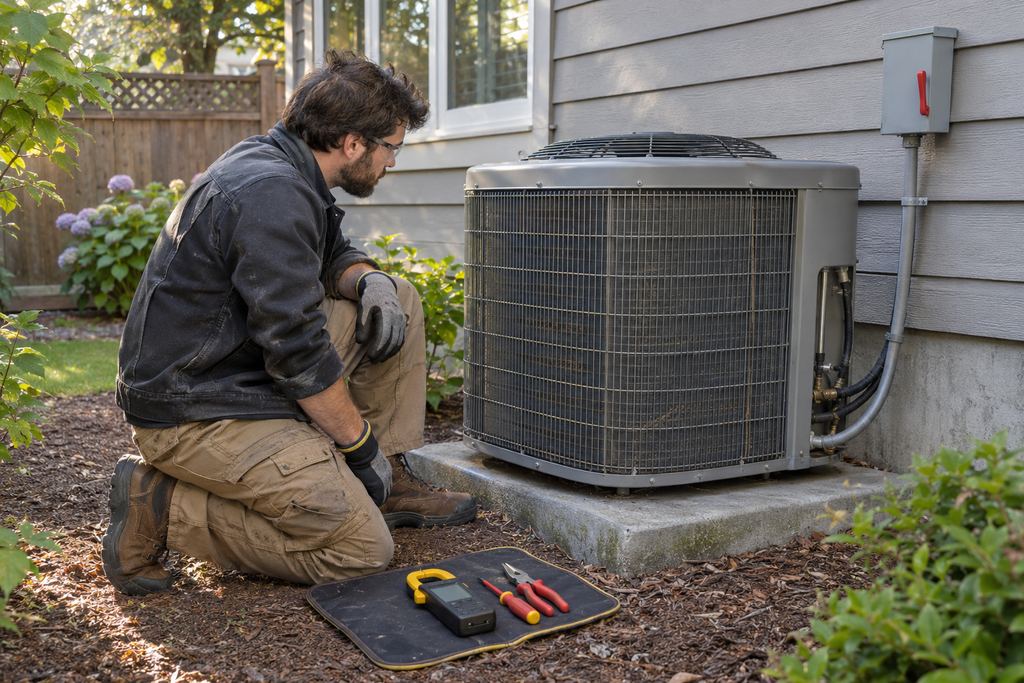
Checks you can make and work to hand off
Safe checks you can do
No tools beyond a flashlight. Turn the system off at the thermostat before opening any filter or access door.
- Replace the filter if it looks gray or you cannot remember the last change.
- Put fresh batteries in the thermostat and confirm it is on Cool with the fan on Auto.
- Check whether the thermostat sits in sun or near a vent or heat source.
- Look for ice on the copper lines; if present, run fan only to thaw.
- Pull leaves, cottonwood and grass clippings away from the condenser by hand and trim shrubs so it has room on every side.
- Look at the drain pan or the outdoor drain outlet for signs of a backup.
Leave these to a licensed technician
These involve high voltage, refrigerant or sealed components. Refrigerant work requires EPA Section 608 certification.
- Testing capacitors, contactors and pressure switches.
- Checking refrigerant charge and searching for leaks.
- Deep cleaning the condenser or evaporator coil.
- Relocating a thermostat or fixing control wiring.
- Running a load calculation to judge whether the system is oversized.
How long cycles should last
There is no single right number. In mild weather a single-stage system commonly runs somewhere around 10 to 20 minutes per cycle, and on a hot afternoon it may run much longer or nonstop. Two and three stage and variable speed systems run longer at lower output by design. What matters is a sudden change: cycles that got much shorter, or a system that now stops before the house reaches the setpoint. If short runs are the main symptom, the short cycling guide goes deeper.
Short cycles also leave more moisture in the air. Keeping indoor humidity down helps limit mold and dust mites, which matters for anyone with allergies.
Upkeep that prevents shutdowns
- Change filters on schedule and more often during heavy use.
- Keep two feet of clearance around the condenser and keep it free of plant growth.
- Flush the condensate line at the start of summer if your manual allows.
- Schedule a tune-up that includes electrical tests and coil checks before peak season.
Frequently asked questions
Why does my AC turn on and off over and over?
Usually an iced coil, a thermostat problem, an overheating condenser, low refrigerant or an oversized system. The pattern of the shutdowns helps a technician narrow it.
Is a delay before the AC restarts normal?
Yes. On many systems a timer keeps the compressor off for roughly three to five minutes after each stop so pressures settle. That delay is not the same as the system shutting itself off mid-cycle.
What is a normal run time per cycle?
It depends on weather, system type and size. Many single-stage systems run roughly 10 to 20 minutes per cycle in mild weather, and longer in heat. Much shorter cycles are worth checking.
Can an AC that short cycles make allergies worse?
It can. Short runs remove less moisture, and higher indoor humidity helps mold and dust mites grow. Fixing the cycling and keeping humidity in check helps.
Should I keep resetting the breaker if the AC shuts off?
Reset it once. If it trips again, leave it off and call for service. Repeated trips point to an electrical or compressor fault.
Related guides and services
Get the shutdowns diagnosed
Tell us how long the AC runs before it stops and what you see at the thermostat. A local contractor can contact you to set up a visit. Availability varies by ZIP code and season.
Note roughly how long it runs and whether it restarts. A local contractor can follow up to schedule a diagnosis.
Please keep this page open.
- We pair the request with an independent contractor or partner network that works in your ZIP code.
- The contractor gets in touch to go over the details and agree on a visit.
- After checking the system they quote the job, and you choose whether to proceed.
Read how requests are handled.
Online requests are not connected to a contractor network yet. Nothing you typed was sent or saved. Please phone us instead, or try again later.
Call (888) 555-0199