AC Repair Across Texas: How to Get a Broken System Fixed
A dead air conditioner in Texas is rarely a mystery for long once someone with the right meters looks at it. HVAC Service Near Me forwards what you tell us about the symptom to independent HVAC firms near you; it has no crews of its own and sets no prices.
- Requests go to independent contractors in your part of Texas
- Look up the firm on TDLR's license search first
- Timing hinges on your ZIP code, the season and each firm's calendar
Share your ZIP code and the symptom. Availability varies by area and season.
Please keep this page open.
- We pair the request with an independent contractor or partner network that works in your ZIP code.
- The contractor gets in touch to go over the details and agree on a visit.
- After checking the system they quote the job, and you choose whether to proceed.
Read how requests are handled.
Online requests are not connected to a contractor network yet. Nothing you typed was sent or saved. Please phone us instead, or try again later.
Call (888) 555-0199Why Texas air conditioners wear out faster
A system in Houston or Corpus Christi breathes sticky Gulf air nine or ten months a year, so the indoor coil wrings out gallons of water and the drain line rarely gets a rest. Up the road in Dallas, Fort Worth and Austin, the issue is long runs of 100 degree afternoons that leave compressors and condenser fans baking until well after sunset. Far West Texas is a different story again: El Paso air is dry enough that many homes still rely on evaporative coolers instead of, or next to, refrigerated air.
Grid conditions matter too. ERCOT, which runs the power grid for most of the state, asks people to conserve electricity when supply gets tight, and the February 2021 winter storm left millions of Texans without power for days. Power that drops out and surges back stresses start components and circuit boards, which is one reason a unit that hummed along in spring can give up in the first serious July stretch.
Work a Texas repair visit can cover
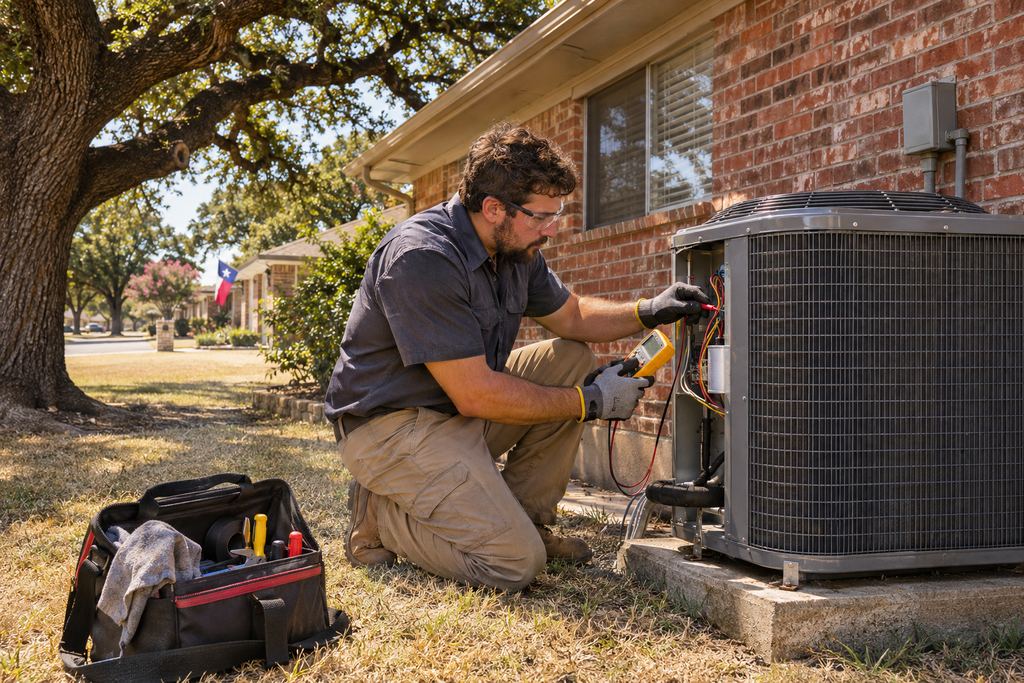
- Electrical diagnosis: Meter work on start components, fuses and wiring for a condenser that buzzes, clicks or sits silent.
- Leak hunting: Tracing lost charge to a coil or line set and fixing it. Federal rules limit refrigerant handling to people holding EPA Section 608 certification.
- Drain and water problems: Unclogging condensate lines and inspecting pans and float switches, a staple call near the coast.
- Fan and blower motors: Swapping a seized outdoor fan motor or an indoor blower that no longer pushes air through the vents.
- Frozen coils: Working out why ice formed, usually starved airflow or a short charge, once the coil is clear.
- Thermostat and controls: Tracing a system that ignores the wall control back to low-voltage wiring, a setting or a board.
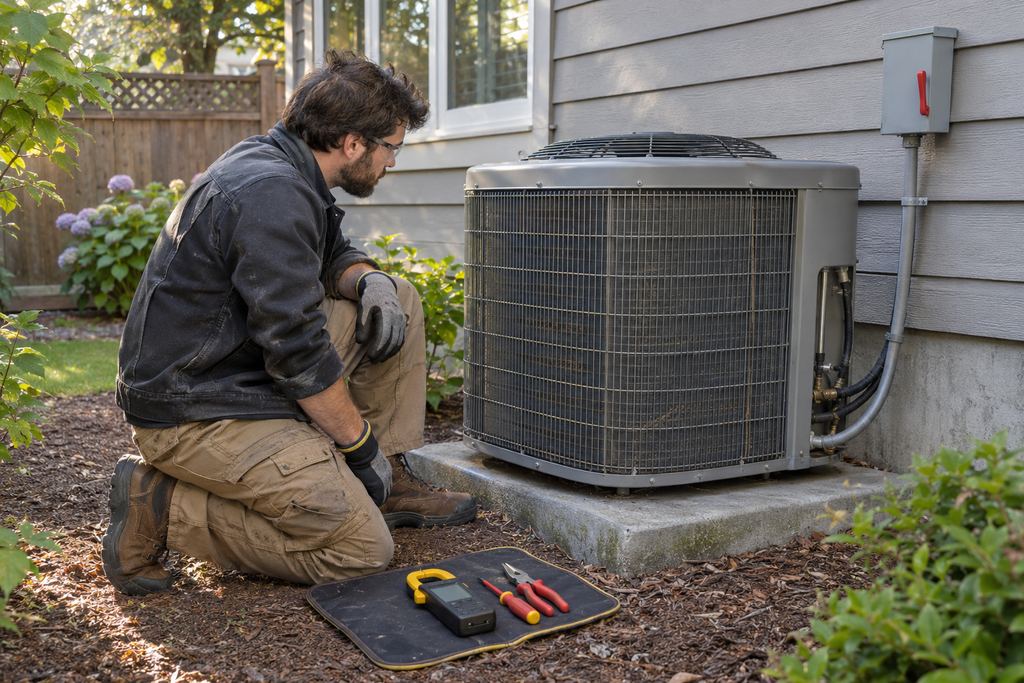
Equipment you will find in Texas homes
Owner checks versus licensed work
Safe checks you can do
No tools beyond a flashlight. Turn the system off at the thermostat before opening any filter or access door.
- Look at the wall control: mode on Cool, setpoint under the indoor reading, fresh batteries if the model uses them.
- Slide out the return filter; if no daylight shows through it, put in a new one.
- A tripped condenser breaker gets one reset. A second trip means hands off.
- Rake mulch, clippings and stored junk a couple of feet back from the outdoor cabinet.
- Frost on the copper line? Run the fan alone for a few hours so the technician can see the coil.
Leave these to a licensed technician
These involve high voltage, refrigerant or sealed components. Refrigerant work requires EPA Section 608 certification.
- Removing the condenser's access panel or touching a breaker box interior
- Any capacitor or contactor diagnosis
- Refrigerant of any kind, in or out
- Board, motor and compressor repair
- Defeating a float switch, pressure switch or other safety
Shut the system down at the thermostat and keep it down if you smell something scorching, see sparks or the breaker refuses to stay on. Flames or visible smoke mean everyone goes outside and someone dials 911. A person who turns confused, faints or stops sweating in the heat may have heat stroke, which is also a 911 call before any thought of the equipment.
What moves a repair bill in Texas
Two neighbors with the same warm-air complaint can pay very different amounts. Here is why a price only makes sense after diagnosis.
Small start parts sit at one end of the scale; a compressor or indoor coil sits at the other.
Older units charged with R-22 cost more to top off, since new production stopped in 2020 and only reclaimed supply remains.
A July attic, a cramped crawl space or a roof unit all add labor time.
After-hours and holiday calls frequently carry a premium, so ask about it on the phone.
Parts coverage on a registered unit can shrink the bill. The data plate on the condenser lists the serial number the contractor will ask for.
Repair or replace: the math Texans run
You will hear contractors mention the $5,000 rule. Take the unit's age, times it by the quoted repair, and a product over five thousand points toward shopping for new equipment. It is an industry rule of thumb, not a regulation, and it ignores things that matter in Texas, such as an aging R-22 unit with a leak, or one that already can't hold 78 inside during an August afternoon. Treat the rule as an informal screen rather than a DOE or trade standard; check warranty coverage first, then get the fault diagnosed and compare real quotes for the repair and for a new system before deciding.
Central air conditioners are commonly replaced at 10 to 15 years, and long cooling seasons push many Texas systems toward the shorter end. When an old unit needs a big fix, request two numbers on paper during the same visit: the repair and a new system. Our AC repair cost section walks through what to compare.
Checking a Texas HVAC contractor
In Texas, the state agency that issues air conditioning and refrigeration contractor licenses is TDLR, the Texas Department of Licensing and Regulation. Class A holders may work on equipment of any size; Class B holders are capped at 25 tons of cooling. Technicians working under a contractor also register with TDLR. TDLR's online search pulls up a firm or individual and shows whether the license is current.
After that, request a certificate of insurance, an itemized estimate that spells out the replacement part, and the terms of any labor warranty. Regular service also helps avoid the next breakdown; spring is the usual time for a cooling maintenance visit before the heat arrives.
How a service request works
HVAC Service Near Me is a referral service. We don't send our own technicians. We connect you with independent local contractors.
- Describe the job
Type your ZIP code, pick a service and add a line or two about the problem or project.
- We pass it on
An independent HVAC contractor or partner network that works in your area and does that kind of job receives it.
- You hear back
The contractor gets in touch to check the details and set a time to come out.
- The choice is yours
After a diagnosis the contractor gives you a quote. Price, timing and warranty are agreed directly between the two of you.
AC Repair by city in Texas
Pick your city for local details.
Frequently asked questions
Where does the $5,000 AC rule come from?
It is shorthand passed around the trade: age times repair price, with anything past $5,000 flagged for a replacement conversation. The rule is informal and carries no DOE or industry backing; check warranty coverage first, then get the fault diagnosed and compare real quotes for the repair and for a new system before deciding. Use it as a first filter only, then factor in refrigerant, efficiency and comfort.
Does a Texas landlord have to fix a broken air conditioner?
State statute never names air conditioning. Under the Texas Property Code, once a tenant who is paid up gives notice, the landlord owes a diligent effort to fix any condition that materially affects an ordinary tenant's health or safety. Some cities, Dallas among them, add cooling standards for rentals. For your situation, check the statute or a tenant legal aid group.
How much does AC repair cost in Texas?
There is no single statewide figure. The bill turns on the component, refrigerant, how hard the unit is to reach and when the visit happens. Confirm the trip or diagnostic charge on the call, and get the repair price in writing; our cost section covers the variables. HVAC Service Near Me does not set contractor prices.
What lifespan should a Texas AC have?
Central systems commonly run 10 to 15 years. Months of daily runtime, coastal salt and neglected service all pull that number down.
How can I confirm a company holds a Texas license?
TDLR publishes a free lookup. Enter the business name and the result lists the class, status and expiration date.
Start a Texas repair request
Give us the ZIP, the kind of equipment and the symptom. A nearby independent contractor can then contact you about scheduling and price, subject to local availability.
Share your ZIP code and the symptom. Availability varies by area and season.
Please keep this page open.
- We pair the request with an independent contractor or partner network that works in your ZIP code.
- The contractor gets in touch to go over the details and agree on a visit.
- After checking the system they quote the job, and you choose whether to proceed.
Read how requests are handled.
Online requests are not connected to a contractor network yet. Nothing you typed was sent or saved. Please phone us instead, or try again later.
Call (888) 555-0199