24 Hour AC Repair in Orlando: What to Do When the Cooling Quits
When the AC dies at 10 p.m. in an Orlando summer, the first job is keeping people cool and safe; the second is finding a contractor who still answers. Send the details through HVAC Service Near Me, and the request goes to an independent contractor in the Orlando area. Ask whether they take night or weekend calls, because after-hours availability varies by company, ZIP code and season.
- Say who is at home: older adults, babies, anyone sick or on heat-sensitive medicine
- After-hours visits usually cost more; ask for the fee up front
- Heat illness symptoms mean 911, not a service call
Tell us what happened, the type of home, and whether anyone at risk is inside.
Please keep this page open.
- We pair the request with an independent contractor or partner network that works in your ZIP code.
- The contractor gets in touch to go over the details and agree on a visit.
- After checking the system they quote the job, and you choose whether to proceed.
Read how requests are handled.
Online requests are not connected to a contractor network yet. Nothing you typed was sent or saved. Please phone us instead, or try again later.
Call (888) 555-0199A person in the house becomes confused, passes out, or has hot, flushed skin and has stopped sweating, or smoke or flames appear at the equipment or the electrical panel. Leave the home if there is smoke or fire. Move anyone overheated to the coolest place available while you wait for help.
How to tell an urgent call from one that can wait until morning
A dead AC is uncomfortable in any Orlando summer, but the risk depends on the people in the house and how hot it gets indoors. Move fast when the thermostat reads mid 80s and rising and the household includes a grandparent, a baby, a pregnant woman or anyone with heart, lung or kidney trouble. The CDC notes that some medications, including certain heart and mental health drugs, make it harder for the body to handle heat.
It is also urgent when the equipment itself is the hazard: a burning smell, sparking, buzzing from the outdoor unit that does not stop, or water pouring from an attic air handler onto a ceiling. Those cases call for shutting the system down right away.
A system that runs but cools poorly, a slow drip into the secondary pan or an odd noise that has been going on for days can usually wait for a regular visit. Booking those during business hours avoids the after-hours fee. Our standard Orlando AC repair page covers those calls.
Signs that point to a failure, not a setting
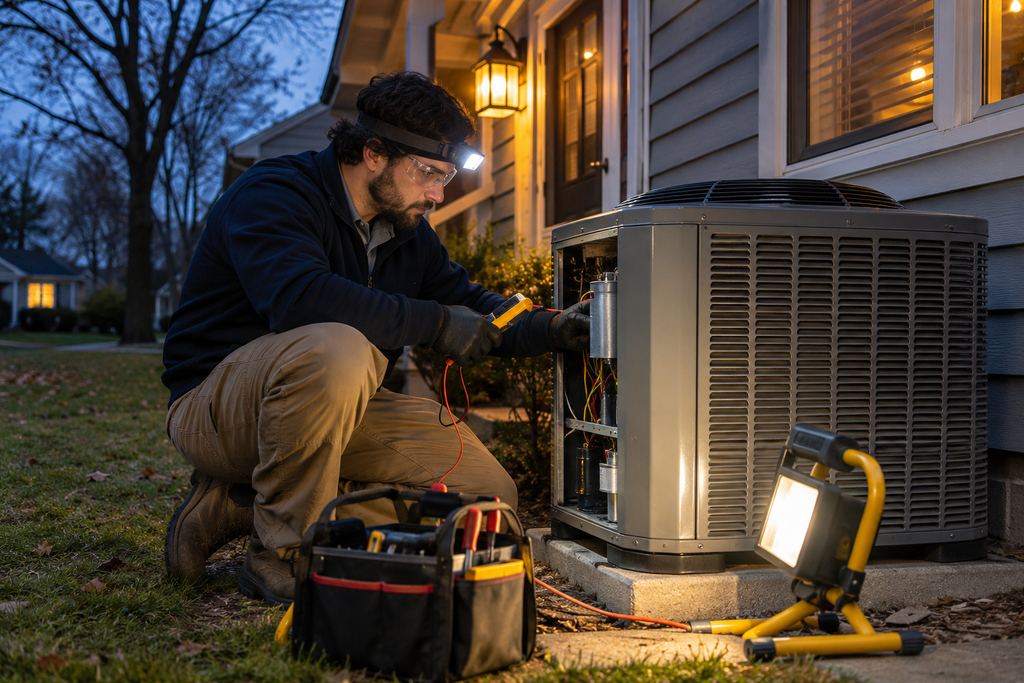
- Outdoor unit silent, indoor fan running: Often a capacitor, contactor or tripped breaker.
- Nothing runs at all: Power, a blown low-voltage fuse, a float switch that cut the system off, or a dead thermostat.
- Frost on the suction line or indoor coil: Airflow or refrigerant trouble; continuing to run it makes the ice worse.
- Water on the ceiling or floor: A clogged condensate line or a cracked pan.
- Burning or electrical smell: Turn it off and keep it off.
- Repeated breaker trips: A short or failing motor or compressor. Reset only once.
What you can safely try before the technician arrives
Safe checks you can do
No tools beyond a flashlight. Turn the system off at the thermostat before opening any filter or access door.
- Confirm the thermostat says Cool, the setpoint sits a few degrees under the room reading, and the display is not blank from dead batteries.
- Open the main panel door and look for a flipped AC or air handler breaker. One reset is fine; a second trip means it stays off.
- Check whether the air filter is clogged and swap it if you have a spare of the right size.
- Frost or ice on the lines? Switch cooling off, leave the blower on Fan, and let it melt by itself. Never scrape it.
- Look at the drain pan or float switch area for standing water and tell the technician what you see.
- Clear branches, leaves or storm debris away from the outdoor unit without reaching inside it.
Leave these to a licensed technician
These involve high voltage, refrigerant or sealed components. Refrigerant work requires EPA Section 608 certification.
- Removing the service cover on the condenser or handling the capacitor; it can stay charged even with the breaker off.
- Adding refrigerant or connecting gauges.
- Bypassing or removing the float switch to make the system run.
- Diagnosing burned wiring, a failed board or a compressor that will not start.
- Anything on a roof or in an attic you cannot reach safely at night.
Keeping the house bearable until help arrives
Close blinds on the west and south side, run ceiling fans counterclockwise, and keep the oven and dryer off. Move sleepers to the lowest, shadiest room; in a two-story home the ground floor is usually cooler. Drink water before you feel thirsty. If indoor heat is getting dangerous and the repair will take a while, consider a night with relatives, a hotel or a public cooling site. During declared heat events, watch local government announcements for cooling sites.
Renters: Florida's landlord-tenant statute, section 83.51, requires landlords to provide heat in winter yet leaves air conditioning off that default list. Many leases do cover AC, so read yours, notify the landlord or manager by text or email and keep a record of the date and time.
Storm season and power outages
Central Florida's summer thunderstorms bring frequent lightning, and a surge can take out a thermostat, a control board or the contactor in the outdoor unit. When power comes back after an outage and the AC will not restart, wait a few minutes, check the breaker once, and then call. Do not keep cycling it.
Hurricanes add a bigger version of the same problem. Charley crossed the Orlando area in 2004, and Ian flooded parts of Central Florida in 2022. After a storm, leave a flooded condenser switched off until a technician has looked at it. If you run a portable generator, park it outside, far from doors, windows and vents, since its exhaust carries carbon monoxide. Most portable generators cannot start a central AC anyway.
Why an after-hours visit costs more
HVAC Service Near Me does not set prices. Ask about each line below before anyone is dispatched.
Many companies add a premium for nights, weekends and holidays. Some fold it into a higher diagnostic fee.
Payable whether or not you go ahead. Some companies subtract it from the repair if you approve the work.
A capacitor or contactor can often be replaced the same night. A motor, board or compressor may require a return visit.
Priced by the pound. Older R-22 systems cost much more to recharge because new production of R-22 has ended.
Attic air handlers and roof units take longer, especially in the dark.
Emergency repair costs, in plain terms
There is no single after-hours price in Orlando. The bill is the after-hours fee plus diagnosis plus whatever part fails. If the problem is minor, some owners pay for the diagnosis that night and book the repair for business hours. National ranges for common repairs are in our AC repair cost section. Ask for the number before the technician starts.
Equipment an urgent call may involve
If the repair is big: repair now or replace?
A night call sometimes ends with bad news, like a seized compressor or a coil leak on equipment installed back in the 2000s. You do not have to decide at midnight. Get the repair figure written down, restore cooling with a temporary fix if the technician says it is safe, and compare it with a replacement quote in daylight. Some homeowners lean on the so-called $5,000 rule: take the unit's age in years, times the repair price, and treat anything over 5,000 as a cue to price a new system. Treat it as a quick gut check; no code or manufacturer endorses it. Treat the rule as an informal screen rather than a DOE or trade standard; confirm the warranty status, ask for a written diagnosis and compare the repair price after any coverage with a replacement bid before you choose either path. Our Orlando AC installation guide explains what a new system involves.
Questions to ask when you call at night
- Can you come tonight, and when?
Pin down an arrival window instead of a vague callback. - What will the night premium and the diagnosis cost?
Ask whether either is applied to the repair. - Can I look up your license now?
Florida's CILB, inside DBPR, issues AC contractor licenses. Search the business on myfloridalicense.com during the call. - Do you carry common parts?
Capacitors, contactors and fan motors for your brand, if you know it. - Will you text or email the price before you start?
Written beats verbal, even at 1 a.m.
Where requests go in the Orlando area
Requests from Orlando and nearby parts of Orange County go to independent contractors who say they serve that area. Fewer companies run night crews, and the gap widens in peak summer weeks and in outlying ZIP codes. If no one can come quickly, the form still records your request so a contractor can follow up first thing. More about the city is on our Orlando AC service page, and the general guide to emergency AC repair covers the same steps for any region.
How a service request works
HVAC Service Near Me is a referral service. We don't send our own technicians. We connect you with independent local contractors.
- Describe the job
Type your ZIP code, pick a service and add a line or two about the problem or project.
- We pass it on
An independent HVAC contractor or partner network that works in your area and does that kind of job receives it.
- You hear back
The contractor gets in touch to check the details and set a time to come out.
- The choice is yours
After a diagnosis the contractor gives you a quote. Price, timing and warranty are agreed directly between the two of you.
Other AC services in Orlando
- Air Conditioning Installation in Orlando, Florida
- AC Maintenance for Orlando Homes
- Orlando AC Repair for Homes and Small Businesses
- Replacing an Air Conditioner in Orlando
Emergency AC Repair in other Florida cities
Frequently asked questions
How much does an emergency AC repair cost in Orlando?
Add three things: the off-hours premium, the diagnostic charge and the part. Each company sets its own numbers, so get the fees on the phone and the repair figure in writing.
Is a broken AC considered an emergency in Florida?
There is no statewide rule that makes it one. For renters, Florida statute 83.51 mentions heat but not air conditioning, though many leases cover AC. In practice, it becomes urgent once indoor heat threatens a vulnerable person or the equipment shows electrical trouble.
What counts as an AC emergency?
Electrical warning signs (scorched odor, sparks, smoke, a breaker that will not stay on), a ceiling sagging or dripping under the air handler, and indoor temperatures that put vulnerable people at risk.
What is the $5,000 AC rule?
Age in years times the repair quote. Above 5,000, it is worth hearing a replacement price before you commit. Nothing official stands behind the number.
Is it safe to turn the AC back on after a hurricane?
Hold off if the condenser sat in water or the grid keeps flickering. Wait for a technician to inspect flooded equipment. If it was only an outage, restore power, wait a few minutes, and try once.
Will someone definitely come tonight?
We cannot promise that. Night and weekend coverage depends on the contractors serving your ZIP code and the season. Send the request with the details and ask the contractor about timing when they reach you.
Related guides and services
Send an urgent AC request for Orlando
Add your ZIP code, the failure and who is in the house. A nearby independent contractor reaches out about arrival time and fees.
Tell us what happened, the type of home, and whether anyone at risk is inside.
Please keep this page open.
- We pair the request with an independent contractor or partner network that works in your ZIP code.
- The contractor gets in touch to go over the details and agree on a visit.
- After checking the system they quote the job, and you choose whether to proceed.
Read how requests are handled.
Online requests are not connected to a contractor network yet. Nothing you typed was sent or saved. Please phone us instead, or try again later.
Call (888) 555-0199