California AC Repair, From the Coast to the Desert
Tell HVAC Service Near Me your ZIP code and the symptom, and the note goes to an independent HVAC company that takes jobs in your part of California. This page explains why a Bakersfield breakdown rarely looks like a Santa Monica one, which parts a technician tends to replace, and how to confirm a state license in under a minute.
- Your request reaches an outside contractor; this site has no crews of its own
- Confirm the C-20 license number at cslb.ca.gov before anyone opens the unit
- Whether someone can come soon varies with the region, the month and the equipment
Share your ZIP code, the type of system and the symptom. Availability varies by region and season.
Please keep this page open.
- We pair the request with an independent contractor or partner network that works in your ZIP code.
- The contractor gets in touch to go over the details and agree on a visit.
- After checking the system they quote the job, and you choose whether to proceed.
Read how requests are handled.
Online requests are not connected to a contractor network yet. Nothing you typed was sent or saved. Please phone us instead, or try again later.
Call (888) 555-0199One state, several cooling climates
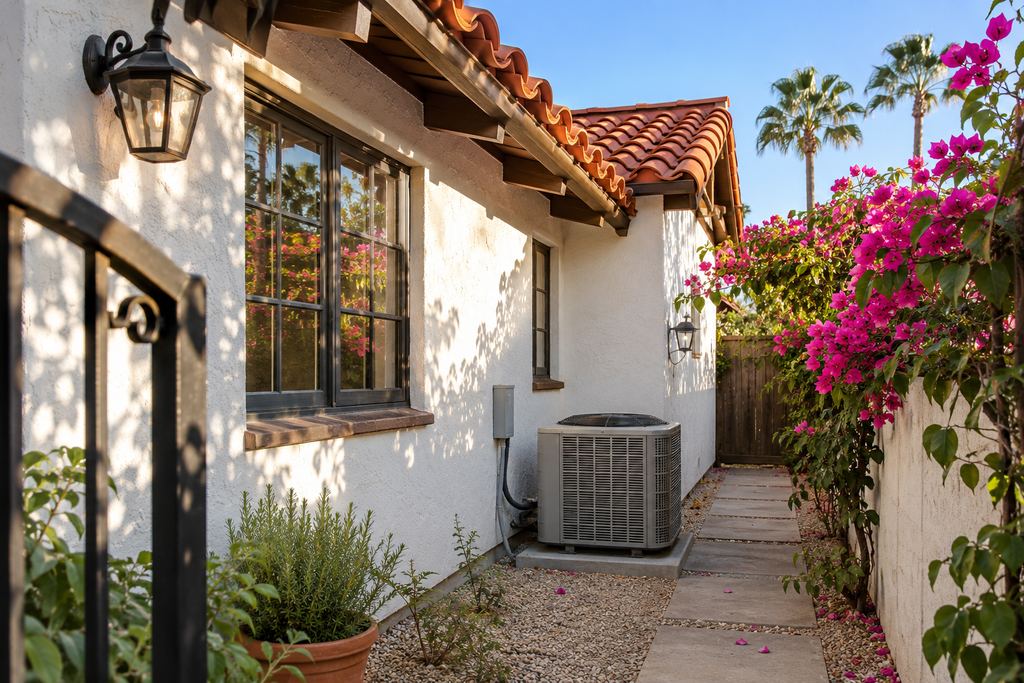
A ducted split system in Santa Monica and the same model in Bakersfield lead very different lives. Near the ocean, the marine layer keeps many summer afternoons mild, so a coastal unit may sit idle for weeks and then struggle during a rare hot spell. Salt air works on the outdoor coil fins and electrical terminals year after year. In the Central Valley, the Inland Empire and the high and low deserts, the compressor can run most of the day from June into September, and dust, pollen and wildfire smoke load the filter and condenser coil far faster than the manual assumes.
Those differences show up in repair calls. Coastal homeowners often report corrosion, a failed contactor or a system that will not start after months off. Inland and desert households more often see worn capacitors, overheated fan motors, refrigerant leaks at stressed joints and frozen evaporator coils caused by restricted airflow. If you live in one of the larger metro areas, the city pages for Los Angeles, Fresno, Sacramento and San Diego go into local detail.
Pick the closest symptom
Every linked guide sorts probable causes and keeps the owner checks to things that need no tools.
Parts and tasks that come up on California service calls
Shops price and bundle these differently, so hold quotes up against this list.
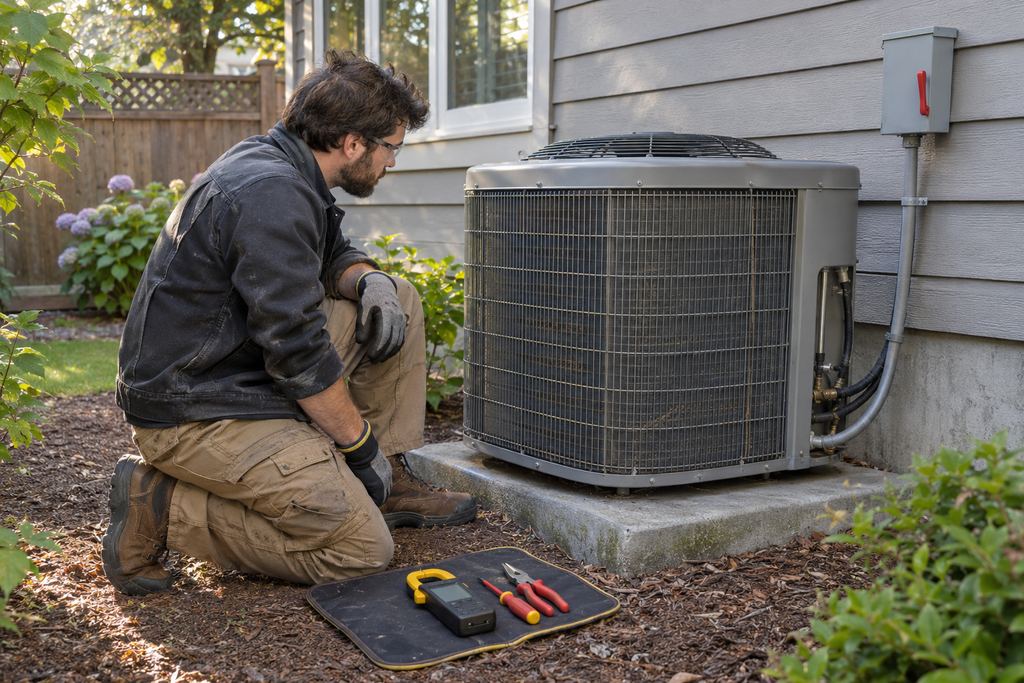
- Diagnosis: Meters on the electrical side, probes on the supply and return air and gauges on the service ports, so the fault is found rather than guessed.
- Electrical parts: Run and start capacitors, the contactor, relays, fuses and the disconnect box. Long inland summers cook these first.
- Motors: The fan on top of the outside unit and the blower inside, plus their bearings and wire connections.
- Refrigerant circuit: Tracing a leak, brazing or replacing the leaking piece and weighing in a charge. Only a Section 608 certified person may handle refrigerant.
- Coils and drainage: Washing dust out of the outdoor coil, cleaning a matted indoor coil and opening a blocked drain.
- Controls: Thermostat wires, the 24-volt control circuit and the float and pressure switches that stop the system on purpose.
Equipment you find in California homes
The typical post-1970s California house pairs an outdoor condenser beside the garage with a gas furnace or air handler up in the attic, out in the garage or tucked in a hallway closet. Attic installations are common in single-story ranch homes across the valleys and the Inland Empire, which means the indoor coil, drain pan and ducts sit in a space that gets far hotter than the rooms below on a summer afternoon. Older bungalows and many pre-war homes in Los Angeles and the Bay Area went up with a wall heater or floor furnace and never got ducts, which is why so many of them now rely on room units or a ductless mini-split.
Evaporative coolers, often called swamp coolers, still sit on many roofs in inland and desert communities. They need a different kind of service than a refrigerant-based AC, and some contractors no longer work on them, so mention it in your request. Rooftop packaged units show up on some homes and on most small commercial buildings.
Owner checks versus technician work
Safe checks you can do
No tools beyond a flashlight. Turn the system off at the thermostat before opening any filter or access door.
- Look at the thermostat screen: mode on Cool, setpoint a few degrees under the room reading, display not blank from dead AA cells
- Pull the filter and hold it to the light; swap it if you cannot see through it, which happens fast after fire season
- A breaker for the condenser that has flipped may be pushed back once. A second trip means a fault, so leave it alone
- Pull weeds, leaves and stored items at least a couple of feet back from the outdoor unit
- Frost on the copper pipe: switch from Cool to Fan and give it a few hours to melt, then book the visit
Leave these to a licensed technician
These involve high voltage, refrigerant or sealed components. Refrigerant work requires EPA Section 608 certification.
- Anything behind the condenser's electrical cover, including capacitors, which hold a charge
- All refrigerant work, from leak tracing to recharging
- Work inside the home's main electrical panel
- Drain clearing that the owner's manual does not walk you through
- Finding why a breaker keeps tripping or where an odor of hot wiring comes from
A hot-wiring odor, visible sparks or a breaker that flips again and again all mean the same thing: turn the AC off at the thermostat and the breaker and wait for a pro. Visible smoke or flames call for leaving the house and dialing 911. In extreme heat, a person who becomes confused, faints or stops sweating needs 911 too; the National Weather Service heat pages describe the warning signs.
Heat waves, Flex Alerts and power shutoffs
On the hottest days CAISO, the operator of most of the state grid, may call a Flex Alert. It asks households to ease off power use for a few hours toward evening and carries no penalty. Many families run the AC harder around midday, then let the setpoint drift up during the alert, though anyone elderly, ill or very young should stay cool regardless. In high fire-risk weather, some utilities also cut power to lines in a Public Safety Power Shutoff. Once power returns, hold off on restarting for several minutes so pressures settle; if cooling still does not resume, see the guide for an AC that stopped working after a power outage.
Five questions before you hire
A phone call and one website visit answer all of them.
- Does the CSLB record look clean?
Type the company name or number into the lookup at cslb.ca.gov. You want an active C-20 classification (Warm-Air Heating, Ventilating and Air-Conditioning), a current bond and either workers' comp coverage or an exemption on file. - Who touches the refrigerant?
The person on site should carry a federal Section 608 card. Asking to see it is normal. - Can the findings go on paper?
A quote naming the bad component, labor hours and pounds of refrigerant lets a second company price the same job. - Does this job need a permit?
Swapping a part rarely does. Changing out a condenser, furnace or coil usually triggers a permit under the state energy code, Title 24 Part 6, and some change-outs add a HERS rater's test. - How long is the fix covered?
Labor coverage is set by the shop. Part coverage often comes from the manufacturer and may depend on the original owner having registered the unit.
Why two repair bills differ
California has no going rate. These variables explain most of the gap between quotes.
Swapping a capacitor takes minutes; replacing a compressor or indoor coil takes most of a day plus the refrigerant.
Older units charged with R-22 rely on recycled gas, since new production and imports stopped in 2020. Expect a steep price per pound.
Crawling across attic joists or hauling tools onto a roof adds labor time.
After-hours and weekend calls in a heat wave can be billed at a premium; ask first.
On a tired system, the first fix sometimes exposes a second weak part.
When the money should go to a new system
Three situations tip the decision: an R-22 unit that has lost charge, a dead compressor in equipment more than a decade old, and a pattern of yearly breakdowns. By contrast, a five-year-old system with one burned-out electrical component is a straightforward fix. California falls in the Department of Energy's Southwest region, so a new split AC below 45,000 Btu/h has to reach 14.3 SEER2 and a separate EER2 floor. Replacement equipment now ships with R-410A from older stock or with A2L refrigerants like R-454B and R-32. National price drivers are laid out in the AC repair cost section and the California locations page for city pages.
How a service request works
HVAC Service Near Me is a referral service. We don't send our own technicians. We connect you with independent local contractors.
- Describe the job
Type your ZIP code, pick a service and add a line or two about the problem or project.
- We pass it on
An independent HVAC contractor or partner network that works in your area and does that kind of job receives it.
- You hear back
The contractor gets in touch to check the details and set a time to come out.
- The choice is yours
After a diagnosis the contractor gives you a quote. Price, timing and warranty are agreed directly between the two of you.
AC Repair by city in California
Pick your city for local details.
Frequently asked questions
How much does an AC repair cost in California?
No honest page can give one figure, because a cheap fuse and a new compressor both count as a repair. Get the diagnosis written down and, for anything major, let another company quote it as well.
Is R-22 still sold in California?
Only as recycled, reclaimed or previously produced stock. The federal phaseout stopped new R-22 in 2020, so technicians draw on reclaimed supplies that keep shrinking. Recharging a unit that leaks it means paying again after the next leak, which is why many owners replace instead.
Is a 7-year-old air conditioner considered old?
No. Seven years is middle age for a central system that gets yearly service. Desert heat and ocean spray wear equipment faster, yet a unit this age with one bad part is still worth fixing.
Can I get a replacement system at no cost?
Seldom. Income-qualified weatherization and utility programs occasionally cover equipment, and rebates trim the price of efficient models. Call your power company for what runs this year, and treat any free-system pitch that asks for a deposit as a warning sign.
Does an AC repair have to be done by a licensed contractor?
Outside of very small jobs, yes. The Contractors State License Board issues HVAC licenses under the C-20 class, and its free lookup also lists bond and insurance details.
Send the details
Write a line about what the system is doing, add the ZIP code, and a contractor near you will reply about timing and the first visit.
Share your ZIP code, the type of system and the symptom. Availability varies by region and season.
Please keep this page open.
- We pair the request with an independent contractor or partner network that works in your ZIP code.
- The contractor gets in touch to go over the details and agree on a visit.
- After checking the system they quote the job, and you choose whether to proceed.
Read how requests are handled.
Online requests are not connected to a contractor network yet. Nothing you typed was sent or saved. Please phone us instead, or try again later.
Call (888) 555-0199