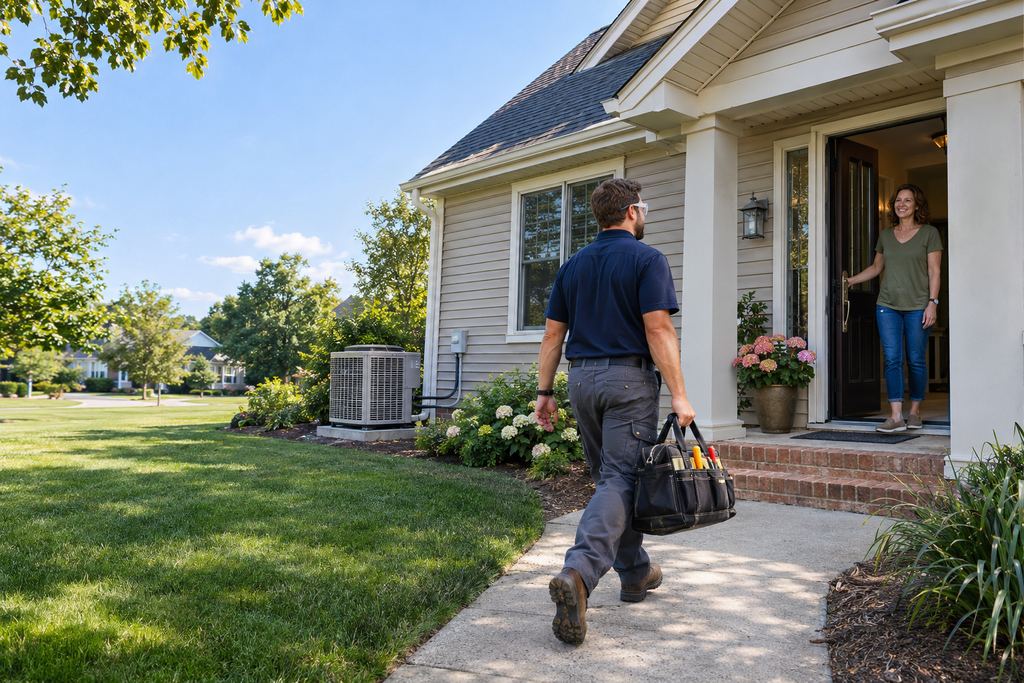
Georgia HVAC Repair for Air Conditioners and Heat Pumps
Tell us the ZIP code and what the cooling system is doing, and HVAC Service Near Me forwards the request to an independent Georgia contractor who handles AC repair in that area. Which contractor responds, and when, depends on where in the state you are and how busy the season is.
- Regional differences between North Georgia, the Piedmont and the coast
- Owner checks that are safe before anyone drives out
- Repair or replace: the questions that settle it
ZIP code, whether it is cooling or heating trouble, and the type of system (heat pump, AC with gas furnace, mini-split) if you know it.
Please keep this page open.
- We pair the request with an independent contractor or partner network that works in your ZIP code.
- The contractor gets in touch to go over the details and agree on a visit.
- After checking the system they quote the job, and you choose whether to proceed.
Read how requests are handled.
Online requests are not connected to a contractor network yet. Nothing you typed was sent or saved. Please phone us instead, or try again later.
Call (888) 555-0199One state, three cooling climates
Georgia is humid and subtropical across most of its area, yet an air conditioner in Blairsville lives a different life than one in Valdosta. Mountain counties in the north get cooler nights and a shorter run season. The Piedmont band around metro Atlanta sees long, sticky summers where the system has to pull moisture as well as heat. South of the fall line, through the coastal plain and out to the islands, the season stretches from spring well into fall and outdoor coils near the ocean take on salt.
That spread shapes what breaks. Long runtimes wear out fan motors and capacitors. Constant moisture removal keeps the condensate drain busy, so clogged lines and overflowing pans are routine calls. Near the coast, corroded coil fins and rusted cabinet panels show up earlier than they do inland. If you live in or near the two largest service areas, the city pages for Atlanta and Savannah go into local detail.
What Georgia homeowners usually report
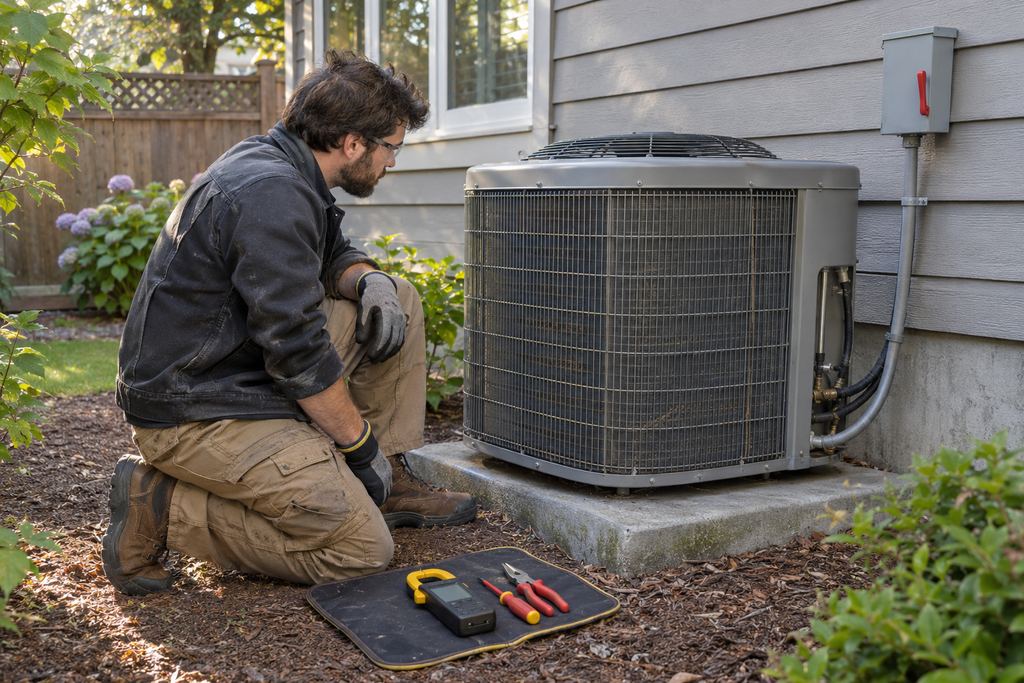
Five things to look at, and where to stop
Safe checks you can do
No tools beyond a flashlight. Turn the system off at the thermostat before opening any filter or access door.
- Thermostat: mode on Cool, setpoint lower than the room, display awake. Swap AA batteries if the screen is blank or dim.
- Slide out the return filter. A gray mat you cannot see daylight through needs replacing.
- Breaker labeled for the condenser: if it sits in the middle or off position, push it fully off and back on, once.
- Outdoor cabinet: rake away pine straw, leaves and mower clippings piled against the fins.
- Ice on the big copper pipe: set the thermostat to Off for cooling and Fan On so the coil melts while you wait for a technician.
Leave these to a licensed technician
These involve high voltage, refrigerant or sealed components. Refrigerant work requires EPA Section 608 certification.
- Testing capacitors, contactors and motors inside the electrical compartment.
- Any refrigerant work. Gauges, leak detection and charging are reserved for people holding EPA Section 608 certification.
- Clearing a blocked drain trap or replacing a safety float switch.
- Tracking down why a breaker flips a second time.
- Cleaning a heavily soiled evaporator or condenser coil.
Repair work Georgia contractors commonly take on
- Diagnostic visit: Electrical readings, temperature split across the indoor coil, airflow and a look at the drain.
- Electrical parts: Capacitors, contactors, fuses and fan motors that fail after long summer runs.
- Refrigerant leaks: Leak search, coil or line repair, and recharge with the refrigerant the system was built for.
- Condensate problems: Drain line clearing, pan replacement and float switch checks on attic and closet air handlers.
- Heat pump faults: Reversing valve, defrost board and outdoor sensor issues on systems that also heat.
- Duct and airflow issues: Disconnected or crushed attic ducts, blocked returns and failing blower motors.
Equipment you find in Georgia homes
Split systems are the norm: a condenser on a pad outside and an air handler or furnace coil indoors. In ranch houses and newer subdivisions the indoor half is usually in the attic, where summer heat bakes the drain pan and ductwork. Older homes in many towns sit over a vented crawl space, so the air handler or the ducts run underneath the floor where humidity is high. Heat pumps are common because winters across much of the state are mild, and a heat pump that will not cool often has the same root cause as one that will not heat. Ductless mini-splits turn up in additions, garages converted to rooms and older houses that never had ducts.
Before the visit, note where the indoor unit sits and whether the outdoor unit has a heat pump label. That saves time on the first call.
Why two Georgia repair bills can look nothing alike
A fair number needs eyes on the equipment. Expect these variables to drive the written quote.
Swapping a start capacitor is a short job. Replacing a compressor or evaporator coil is a major one, and on an aging unit it may not pencil out.
Older units designed around R-22 are expensive to top off. Production ended in 2020, so what is left comes from reclaimed or stored supply.
A cramped attic in August or a low crawl space adds labor time compared with a closet unit.
After-hours, Sunday and holiday calls tend to add a premium to the dispatch fee. Ask what it is up front.
If the unit was registered with the manufacturer, a covered part may cost little or nothing, while labor is normally billed apart.
Fix it or replace it
A young system with one small failure, in a house that stayed comfortable until last week, is a clear repair. The picture flips toward a new unit when R-22 is on the nameplate, when a compressor or coil dies past year twelve or so, or when you are calling for service every July and humidity indoors never quite comes down. Some technicians quote a shortcut: unit age times repair price, with a big product hinting at replacement. Treat it as shop talk rather than a rule. The clearest comparison is a single sheet listing the diagnosis, the fix price and a replacement figure. The AC repair cost section explains national price drivers in more detail.
Upkeep that cuts down on repair calls
Georgia systems run hard for months, so a spring checkup before the first heat wave pays off. A technician can clean the condenser coil, flush the condensate drain, check electrical connections and measure the refrigerant charge. Between visits, change filters on schedule, especially during spring pollen, and keep shrubs trimmed a couple of feet back from the outdoor unit. Details are on the AC maintenance page.
A scorched odor, visible sparks or a breaker that will not hold on its second try means the system goes off at the thermostat and stays off until a technician sees it. Smoke you can see, or flame, means get everyone outside and dial 911. Heat illness signs such as confusion, fainting or skin that is hot and dry are a 911 call before anything else.
How a service request works
HVAC Service Near Me is a referral service. We don't send our own technicians. We connect you with independent local contractors.
- Describe the job
Type your ZIP code, pick a service and add a line or two about the problem or project.
- We pass it on
An independent HVAC contractor or partner network that works in your area and does that kind of job receives it.
- You hear back
The contractor gets in touch to check the details and set a time to come out.
- The choice is yours
After a diagnosis the contractor gives you a quote. Price, timing and warranty are agreed directly between the two of you.
AC Repair by city in Georgia
Pick your city for local details.
Frequently asked questions
Can I send a repair request from a small town in Georgia?
Yes. The ZIP code tells us which independent contractors travel there. Coverage is thinner in some rural counties, so a match outside the big metros can take longer, and in a few places there may be none during peak season.
Do heat pumps and air conditioners need different repair contractors?
Usually not. A conditioned air contractor in Georgia generally services both. Mention that you have a heat pump so the technician brings the right parts.
Why does my AC leak water in the attic every summer?
The indoor coil wrings gallons out of Georgia air on a humid day, and slime grows in the drain line. Once it plugs, water backs into the pan and overflows. Shut cooling off if a ceiling stain is spreading and ask for a drain line service. See AC leaking water.
Is an older R-22 system still worth repairing?
For a cheap electrical part, often yes. A leak or a dead compressor on an R-22 unit is a different story, because refrigerant is scarce and the rest of the system is old too. Have both options priced on paper.
How do I know a Georgia HVAC contractor is licensed?
Request the conditioned air license number, search it in the Secretary of State lookup, and compare the business name and expiration date with the paperwork in front of you.
Describe the problem and send your ZIP
Two lines about the symptom and the spot where the indoor unit lives let a Georgia contractor pack the right parts. Timing varies by county and season.
ZIP code, whether it is cooling or heating trouble, and the type of system (heat pump, AC with gas furnace, mini-split) if you know it.
Please keep this page open.
- We pair the request with an independent contractor or partner network that works in your ZIP code.
- The contractor gets in touch to go over the details and agree on a visit.
- After checking the system they quote the job, and you choose whether to proceed.
Read how requests are handled.
Online requests are not connected to a contractor network yet. Nothing you typed was sent or saved. Please phone us instead, or try again later.
Call (888) 555-0199