
Air Conditioner Repair Across Connecticut
Most air conditioner repair calls in Connecticut come from systems that were added to houses built for boiler heat: an air handler squeezed into the attic, or ductless heads mounted on bedroom walls. Tell us which one you have and what it is doing, and the request goes to an independent HVAC company that takes work near you. Availability varies by town and season.
- Retrofit attic units and ductless heads
- Shoreline salt and storm wear
- License lookup through the state DCP
System type, where the indoor unit is and the symptom. Availability varies by ZIP code and season.
Please keep this page open.
- We pair the request with an independent contractor or partner network that works in your ZIP code.
- The contractor gets in touch to go over the details and agree on a visit.
- After checking the system they quote the job, and you choose whether to proceed.
Read how requests are handled.
Online requests are not connected to a contractor network yet. Nothing you typed was sent or saved. Please phone us instead, or try again later.
Call (888) 555-0199Why so many repairs start upstairs
A large share of Connecticut colonials, capes and older ranches heat with oil or gas boilers feeding baseboard or radiators. Those houses never had ductwork, so when owners wanted central air, the installer put the air handler in the attic and ran short ducts down through the second-floor ceilings. That location is hard on equipment. In July the attic can be far hotter than the outdoor air, and the unit's condensate drain and pan sit directly over finished rooms.
The result is a predictable set of service calls. A drain line slimes over, the pan fills, and a float switch cuts the system to protect the ceiling. Or the coil freezes because the filter, often in a return grille that nobody remembers, has clogged. If the cooling quit on a muggy afternoon and you see water around the attic unit, read our notes on an AC leaking water and leave the float switch in place for the technician.
Which system you probably have
Knowing the setup helps the contractor bring the right parts.
| House | Usual cooling | What tends to break |
|---|---|---|
| Boiler-heated colonial or cape | Attic air handler with ceiling vents, or ductless heads | Clogged drains, float switch shutdowns, iced coils, hot second floor |
| Newer subdivision house with a furnace | Split AC whose coil sits on the furnace | Run capacitors, contactors, slow refrigerant leaks |
| Two- and three-family houses in Hartford, New Haven or Bridgeport | Window units or a ductless head per unit | Head drain clogs, control board faults, loose wall brackets |
| Shoreline cottage or raised house | Central AC or a heat pump on a stand | Corroded coils and fan parts, storm and flood damage |
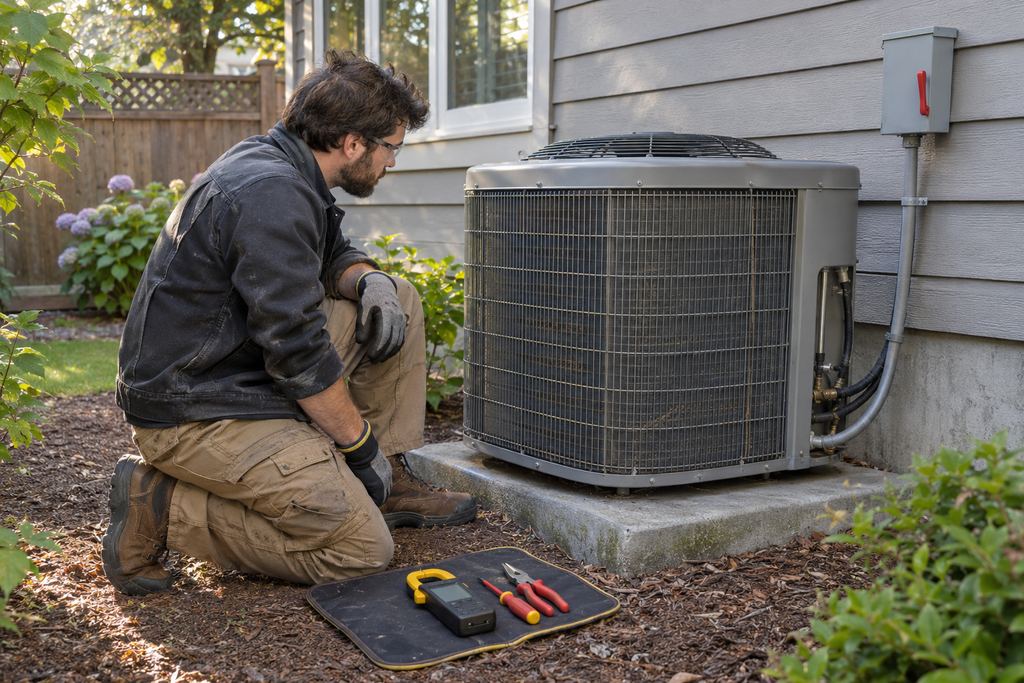
Your checks versus the technician's work
Safe checks you can do
No tools beyond a flashlight. Turn the system off at the thermostat before opening any filter or access door.
- Confirm the thermostat says Cool and the setpoint is below room temperature; swap weak batteries.
- Pull the filter and replace it if it is gray or matted.
- Reset a tripped AC breaker one time. If it trips again, stop.
- Rake leaves and grass clippings away from the outdoor unit.
- If you see frost on the refrigerant lines, set the system to fan only and let it thaw.
Leave these to a licensed technician
These involve high voltage, refrigerant or sealed components. Refrigerant work requires EPA Section 608 certification.
- Testing capacitors, contactors and fan motors.
- Finding and repairing refrigerant leaks, which requires EPA Section 608 certification.
- Clearing an attic drain and checking the pan and float switch.
- Reading error codes and replacing boards on ductless systems.
- Checking attic duct joints and insulation that leak cooled air.
Repair topics worth a closer look
Vetting a Connecticut HVAC company
A directory ranking says nothing about whether a company may legally do the job.
- Does the company hold a state heating, piping and cooling license?
The Department of Consumer Protection issues these trade licenses and runs a public lookup at portal.ct.gov/dcp. Search the business and the technician. - Is it registered as a home improvement contractor?
Work on a home in Connecticut generally also calls for DCP home improvement registration. - Will a permit be pulled if equipment is replaced?
Swapping a condenser or air handler usually goes through the town building official. A simple part repair usually does not. - Can I get the diagnosis and price in writing?
Ask for the failed part, the reading that showed it, and the total before you approve anything.
Fixing it versus starting over
A system under ten years old with one failed electrical part is usually worth fixing. The math changes when an attic unit has a rusted pan, a leaking evaporator coil or still runs on R-22, the refrigerant whose production ended in 2020. Many Connecticut owners in that spot price a heat pump, since it can also take some load off the oil boiler in shoulder seasons. Energize Connecticut, the efficiency program offered with Eversource and United Illuminating, posts the incentives in effect now. Compare options on the AC replacement page and read the factors in the repair cost section.
How a service request works
HVAC Service Near Me is a referral service. We don't send our own technicians. We connect you with independent local contractors.
- Describe the job
Type your ZIP code, pick a service and add a line or two about the problem or project.
- We pass it on
An independent HVAC contractor or partner network that works in your area and does that kind of job receives it.
- You hear back
The contractor gets in touch to check the details and set a time to come out.
- The choice is yours
After a diagnosis the contractor gives you a quote. Price, timing and warranty are agreed directly between the two of you.
Frequently asked questions
Which agency licenses HVAC contractors in Connecticut?
The Department of Consumer Protection. It licenses heating, piping and cooling contractors and journeypersons and lets you verify a license online.
Why does my AC shut off when it is humid out?
On attic systems, a full drain pan often trips the float switch, which kills power to the cooling on purpose. The drain needs clearing; the switch should not be bypassed.
Can a ductless system be repaired, or does the head get replaced?
Most faults are repairable: drains, sensors, fan motors and boards. A technician reads the error code first. See mini-split repair for common codes and causes.
Are there rebates for a new system in Connecticut?
Incentives change. Check Energize Connecticut and the ENERGY STAR rebate finder for what applies to your address and equipment.
Does salt air shorten an outdoor unit's life near the coast?
It can. Salt speeds corrosion of coil fins, fan parts and electrical terminals, so shoreline units benefit from regular rinsing per the manufacturer and a yearly inspection.
Get your Connecticut AC looked at
Note the system type, where the indoor unit sits and what you are seeing. The request goes to an independent contractor; availability varies by town and season.
System type, where the indoor unit is and the symptom. Availability varies by ZIP code and season.
Please keep this page open.
- We pair the request with an independent contractor or partner network that works in your ZIP code.
- The contractor gets in touch to go over the details and agree on a visit.
- After checking the system they quote the job, and you choose whether to proceed.
Read how requests are handled.
Online requests are not connected to a contractor network yet. Nothing you typed was sent or saved. Please phone us instead, or try again later.
Call (888) 555-0199