Carrier AC Installation: What to Settle Before You Sign
Picking Carrier is the easy part of a new air conditioner. The outcome depends on four decisions the installer makes with you: the capacity, the efficiency tier, the matching indoor coil or furnace, and how the old system and ducts are handled. This page lays out each one so you can read installer bids side by side.
- Capacity from a Manual J load calculation
- SEER2 floor depends on your region
- New systems ship with A2L refrigerants
Include the approximate square footage if you know it. A local installer follows up to schedule an estimate.
Please keep this page open.
- We pair the request with an independent contractor or partner network that works in your ZIP code.
- The contractor gets in touch to go over the details and agree on a visit.
- After checking the system they quote the job, and you choose whether to proceed.
Read how requests are handled.
Online requests are not connected to a contractor network yet. Nothing you typed was sent or saved. Please phone us instead, or try again later.
Call (888) 555-0199Start with the right size
Tonnage picked by matching the old nameplate repeats whatever mistake was made twenty years ago. ACCA's Manual J is the accepted method for calculating a home's cooling load from its square footage, windows, insulation, orientation and air leakage. An oversized Carrier unit cools the air quickly but cycles off before it pulls moisture out, which leaves rooms clammy. An undersized one runs nonstop on the hottest afternoons. Ask every bidder whether their number came from a load calculation and ask to see it.
Ductwork belongs in the same conversation. A larger or higher-efficiency system on undersized ducts will be noisy and may not reach its rated performance.
Carrier-specific steps
Checks for Carrier installation that depend on the equipment itself. Link checked November 25, 2026.
- Find the model and serial number: When comparing Carrier installation bids, ask each one to list the exact model numbers, which appear on the rating plate on the outdoor unit and the label on the indoor coil or furnace once installed.
- Check Carrier coverage: Read the Carrier warranty lookup before you sign: registration deadlines and coverage terms differ by model, so ask the installer who files the registration and when.
- Ask about brand experience: If a bidder says it is a Carrier dealer, ask for proof and what it changes for your coverage. This site has no Carrier affiliation and does not vouch for dealer status.
Efficiency rules that apply to new installs
| Region | Split AC minimum (since Jan 1, 2023) | Notes |
|---|---|---|
| North | 13.4 SEER2 | Applies to most northern states |
| Southeast | 14.3 SEER2 under 45,000 Btu/h; 13.8 SEER2 at 45,000 and up | Install must meet the regional standard |
| Southwest | 14.3 SEER2 under 45,000 Btu/h; 13.8 SEER2 at 45,000 and up | EER2 requirements also apply |
The refrigerant change
Under the EPA technology transitions rule, new residential split systems moved from R-410A to lower global warming potential refrigerants such as R-454B and R-32 starting in 2025. That matters on install day because a new outdoor unit needs a matching indoor coil rated for the same refrigerant, and the old line set has to be judged for reuse or replaced. All refrigerant recovery and charging is done by technicians holding EPA Section 608 certification. Our general AC installation page covers the steps that apply to any brand.
Why two Carrier quotes differ
We do not quote prices. For national context, read AC installation cost.
Single-stage, two-stage and variable-speed equipment sit at very different price points.
Coil, furnace or air handler replacement, and whether a heat pump replaces the AC entirely.
Sealing, resizing or new refrigerant lines add labor and material.
New disconnect, whip or breaker sized for the new unit.
Mechanical permits, inspection and legal recovery of old refrigerant.
A basic thermostat versus Carrier's communicating controls for Infinity systems.
What a complete installation includes
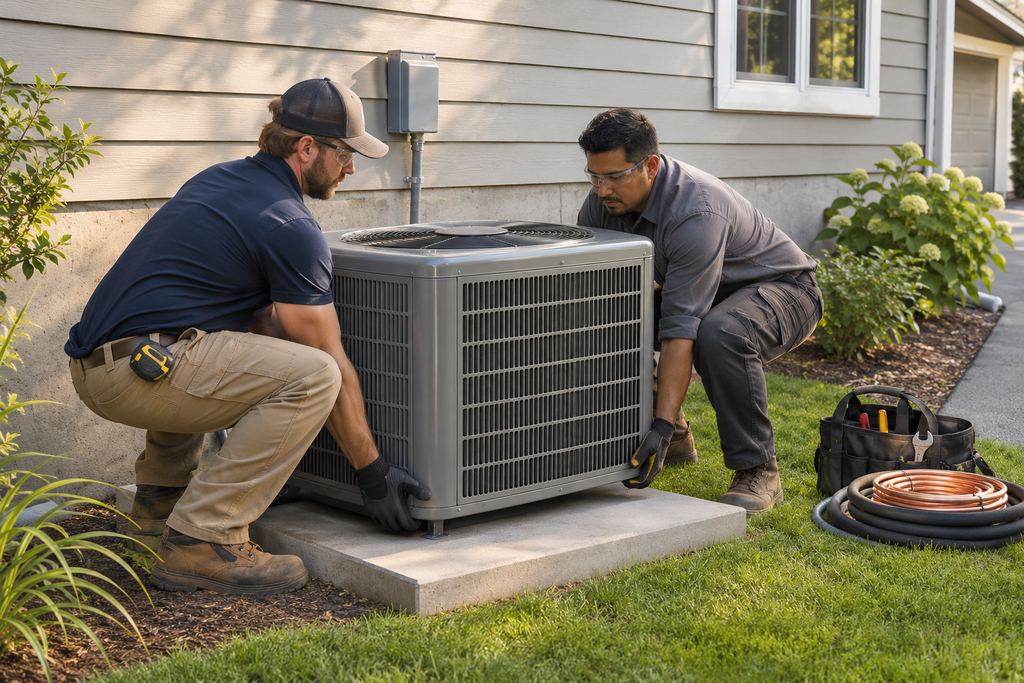
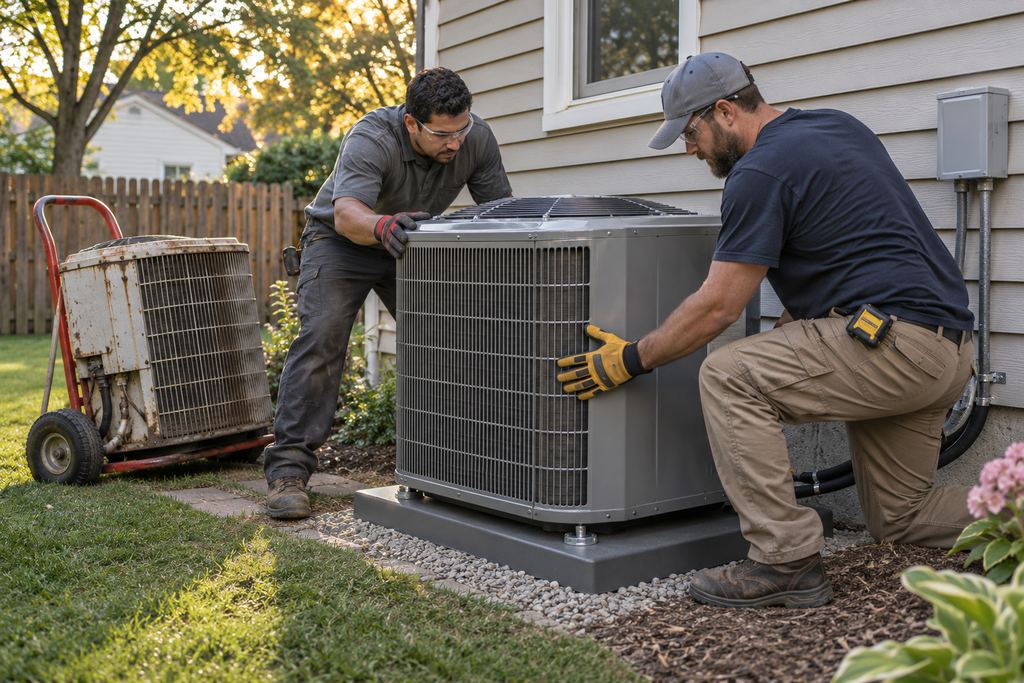
- Removal: Old condenser and coil disconnected, refrigerant recovered, equipment hauled away.
- Pad and placement: Level pad, clearance from walls and dryer vents, and code-required spacing.
- Indoor coil: Matched to the outdoor unit and refrigerant, with a new or cleaned drain pan and trap.
- Line set: Flushed or replaced, insulated, brazed with nitrogen purge, pressure tested.
- Evacuation and charge: Deep vacuum confirmed on a gauge, charge set to the manufacturer's specification.
- Startup report: Measured airflow, temperature split, pressures and amps, left with you in writing.
Repair or replace the old system
Replacement usually makes sense when the compressor or coil fails on a system near the end of its life, when it runs on R-22, or when repair costs keep stacking up. If the problem is a capacitor or fan motor on a younger unit, repair first; our Carrier AC repair page covers that path. Federal tax credits under 25C ended for equipment placed in service after 2025, so check current state and utility incentives on the ENERGY STAR rebate finder instead.
Questions to ask each installer
- Did you run Manual J for my house?
Ask for the report, not just the tonnage. - Which coil and furnace or air handler are you pairing?
A matched set is needed for the rated efficiency. - Are you replacing or reusing the line set?
And why. Reuse is sometimes fine, sometimes not. - Who registers the equipment?
Carrier's site lets owners register products and check warranty coverage; confirm who does it. - Is the permit included?
It should be, along with the inspection. National cost context is in the AC installation cost section.
How a service request works
HVAC Service Near Me is a referral service. We don't send our own technicians. We connect you with independent local contractors.
- Describe the job
Type your ZIP code, pick a service and add a line or two about the problem or project.
- We pass it on
An independent HVAC contractor or partner network that works in your area and does that kind of job receives it.
- You hear back
The contractor gets in touch to check the details and set a time to come out.
- The choice is yours
After a diagnosis the contractor gives you a quote. Price, timing and warranty are agreed directly between the two of you.
Frequently asked questions
Can I install a Carrier air conditioner myself?
Not realistically. Refrigerant connections require EPA Section 608 certification, most areas require a permit and inspection, and warranty terms can depend on who installed the system. Have a contractor do it.
Is Carrier a good choice for a split system?
Carrier is one of the largest US brands with a full range of tiers. Installation quality, sizing and the matching indoor equipment usually matter more than the brand on the cabinet.
How do I use a new Carrier system well?
Set a steady temperature, change the filter on schedule, keep the outdoor unit clear and book a yearly checkup. If you have an Infinity system, read the thermostat's maintenance reminders and alerts.
What size Carrier AC do I need?
Only a load calculation can answer that. Square footage rules of thumb ignore windows, insulation and climate.
Does a ductless system make more sense?
For homes without ducts or a single problem room, it can. Compare with MRCOOL mini split installation and other ductless options.
Related guides and services
Request Carrier installation quotes
Tell us the home's ZIP code, roughly how old the current system is, and whether you want AC only or a heat pump. Independent installers in your area may follow up for a site visit. Availability varies by area and season.
Include the approximate square footage if you know it. A local installer follows up to schedule an estimate.
Please keep this page open.
- We pair the request with an independent contractor or partner network that works in your ZIP code.
- The contractor gets in touch to go over the details and agree on a visit.
- After checking the system they quote the job, and you choose whether to proceed.
Read how requests are handled.
Online requests are not connected to a contractor network yet. Nothing you typed was sent or saved. Please phone us instead, or try again later.
Call (888) 555-0199